Wood / Central Cadillac
Location, Access, Description
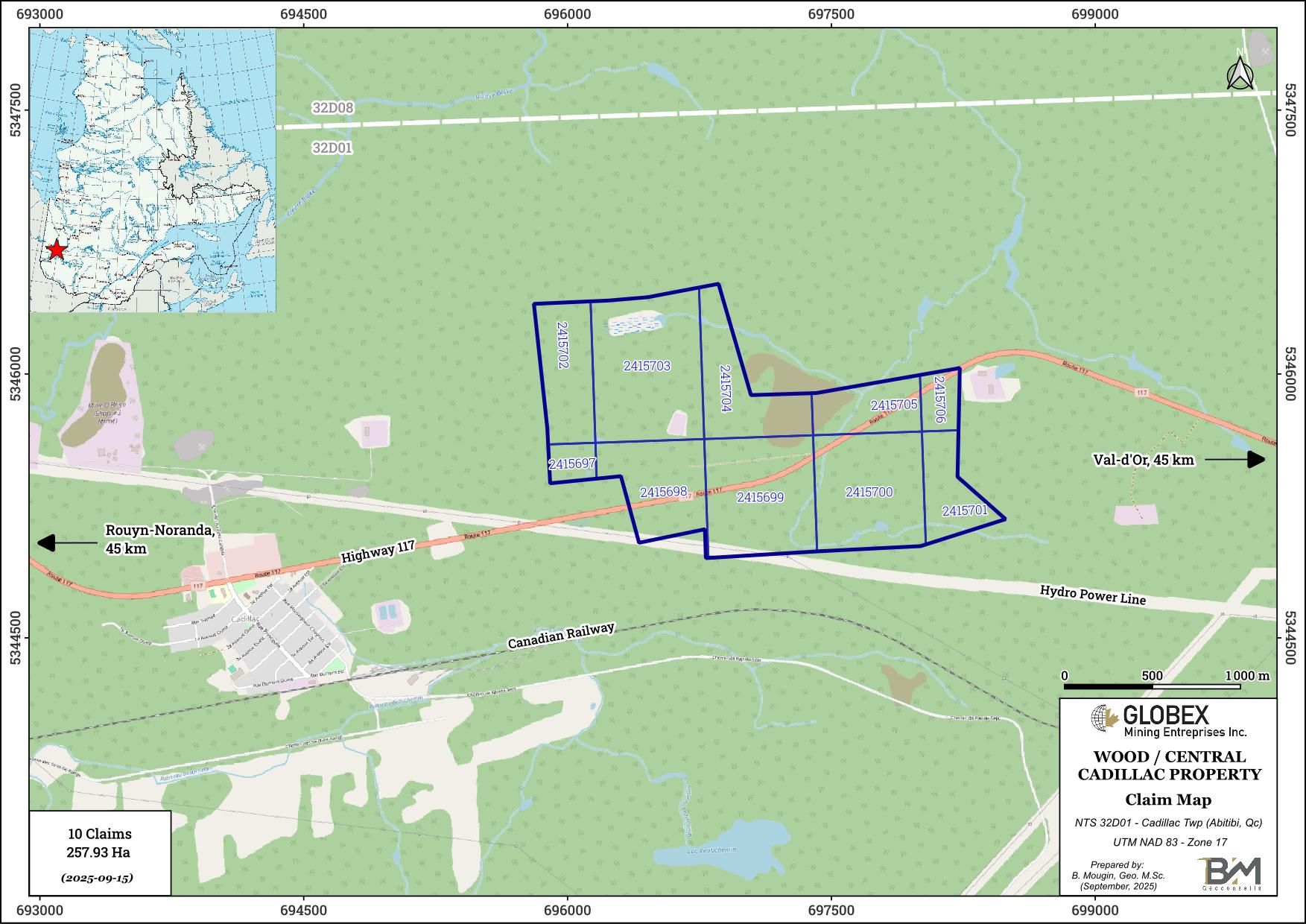
The Wood/Central Cadillac property consists of 10 mining claims covering an area of 257.93 Ha in Cadillac township, MRC of Rouyn-Noranda. The property is located approximately 45 km east of Rouyn-Noranda (Qc) and 45 km northwest of Val-D’Or (Qc). The claims are fully owned by Globex. Also, Globex has purchased a 48.33% interest in the underlying 2% NSR on the Wood/Ironwood claims.
The Wood/Central Cadillac property straddles Trans-Canada Highway 117. The region is associated with several active mines and numerous exploration companies. A full range of infrastructure, service companies, and experienced human resources are available in most nearby communities including Val d’Or, Malartic, and Rouyn-Noranda. Two regional airports, located in the cities of Rouyn-Noranda and Val d’Or, provide regular connection with the main centers of the province (Montreal and Québec City). The Property is also connected to a high voltage power line and is intersected from east to west by the Trans-Canada Railway.
Geology and Mineralization
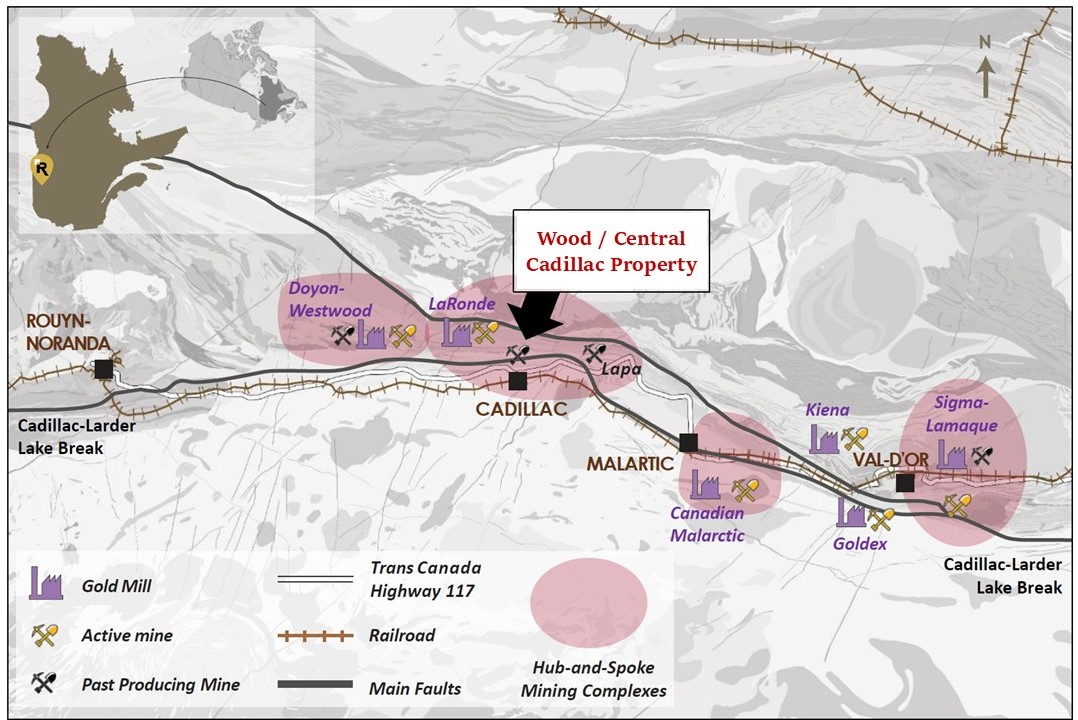
The Wood/Central Cadillac property is located on the contact between the Abitibi and Pontiac subprovinces, separated by the Cadillac–Larder-Lake Deformation Zone (CLLDZ). The Abitibi Subprovince is an Archean greenstone belt which hosts some of the richest mineral deposits of the Superior Province whose total endowment, including Production, Reserves and Resources is estimated to be > 9,375 t Au (Dubé and Mercier-Langevin, 2020).
Volcanic and sedimentary rocks of the Cadillac area form a series of east-west-trending steeply dipping monoclinal panels. Sedimentary rocks, mainly wackes, of the Pontiac Group lie south of the CLLDZ. Most of the orebodies in the southern part of the Cadillac mining camp are hosted in rocks of the Piché Group (volcanic rocks interbedded with conglomerates, wackes, graphitic schists and pyritic cherts), which forms a thin band several tens of kilometres long that follows the trace of the CLLDZ (Evans, 2023).
All Archean rocks were deformed and verticalized during the Kenorean Orogeny (2.7 – 2.68 Ga). Regional metamorphism ranges from the greenschist facies to the upper greenschist facies. Non-deformed NE-oriented Proterozoic diabase dykes run throughout the area.
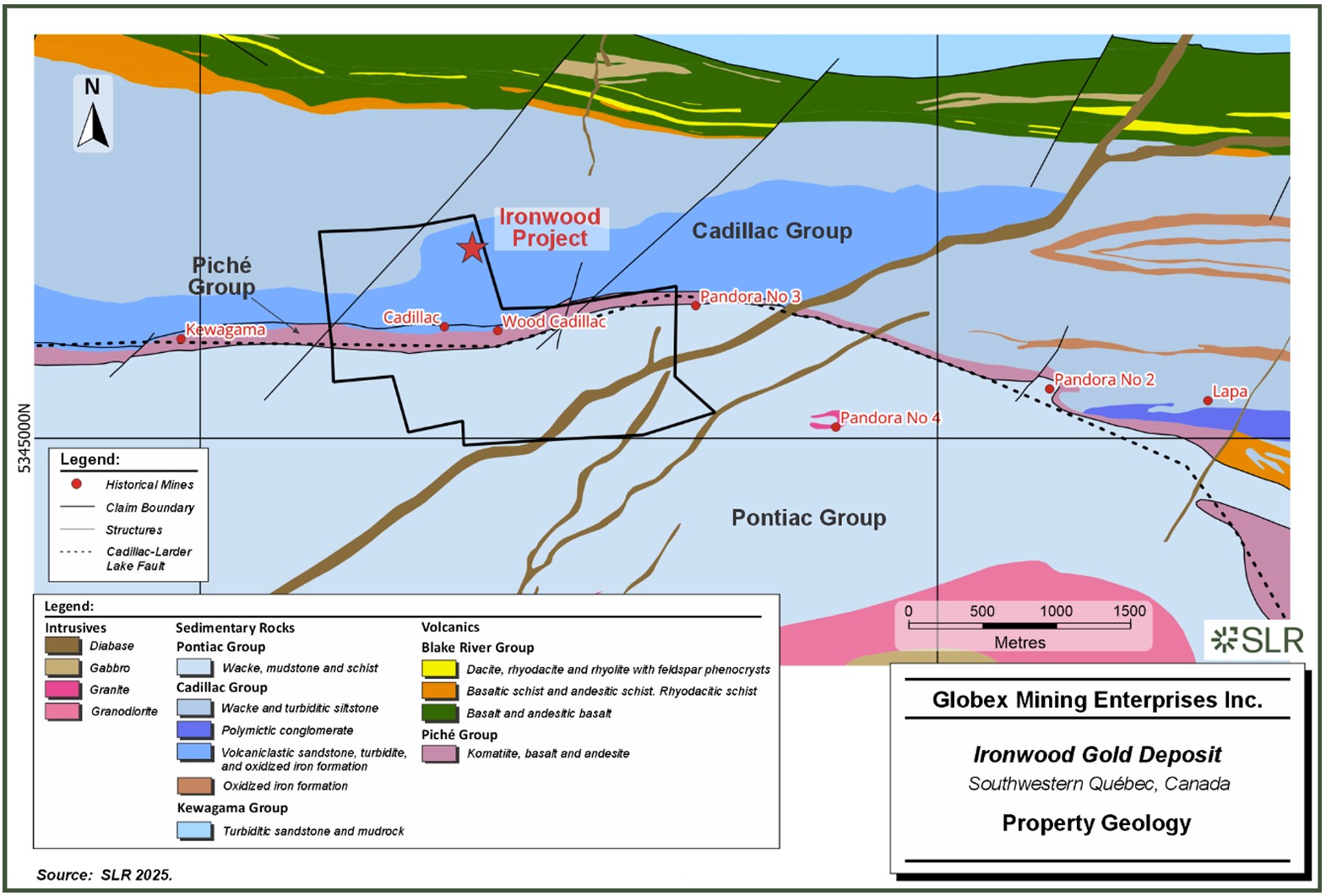
The northern half of the Wood/Central Cadillac property is underlain by steeply south dipping greywackes, mudstones and banded iron formation of the Cadillac Group. Locally, the oxide facies iron formation has been affected by hydrothermal alteration where the primary iron oxide minerals such as magnetite and hematite have been transformed to sulphidebearing minerals such as pyrite, pyrrhotite and arsenopyrite. In some places the concentration of these sulphide minerals is sufficient to provide an electromagnetic anomaly, such as is found associated with the Ironwood Gold Deposit.
The southern portion of the property is underlain by greywackes and lesser mudstones of the Pontiac Group. The sedimentary groups are separated by a narrow but critically important 50-200 m wide band of talc/chlorite schists and mafic volcanic rocks of the Piche Group that strike east-west and dip steeply to the south. The CLLDZ is best developed within the Piche Group mafic and ultramafic volcanic but occasionally widens to encompass parts of the adjacent bounding sedimentary formations.
The Wood/Central Cadillac property is located in the central part of Cadillac Township, in Abitibi, at the heart of one of Canada’s most productive gold mining camps. Most of the gold mineralization in the Cadillac mining Camp is closely associated with the CLLDZ and its subsidiary structures. Approximately 40 gold deposits, which have produced over 60 million ounces of gold since the early 20th century, are associated with this major structure and its subsidiary faults (Evans, 2023 NI 43-101 Technical Report on the O’Brien Project).
The deposits are quartz-lode type, generally consisting of auriferous sulphide-bearing quartz-carbonate shear veins frequently containing free milling gold, disseminated pyrite haloes to the veins in shear zones and related structures and to a lesser extent, veins in extensional fractures, structural zones, and breccias. In general, the wallrock is well foliated and has a distinctive dark brown to brownish grey colour due to intense biotite alteration; wallrock alteration ranges from several centimetres to over a metre thick (Evans, 2023). Generally, zones of biotite alteration accompanied by silicification and sulphidation will yield gold values. Of all the sulphides, arsenopyrite is the most abundant and characteristic of this portion of the Cadillac fault.
The gold mineralization discovered at the Ironwood Gold Deposit is however hosted by an oxide iron formation (magnetite and hematite dominated) and consists primarily of replacement of the host oxide iron minerals by an assemblage of pyrrhotite-arsenopyrite-pyrite. This mineralization has been identified as a sulphidized iron formation. A direct correlation is observed between the amount of secondary sulphide minerals (pyrrhotitearsenopyrite-pyrite) and gold grades.The newly completed drill hole data indicate the presence of two sub-parallel mineralized structures on the hanging wall and footwall of the primary mineralized structure (Pressacco, 2025).
History
Detailed information about work history of the Wood / Central property is given in the NI 43-101 Technical Report written by Pressacco in 2025.
The first exploration work in the Property area dates to 1927-1928, with Wood-Cadillac Mines Ltd. acquiring the claims from Boischatel Québec Mines Ltd. and subsequently conducting trenching. A shaft was sunk in 1937 and production continued until 1942. Production at the Wood-Cadillac mine resumed from 1947 to 1949 in conjunction with the Central-Cadillac Mine (Consolidated Central Cadillac Mines Ltd.). The shaft at the Central- Cadillac Mine was sunk in 1937 and production began in two stages from 1939 to 1943 and from 1947 to 1949. The Wood-Cadillac and Centrale-Cadillac mines were operated jointly in the period 1947 to 1949. The Wood and Central Cadillac mines are reported to have produced 59,689 oz of gold from 1937 to 1942 and from 1947 to 1949. Between 1937 and 1949, underground mining at the Wood-Cadillac site produced over 59,000 oz of gold and 8,600 oz of silver from approximately 438,700 t (approximately 393,000 t) of milled ore.
The mineralization at the Ironwood Gold Deposit was initially discovered in 2006 when a diamond drilling program was conducted to test a geophysical target.
In June of 2022, the Globex/Agnico Eagle 50-50 joint venture in Cadillac Township, Quebec, was terminated (see Globex press release of June 29, 2022). Globex now retains a 100% interest in the Central Cadillac and Wood Gold Mine properties.
In 2024, Globex undertook 3,637 m of DDH (19 holes) and commissioned SLR Consulting to prepare a Mineral Resources estimate on the Ironwood Gold deposit. Indicated Resource of 234,800 t grading 14.38 g/t Au (108.53 Koz Au) was estimated in date of April 15, 2025 (NI‐43‐101 Technical Report for The Mineral Resource Estimate, Ironwood Gold deposit, R. Pressacco). Bulk flotation recovered approximately 97% of the gold in a bulk concentrate.
Resources and Potential
SLR observes that the strike extension of the Ironwood mineralized system has been well defined by drilling. While the depth limits of the mineralized system have been largely well defined by drilling, a steep west plunge to the west has not been defined by drilling.
In addition, Historical Resources of 1,391,400 t grading 5.49 g/t Au to 6.86 g/t Au were estimated by H. J. Bergmann in 1974 for the “Central” section of the consolidated Wood-Central mines on the Property. Both the Wood and Central Cadillac resources were calculated prior to National Policy 43-101 Standards of Disclosure for Mineral Projects, are historic in nature and should not be relied upon, as the accuracy has not been verified by a Qualified Person.
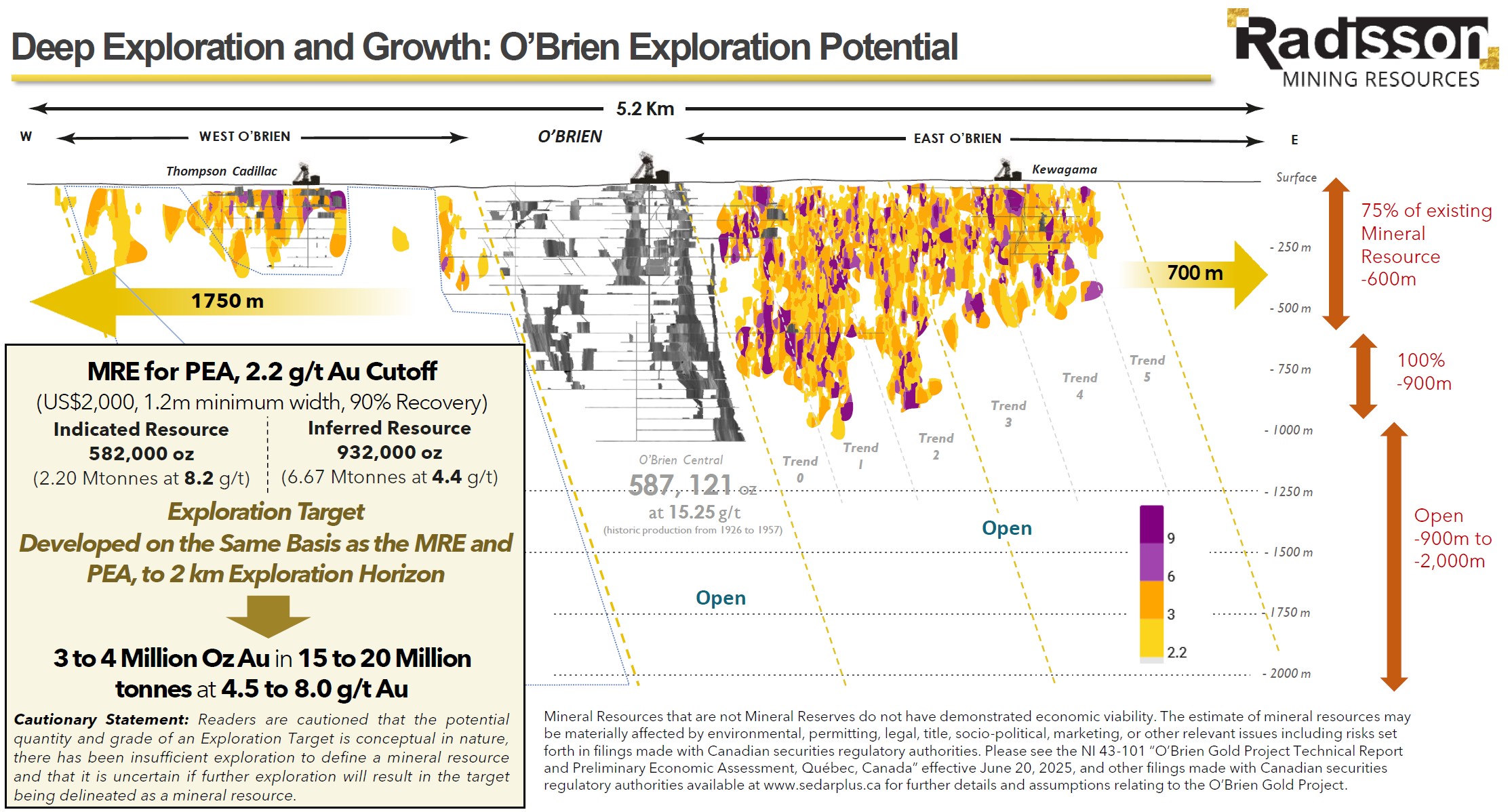
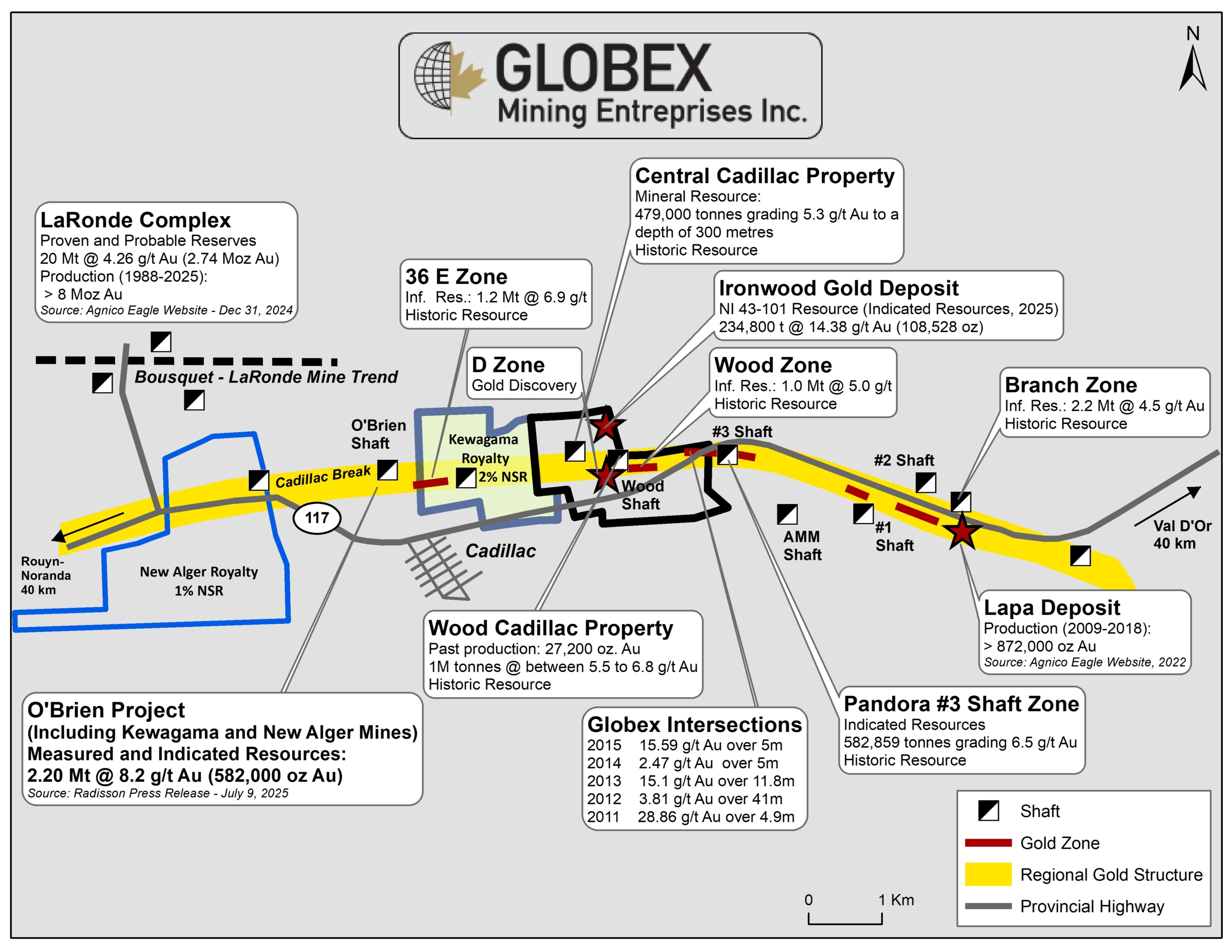
A Preliminary Economic Assessment (NI 43-101 “O’Brien Gold Project Technical Report and PEA, effective date, June 27, 2025) on the O’Brien Project of Radisson estimates Indicated mineral resources of 0.58 million ounces (2.20 million tonnes at 8.2 g/t Au), with additional Inferred mineral resources of 0.93 million ounces (6.67 million tonnes at 4.4 g/t Au). Mineral Resources are fully open at depth below the O’Brien, Kewagama and New Alger former mines and dip to the east in direction of the Wood / Central property (map below).