
Rouyn Merger
Location, Access, Description
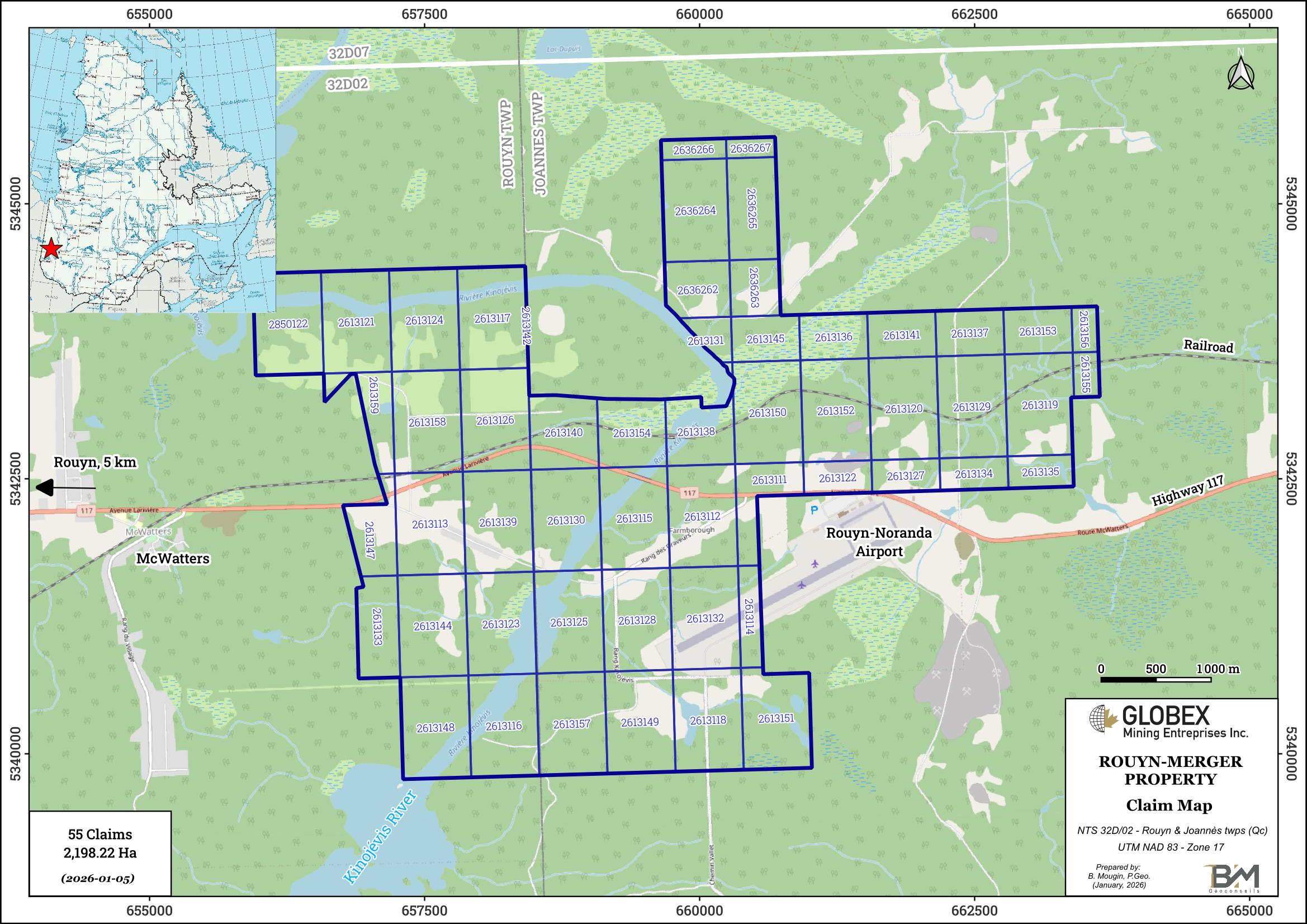
The Rouyn-Merger property is composed of 55 mining claims totaling 2,198.22 Ha located 10 km east of Rouyn-Noranda, in Abitibi-Témiscamingue. Globex is 100% owner of the property which is not subject to any third-party interests. The property is easily accessible by Provincial Road 117 south connecting Rouyn-Noranda to Val-d’Or.
Skilled labour, equipment providers and contractors who are able to facilitate exploration activities are abundant in Rouyn-Noranda. The national railroad crosses through the property. About 1.3 km north of the property is a high-voltage power line running between Rouyn-Noranda and Val-d’Or.
Geology and Mineralization
The Rouyn-Merger property is set on the contact between the Abitibi and Pontiac subprovinces represented by the Cadillac-Larder Lake (CLL) fault. The CLL is the major regional feature of the area; numerous showings and deposits have been uncovered along this prolific structure in both Quebec and Ontario provinces. In the area of the property, the CLL separates volcanic rocks of the Blake River Group (BRG) in the north and metasediments of the Timiskaming and Pontiac Groups in the south. Regional metamorphism is at the greenschists grade and locally reaches the lower amphibolite grade around large Archean intrusions. All Archean rocks of this area have been verticalized during the Kenorean orogenesis that occurred about 2.5 billion years ago. Proterozoic diabase swarms cut through every Archean rocks.
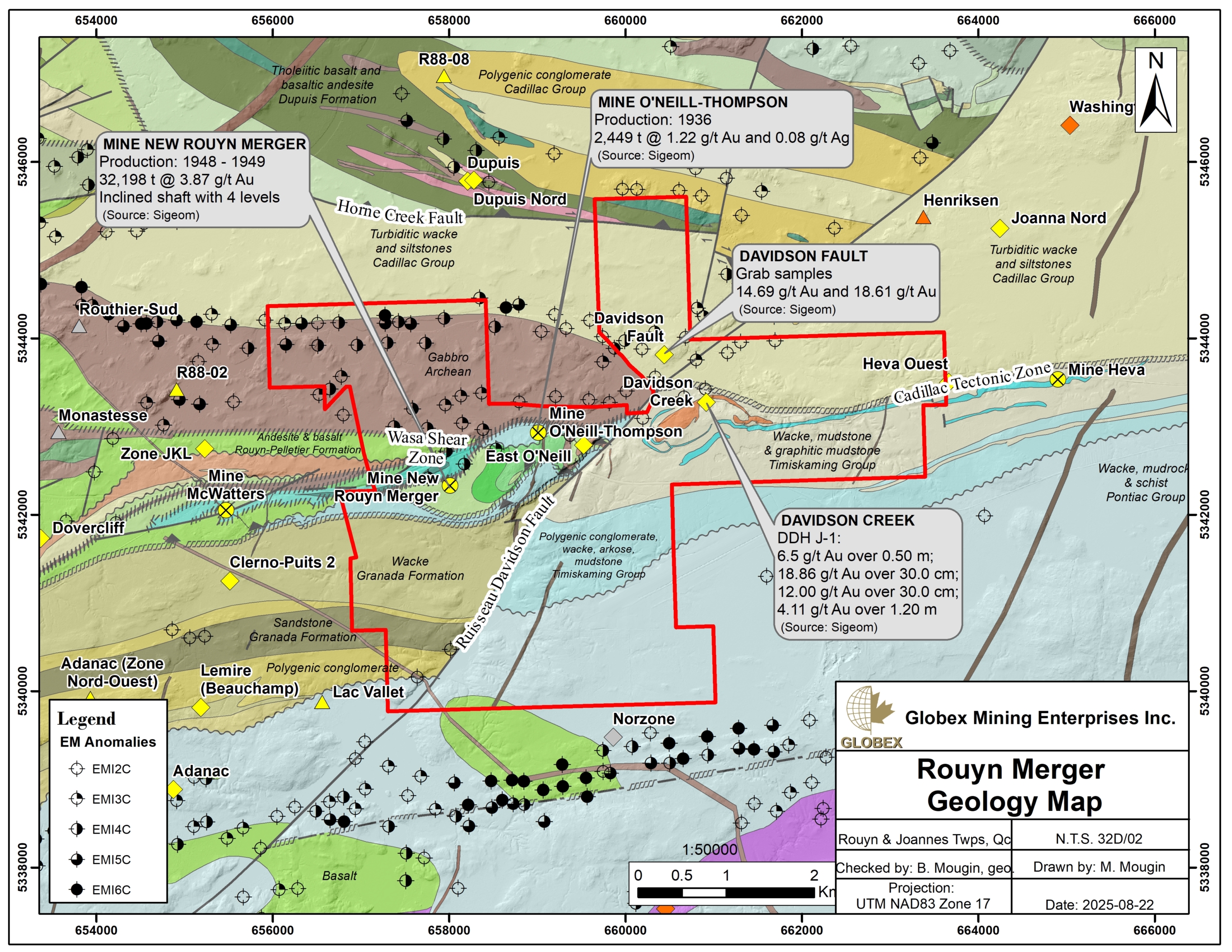
The Rouyn-Merger property includes the Blake River Group volcanics in the north of the property, the Timiskaming Group sediments in the south, the Cadillac Group in the east, and the Pontiac Group in the south. The Davidson Creek Fault crosses the Rouyn-Merger property in a NE-SW orientation.
Stratigraphy is generally E-W dipping north or south between -60° and -85°. Late NE and NW fractures and E-W shear zones are also present on the property and in the vicinity (GM 52670). Numerous quartz veins cut through the Timiskaming sediments and traces to 2% pyrite and arsenopyrite can be observed locally (GM 53662).
The Abitibi Greenstone Belt hosts several world-class deposits and has produced more than 210 Moz Au historically (Dubé and Mercier-Langevin, 2019), which makes it one of the largest and richest greenstone belts in the world. The Larder Lake – Cadillac fault is one of the major gold mineralizing structures in the Abitibi Sub-province, host to numerous deposits > 100t Au (Kirkland Lake, Kerr-Addison, Sigma-Lamaque, Malartic…).
The Blake River Group is associated with VMS deposits of the Noranda Mining Camp, some of which being world-class ones (Horne : 54Mt @ 2.2% Cu, 6.1 g/t Au and 13 g/t Ag ; Waite Amulet : 9.7Mt @ 4.2% Cu, 3.6% Zn, 0.9 g/t Au and 28 g/t Ag), and of the Doyon-Bousquet-LaRonde (DBL) Mining Camp (cumulative production at the end of 2005 : 67Mt @ 5.67 g/t Au (12.3 Moz Au) with the LaRonde Complex still producing at the present date. Source : Chartrand and Cattalani, 1990.
The Rouyn-Merger property hosts numerous gold showings and former mines whose production dates back to the 1930’s-1940’s. Mineralization is vein-type and consists of gold, pyrite, arsenopyrite, pyrrhotite, scheelite, and galena in quartz-carbonate-tourmaline veins cutting through sedimentary rocks of the Cadillac Group and mafic rocks of the Blake River Group (GM 64293). The host rocks are silicified and carbonated schists. Historical production data are shown in the geology map below.
Many gold mineralization, including the former Astoria, Granada, Heva and Hosco mines, are also associated with the Timiskaming Group east and west of the property. Free orogenic gold is observed on the edges of smoky quartz veins mineralized with fine pyrite and arsenopyrite, inside faults and shear zones affecting the Timiskaming sediments. Strong silica-chlorite-carbonate alteration is commonly observed around mineralized zones.

History
The first recorded work on the Rouyn-Merger property was carried out by East Rouyn Gold Mines in the 1930s. Numerous historical exploration programs have been undertaken since, and thousands of meters of historical DDH succeeded in bringing several mines into production. Cambior carried-out 3,790 m of DDH in 2005 and succeeded in highlighting disseminated and massive sulphide mineralization. See Quebec Government report GM62787 for more details about historical exploration on the Rouyn-Merger property.
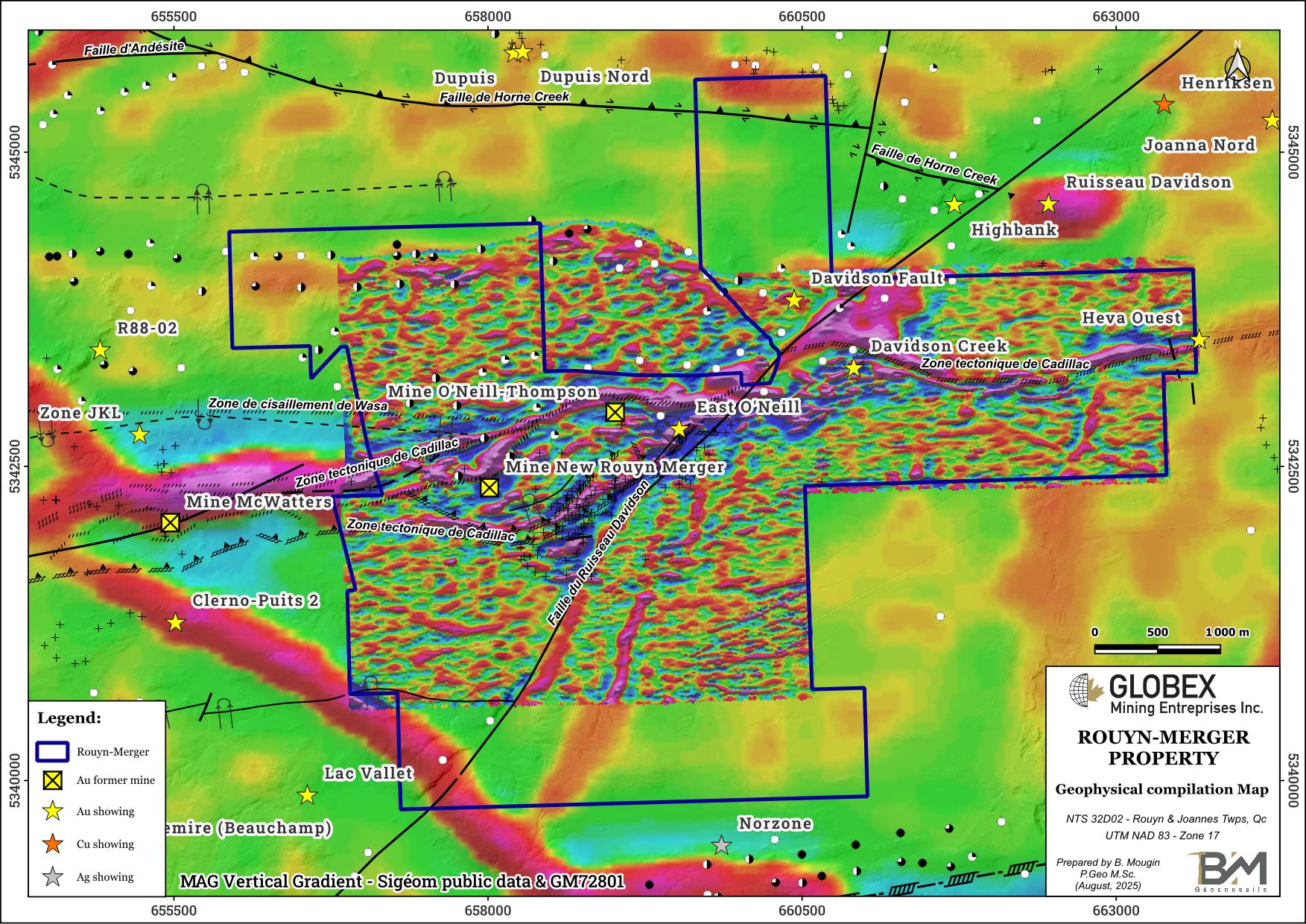
Since 2020, Globex carried out 3D modelling (2020) of underground developments and historical DDH at Rouyn-Merger, ONeill-Thompson and Oneill East, as well as very-high definition Airborne Magnetic Survey (2022, GM72801) of the property. This work highlighted a series of exciting DDH targets to be tested.
In late 2025, Globex started a 1,095 metres (6 holes) DDH program on the Rouyn-Merger property. Preliminary results of the first two (2) holes returned up to 3.44 g/t Au over 38.7 m including 12.60 g/t Au over 6.7 m on DDH RM-25-01. DDH RM-25-02 drilled below RM-25-01 returned up to 3.47 g/t Au over 26.4 m including 11.67 g/t Au over 6.1 m (Globex press release dated December 9, 2025). Best results are presented in the table below :
|
DDH |
From (m) |
To (m) |
Core length |
Au (g/t) |
|
RM-25-01 |
54.3 |
93.0 |
38.7 |
3.44 |
|
Including : |
54.3 |
61.0 |
6.7 |
12.60 |
|
And : |
66.4 |
72.7 |
6.3 |
4.59 |
|
RM-25-02 |
75.3 |
101.7 |
26.4 |
3.47 |
|
Including : |
95.6 |
101.7 |
6.1 |
11.67 |
|
RM-25-03 |
129.0 |
138.0 |
9.0 |
2.74 |
|
RM-25-05 |
74.6 |
79.3 |
4.7 |
13.06 |
Resources and Potential
The New Rouyn-Merger mine was in operation for a short period of time ; the main reasons for its closure were the presence of several sub-horizontal faults disrupting the lenses, a lack of understanding of the mineralization structural control, and the lack of lateral and vertical extension. Resources were estimated by Cambior in 1986 at 141,000 t at a grade of 5.41 g/t Au (Bérubé, 1987). Thus, a better understanding of the deposit could lead to a new exploration focus.
KWG Resources estimated historical resources of 1 Mt grading 5.81 g/t Au at O’neill East (GM 52851, 1984).
The 2025 drilling results from Globex are very encouraging for the future and continue to demonstrate strong exploration potential throughout the property.