
Berrigan Mine
Location, Access, Description
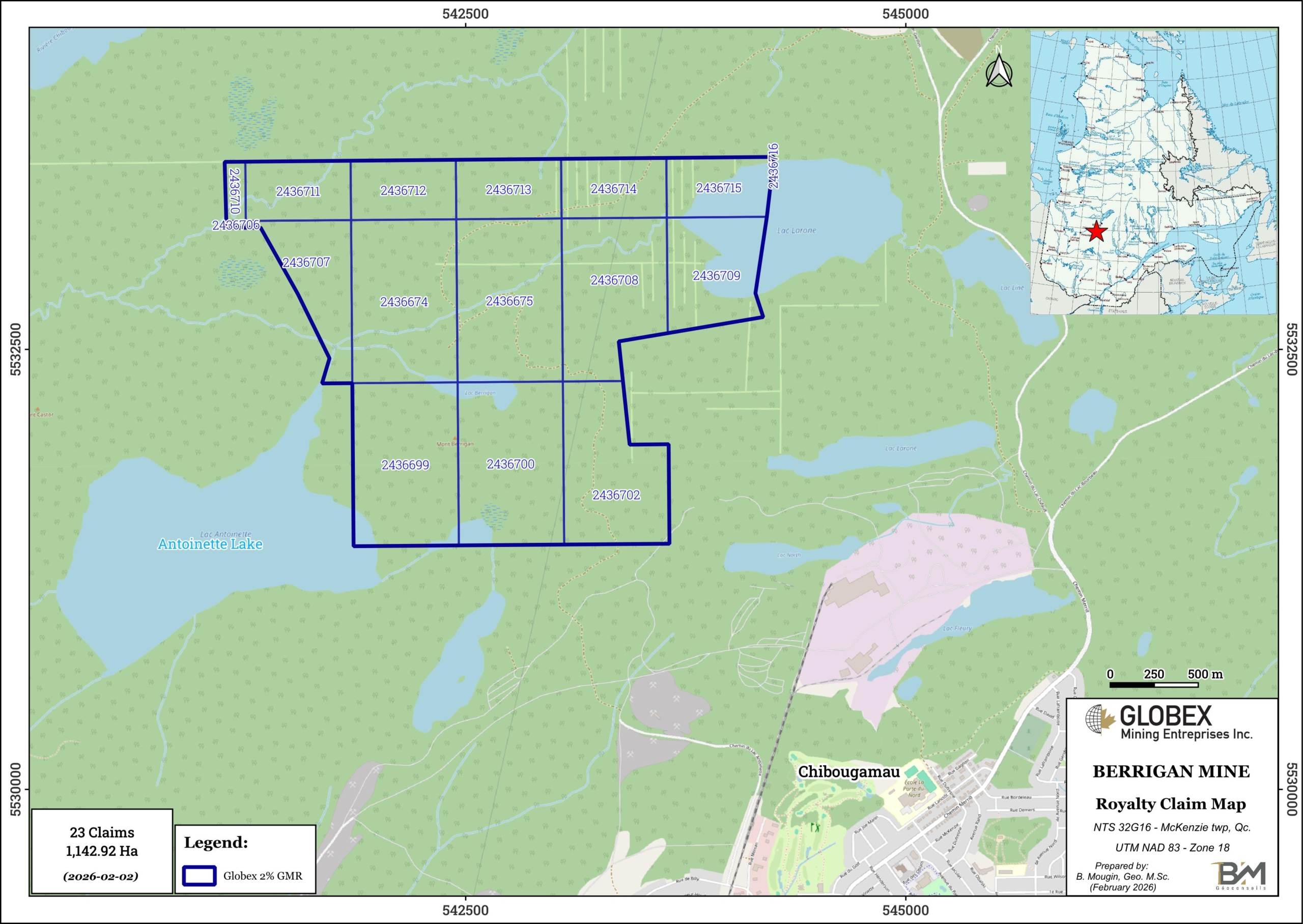
The Berrigan Mine property is located in Eeyou-Istchee James Bay Government, Northern Québec, Canada (NTS 32G16), approximately 2.5 km northwest of Chibougamau. It consists of 16 contiguous claims covering a total area of 482.92 hectares. The Project is easily accessible in vehicle by all- weather gravel roads connecting to regional highway #167.
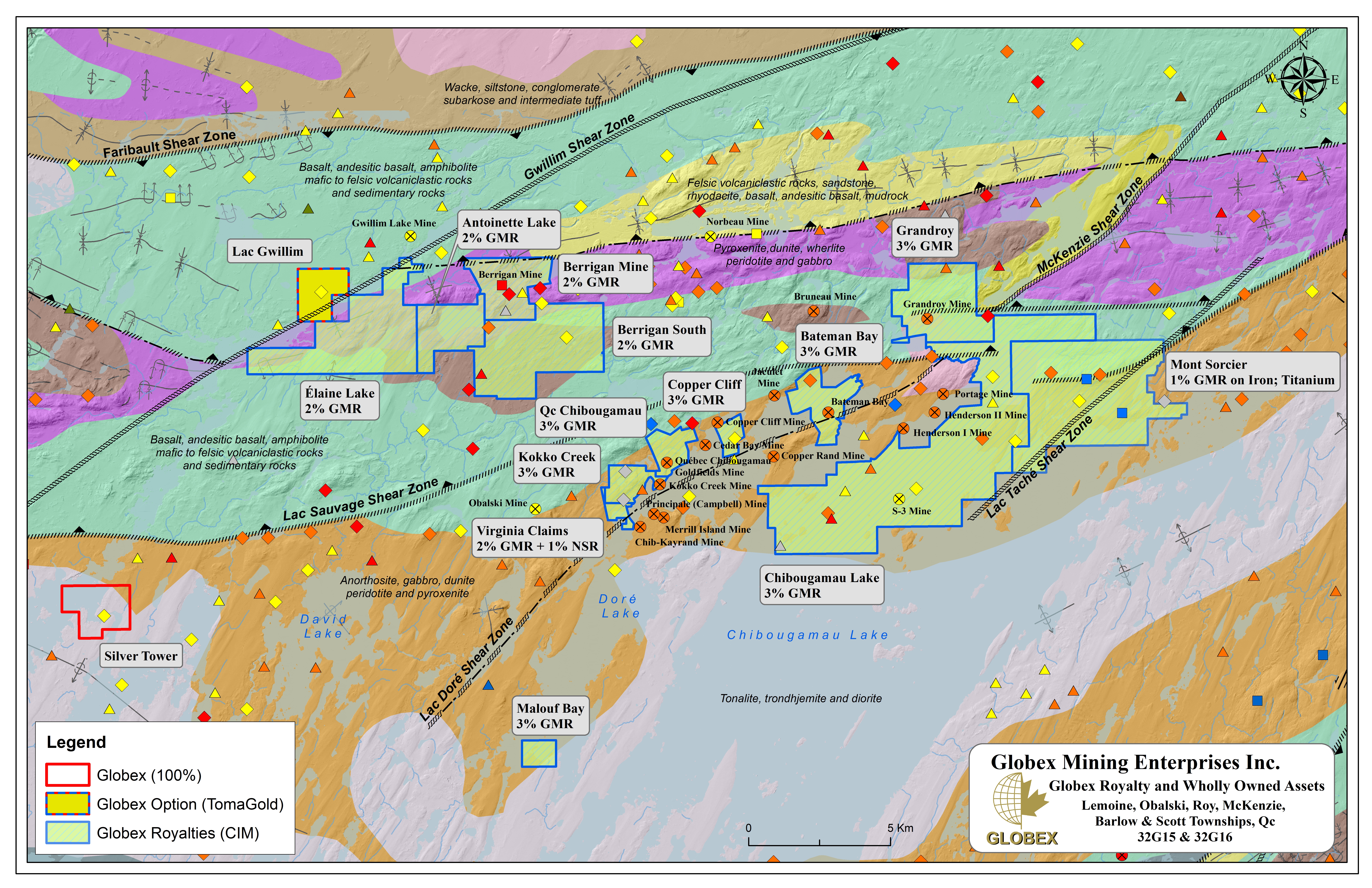
The claims have been stacked by Globex in 2010 and then transferred in 2012 to Chibougamau Independent Mines (CIM), a subsidiary of Globex ; TomaGold optioned the property from CIM in 2023 (as well as several other properties of CIM ; see the General Map of Globex’s assets in the Chibougamau area), and both CIM and Globex will retain a 2% Gross Metal Royalty (GMR) on it.
Historical Resource of 1,388,915t @ 3.17% Zn and 1.77 g/t Au have been estimated on the Berrigan Main Zone by Chouinard et al. (2001) for Coop Extramine 2000 inc (GM61359).
Geology and Mineralization
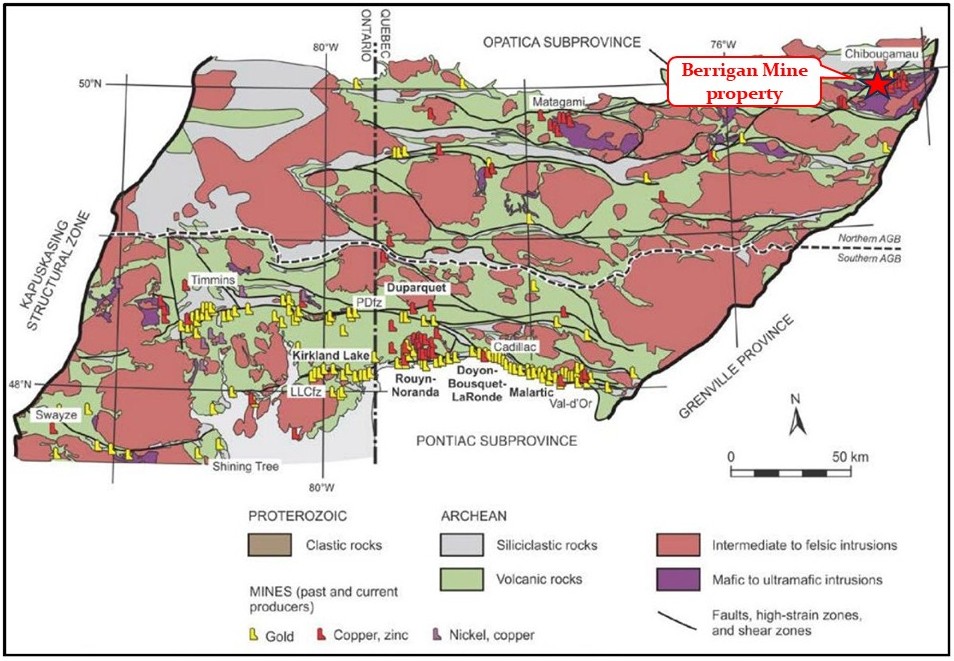
The Berrigan Mine property is located in the Superior Province of the Canadian Shield. The Abitibi Sub-province is known for its prolific and diverse rich mineral deposits; total gold production of the Abitibi Greenstone Belt (AGB) since the beginning of the 20th century is estimated at over 210 million ounces (Moz) Au (Dumas, 2024).
The Chibougamau Mining District is located at the north-east end of the Abitibi Greenstone Belt and hosts a variety of deposits styles; Leclerc et al. (2012) documented volcanogenic massive sulphide (“VMS”) deposits, magmatic Fe-Ti-V and Ni-Cu ± PGE mineralization, early polymetallic (Au-Ag-Cu-Zn-Pb) vein deposits (to which the Property mineralization might belong), Chibougamau-type Cu-Au-veins, shear zone-hosted Au deposits, and Opemiska-type Cu-Au veins. Total production of the Chibougamau mining camp since the beginning of the 20th century is estimated at 1,624.9 Mlbs Cu and 3.22 Moz Au (Houle, 2019).
The Chibougamau region hosts some of the eldest rocks of the AGB; the area is dominated by a stacking of Archean mafic volcanic rocks intercalated with a few felsic units and some sedimentary units, intruded by two large batholiths : the anorthosite Doré Lake Complex, and the Chibougamau Pluto composed of tonalite and granodiorite. These two intrusions played a major role as regional mineralized features, and the vast majority of mines in the Lake Chibougamau area are located within or near these two intrusions. Regional metamorphism is at the greenschists grade.
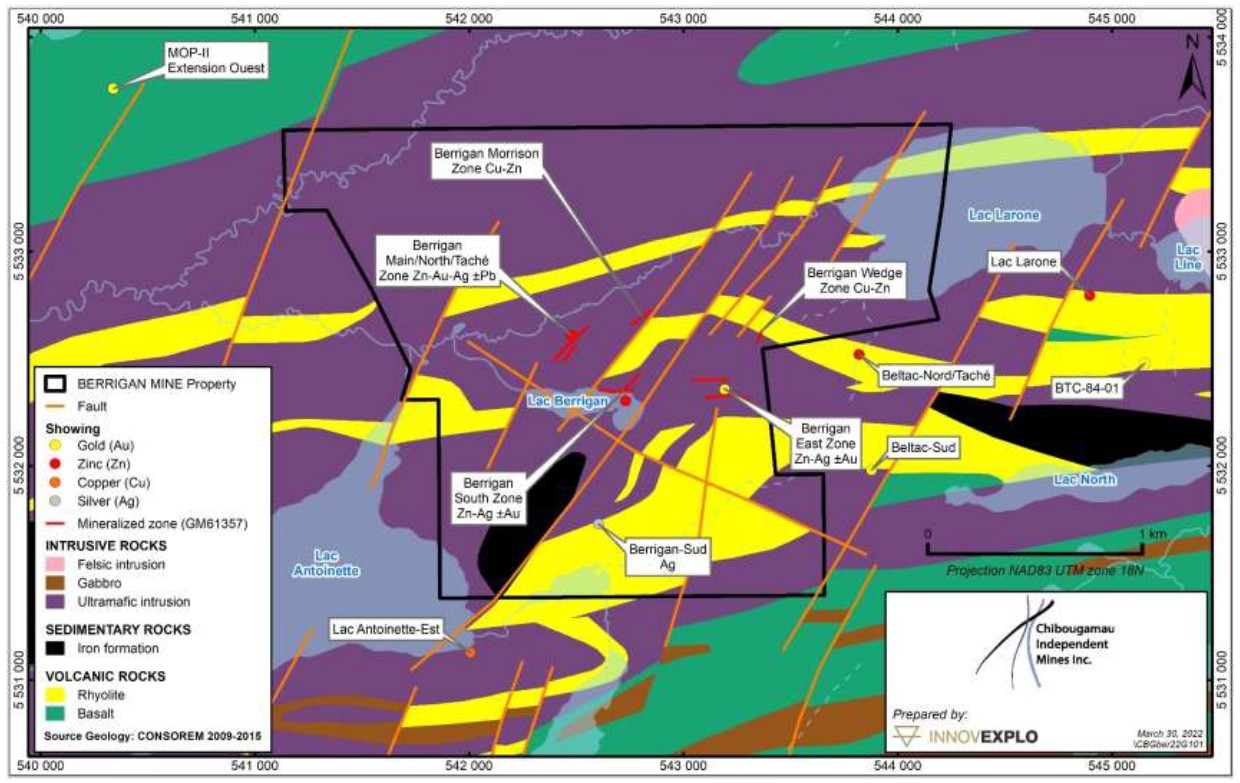
The Berrigan Mine property is largely underlain by ENE-trending mafic to ultramafic intrusive rocks of the Cummings Intrusive Suite and also by volcanic rocks of the Roy Group. The Cummings Suite is composed of three distinct ultramafic to mafic sills named, from bottom to top, the Roberge, Ventures, and Bourbeau sills. On a regional scale, these sills contain significant hydrothermal mineralization, such as that found at the Berrigan Mine. The Main Zone is polymetallic in nature with a metal association of Au-Ag-Cu-Pb-Zn-As. The mineralization is associated with sulphides and occurs as disseminations, stringers and sulphides breccias accompanied by quartz and calcite filling fractures (Pilote, 1987). De Chavigny (2001) stated that “the sulphide content of the mineralized zone varies from 10% to 75%. Pyrrhotite is the most common sulphide, followed by sphalerite and pyrite. Minor galena and arsenopyrite have been described along with traces of chalcopyrite and rarely visible gold.”
The property host six (6) polymetallic mineral occurrences: Main Zone (Zn-Au-Ag ±Pb), South Zone (Zn-Ag ±Au), East Zone (Zn-Ag ±Au), Morrison (Cu-Zn), Wedge (Cu-Zn) and Berrigan-Sud (Ag). Numerous significant polymetallic intercepts were obtained during past drilling programs on the property. The genesis of the polymetallic mineralization on the Property has been described as either VMS or epithermal; regardless of the origin of the sulphides on the Property, it appears that the primary control on mineralization is structural.
Following Larouche (2012), “The mineralization at the Berrigan Project clearly appears to be controlled by structures and the presence of a mineralized breccia locally gives some significant widths of economic interest to the mineralized zones. The presence of numerous parallel and closely spaced mineralized lenses creates an interesting situation for larger tonnage, lower grade “bulk mining” amenable to open pit operation. So far each drilling program conducted on the Berrigan Project has met with considerable success.”

The area also hosts significative potential for VMS mineralization (Lemoine and Lac Scott mines) and Ni-Cu-Co-Cr mineralization associated with ultramafic rocks of the Lac Doré Complex and Cumming sills.
History
Discovery of metallic mineralization on the Berrigan Mine property dates back to 1929 with the discovery of the “Lac Berrigan South Zone” in surface prospection. Numerous exploration programs (mapping, sampling, geophysics, diamond drilling…) as well as historical resource estimates have been undertaken by successive owners, including Noranda, Taché Lake Mines and Camchib Mines. A detailed history of exploration on the property is presented in the NI 43-101 Technical Report on the Berrigan Mine property prepared by InnovExplo (Carrier, 2022).
In 2001, Coop Extramine 2000 inc. carried out a series of work in order to better estimate the economic potential of the Berrigan deposit. Work included underground sampling, preliminary mineral processing tests, environmental characterization, and resource estimation (GM63356, GM61357, GM61358 & GM61359); Extramine estimated a historical resource (non NI 43-101 compliant) of 1,388,915t @ 3.17% Zn and 1.77 g/t Au (Chouinard et al., GM61359).
Prior to its acquisition by Globex in 2010, a total of more than 36,400 linear metres in 327 drill holes (DDH) have been documented on the Berrigan Mine property and were compiled into a “Gemcom” database.
Since 2013, Globex and CIM undertook ground magnetometry and induced polarization (IP) surveys (GM68466), followed by a 1,729 metres (8 holes) DDH program in 2013 (GM67508) and additional 1,428 metres (5 holes) in 2016 (GM70497). Drilling intersected up to 16.94 g/t Au, 48.0 g/t Ag and 9.50% Zn over 0.90 m (BT13-003) and 10.84 g/t Au, 83.0 g/t Ag and 7.89% Zn over 0.60 m (BT-16-010). Channel-sampling in 2017 returned assays up to 19.71 g/t Au, 289.2 g/t Ag, 16.79% Cu and 17.75% Pb over 1.10 metres on the Main Zone (GM70967). CIM drilled two (2) additional holes (891 metres) to follow up in depth on certain intersections from 2013 and 2016; hole Hole BT-22-15 intersected two zones of highly anomalous zinc, gold, and silver mineralization within a core length of 73.2 m, including 2.19 % Zn, 2.02g/t Au and 22.46 g/t Ag over 22.9 m (GM73727).
Recent developments :
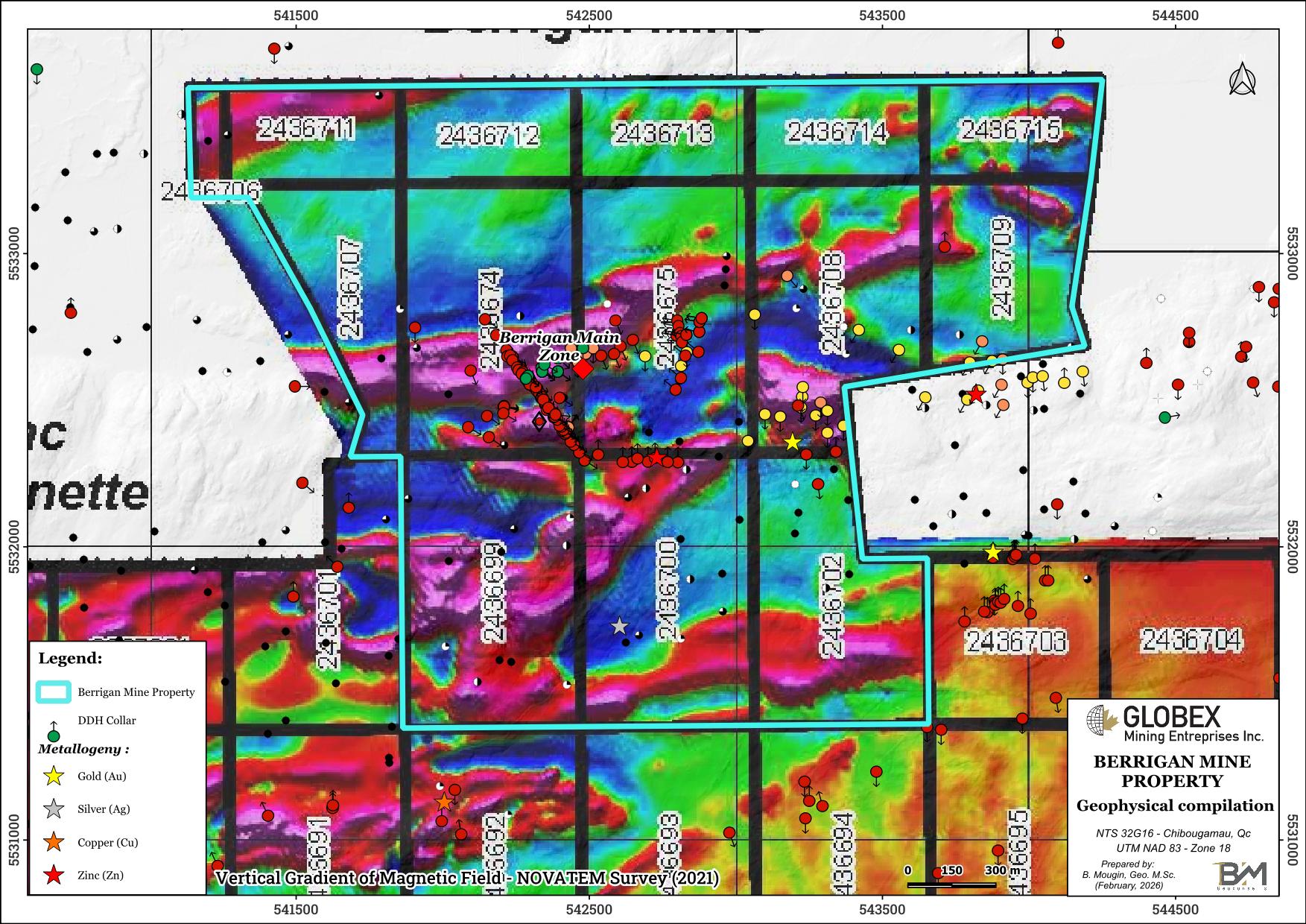
In 2021, CIM requested the services of NOVATEM to fly a very-high resolution airborne magnetic survey (GM72456) over several of its properties in the Chibougamau area, including the Berrigan claims.
In 2022, CIM mandated InnovExplo to prepare a NI43-101 Technical Report on the Berrigan Mine property (Carrier, GM73728). Review of the Property’s history, geological setting, exploration status and potential confirmed the exploration merit of the property and its author recommended a property-scale exploration program including additional drilling and 3D modelling.
TomaGold optioned two (2) blocks of properties from CIM in 2023, including the Berrigan Mine claims (CIM Press Release dated August 14, 2023). In late 2025, the company conducted a 15-holes DDH program on the Berrigan Mine property which intersected significant zinc, silver and gold mineralization (TomaGold press release dated January 29, 2026). In particular, drill hole TOM-25-015 intersected a new deep massive sulfides zone grading 5.75% ZnEq (1.34 g/t AuEq) over 98.5 m under the known zones, as follows :  Borehole-EM survey by Abitibi Geophysics indicates significant extension potential, particularly with the discovery of the Berrigan Deep zone (TomaGold press release dated February 05, 2026).

Resources and Potential
Historical work in the area identified a regional favorable context for several commodities in cluding gold, zinc and silver. The property potential is supported by favourable geological and structural setting and the presence of well-documented metallogenic and litho-tectonic elements such as the layered mafic-ultramafic sills of the Cummings Complex, felsic volcanic and volcanoclastic rocks of the Blondeau Formation, and other structures and alteration (Carrier, 2022).
Globex is pleased with the progress on this project by TomaGold and looks forward to its continued development. In a press release dated January 29, 2026, TomaGold stated that “Drill hole TOM-25-015, grading 5.75% ZnEq (1.34 g/t AuEq) over 98.5 m, is truly transforming the Berrigan Mine project and highlights a new semi-massive sulfide zone that extends at depth beneath the known zones. This very encouraging result suggests the presence of a large mineralized system that remains open at depth.”
Additional drilling in 2026 should enable TomaGold to advance the Project toward a NI 43-101 Mineral Resource Estimate in the short term. TomaGold Corporation has started a 1,500 metres drill program to extend 5 recent drill holes in order to further evaluate the Berrigan Deep zone at depth.