
Carpentier
Location, Access, Description
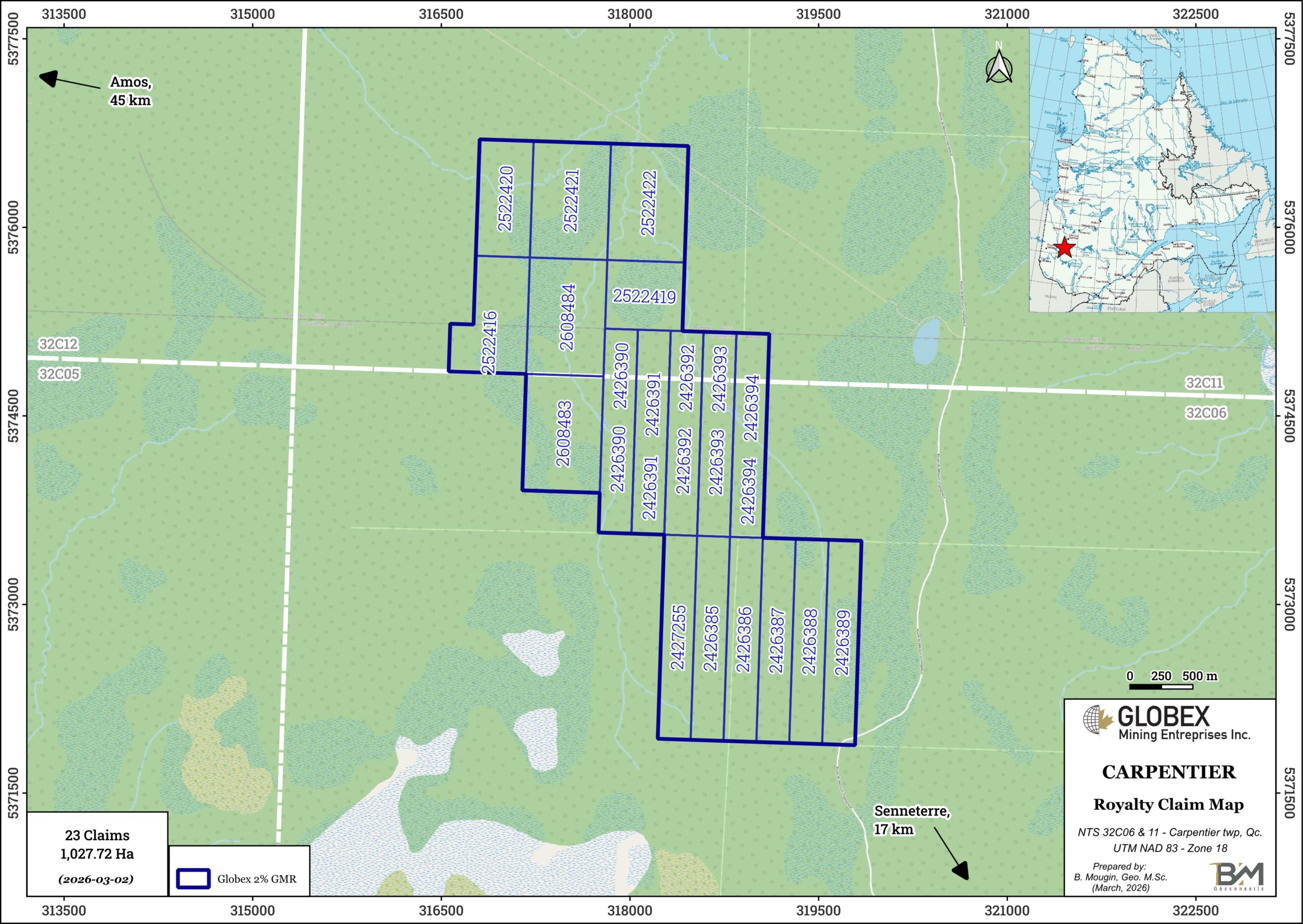
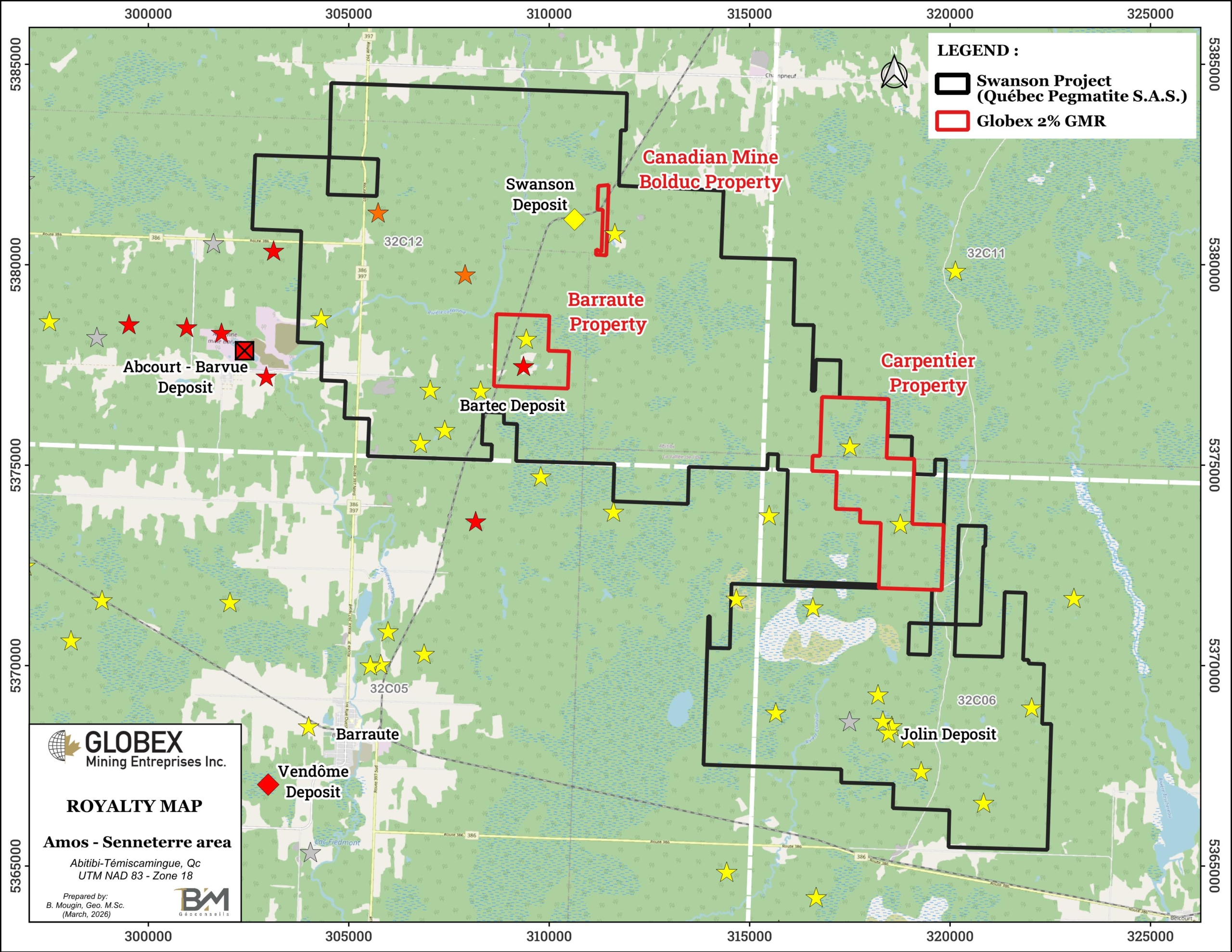
The Carpentier property is located in Abitibi-Temiscaminque (Qc), about 50 km east of Amos and 20 km northwest of Senneterre. The property consists of 23 mining claims totaling 1,027.72 Ha in Carpentier township. The claims are part of the Swanson Project currently developed by Québec Pegmatite S.A., and Globex retains a 2% Gross Metal Royalty (GMR). Globex also retains a 2% GMR on two (2) other blocks of claims within the Swanson Project.
The property is easily accessible by Road 386 connecting Barraute to Senneterre, and a network of gravel roads and forestry trails. Skilled labour, equipment providers and contractors who are able to facilitate exploration activities are abundant in Senneterre, Amos and Val-d’Or.
Geology and Mineralization
The Carpentier property lies within the Archean Greenstone Belt of the Abitibi Sub-province of the Canadian Shield. The Abitibi Sub-province includes a series of bands of ultramafic, mafic and felsic volcanic rocks and sedimentary rocks deposited between 2,790 and 2,690 Ma. All these rocks were deformed several times and verticalized during the Kenorean orogeny that occurred between -2.7 and -2.5 Ga (MB2016-01). Sub-circular pre- to post-tectonic TTG-type plutonic domains intruded Archean volcanic and sedimentary rocks.
More specifically, the property is located within the Taschereau-Amos-Senneterre Volcanic Segment (STAS). This segment is bounded by a series of regional E-W and NW-SE deformation corridors. Regional foliation is molded around the Montgay, Lacorne and Pascalis-Tiblemont batholiths which are large felsic-intermediate intrusions surrounding the property. Regional metamorphism is at the greenschists grade but can reach the amphibolite grade near the intrusions.
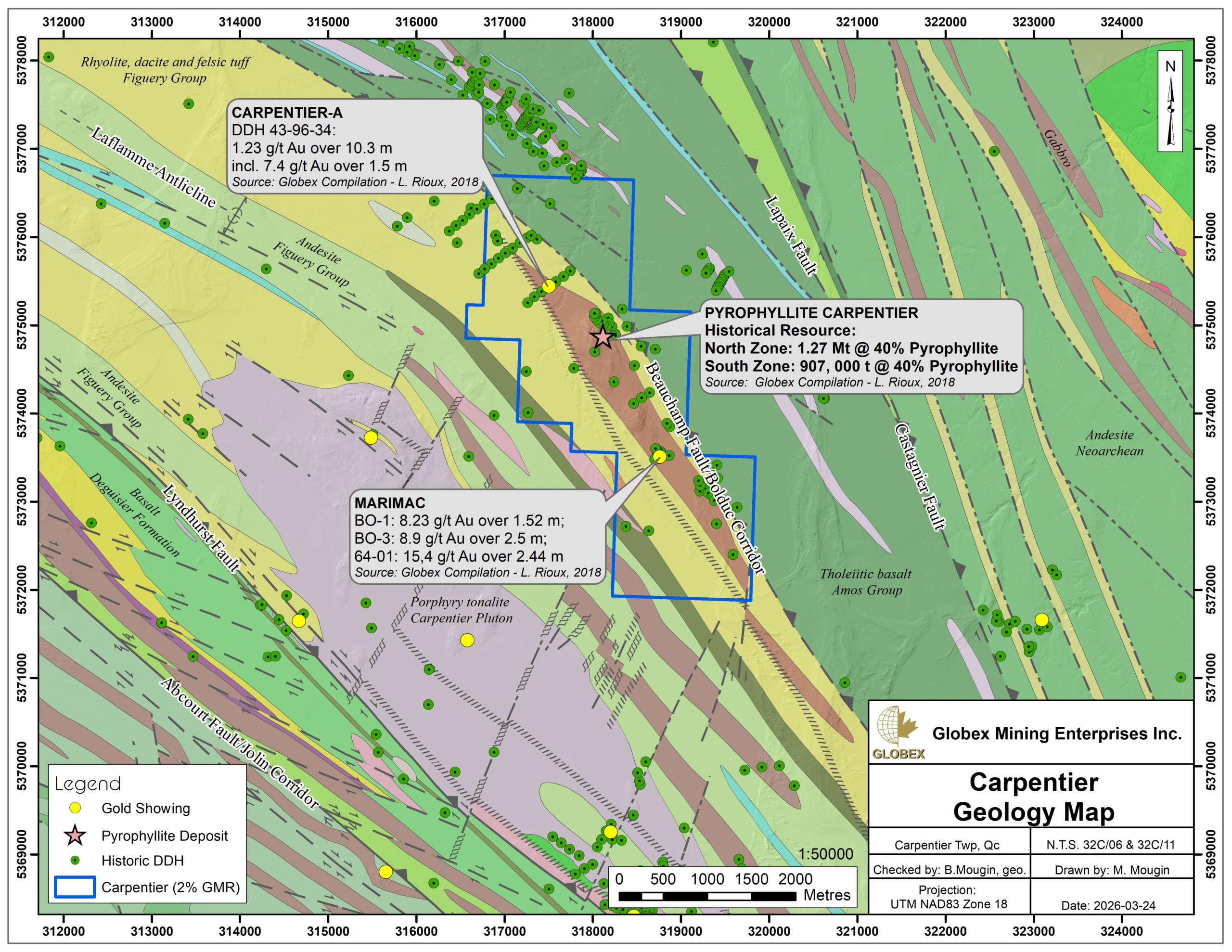
The Carpentier property is largely underlain by Archean tholeiitic mafic volcanics of the Amos Group, to the north, and felsic volcanics and tuffs of the Figuery Group, to the south. A highly metamorphosed pyrophyllite schist occupies a large portion of the central part of the property and appears to be derived from pelitic rock.
Some mafic and ultramafic (UM) sills are intercalated in mafic volcanics; this geological environment is very similar to that of the Dumont Nickel Ni-Co deposit located about 75 km to the west; the Dumont Project is preparing to enter the production phase soon, with Proven and Probable Reserves exceeding 1 billion tons grading 0.27% Ni and 107 ppm Co (Dumont website, March 2026).
The area is known for its gold mineralization potential associated with regional deformation corridors (Swanson, Bartec, Carpentier-A) and quartz-feldspar porphyries (Jolin, Savane). Two different types of mineraalization are reported on the Carpentier property: 1) orogenic Iode gold associated with quartz-feldspaar porphyry (QFP) dykes and shear zones (Beauchamp / Bolduc deformation corridor); 2) pyrophyllite deposits, associated with a strongly sheared and sericite-pyrophyllite-chloritoid-altered pelitic sequence.
The Marimac prospect is of the orogenic Au-type ; it was found by prospecting in 1945. Pyrite, native gold, and disseminated magnetite are associated with quartz veinlets cutting through a N325° porphyry dyke, itself intruding a tuff. The porphyry dyke is fractured and carbonated, and the tuff is intensely sheared. Historical drilling returned anomalies up to 8.23 g/t Au over 1.52 m, 8.9 g/t Au over 2.5 m (GM 07674-B), and 15.4 g/t Au over 2.44 m (GM 15705).
The Carpentier-A prospect is hosted by a porphyritic felsic dike intruding deformed felsic tuff within the Bolduc Deformation Corridor. The mineralization is associated with 5% quartz-sulfide veinlets with up to 4% coarse pyrite and 3% chalcopyrite. Historical DDH returned up to 1.23 g/t Au over 10.3 metres, including 7.4 g/t Au over 1.5 metres. This prospect may be a continuation of the Marimac prospect to the northwest (GM71056).
A potential resource of 1.27 Mt @ 40% pyrophyllite was estimated for the northern deposit and a potential resource of 0.90 Mt @ 40% pyrophyllite for the southern deposit (GM71056). It should be noted that these estimates predate the NI 43-101 national standard.
Numerous other Au prospects are located near the property, the most significant one being the Jolin prospect, located about five (5) kilometers south of the Marimac prospect. In 1988, Abitibi Metal Mines Ltd. estimated an inferred resource (non-compliant with NI 43-101) of 823,673 metric tons at a grade of 1.86 g/t Au over an average thickness of 4.1 meters (GM47555).
History
Mining exploration in the region began in 1945 when Bonsecour Mines Ltd. undertook drilling of four (4) boreholes and discovered gold mineralization, with the best result returning 31.10 g/t Au over 0.54 meters. Several companies subsequently explored the property area, conducting various activities: geophysical and geological surveys, diamond drilling, metallurgical studies and tests… Two pyrophyllite deposits (the northern and southern deposits) were discovered by Domtar during the 1960s. Exploration continued until 1996, when the Agnico-Eagle Group, Exploration Division, drilled 14 vertical surface holes totaling 273 meters and 4 inclined holes totaling 765 meters within the new mining claims.
In 2015, Globex drilled four (4) DDH (603 metres) on the Carpentier property (GM69530) in order to test the lateral extensions of the Marimac showing as well as to verify the presence of pyrophyllite mineralization between the two known deposits. Hole CA-15-001 intersected 1.44 g/t Au over 1.5 m in mafic tuffs. The three (3) drill holes which were intended to confirm the presence of pyrophyllite also achieved their objective, as they intersected zones of intense pyrophyllite-sericite and chloritoid alteration.
In 2018, Globex carried out a compilaation report of historical work on the Carpentier property (GM71056) which presents detailed information about geology, mineralization and historical work and developments on the property and its direct vicinity.
In 2024, Lafleur Minerals (now Québec Pegmatite) commissioned InnovExplo to prepare a NI 43-101 Technical Report and Mineral Resource Estimete (MRE) over the Swanson Project which englobes Globex’s Carpentier royalty claims (Sako et al., 2024). The company carried out the same year geological reconnaissance of targeted outcrops (GM74511) and soil geochemical surveys (GM74645). No soil sample was taken on Globex’s royalty claims but several grab samples returned anomalies up to 0.15 g/t Au in the area of the Marimac gold showing.
Resources and Potential
Historical work succeeded in recognizing both orogenic gold on the Canadian Mine Bolduc property. DDH by Globex in 2015 proved that mineralization is still open laterally from the Marimac Au prospect, and that pyrophyllite mineralization extends between the two known deposits.
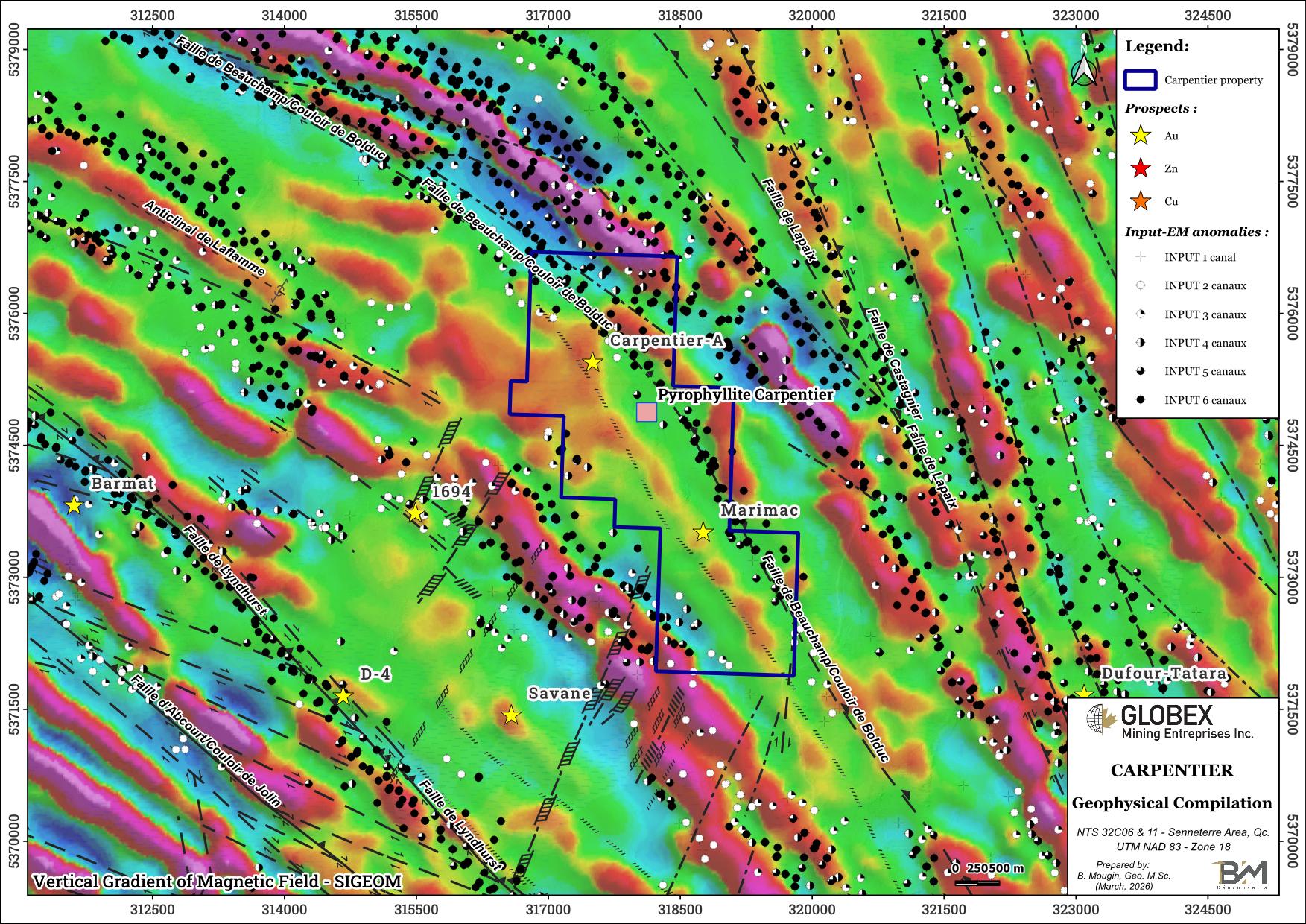
A few historical drill holes have successfully tested structures parallel to the Bolduc deformation zone, such as drill hole 43-96-34 which returned a gold intersection of 1.23 g/t Au over 10.3 meters, including 7.4 g/t Au over 1.5 meters (Carpentier-A showing) within a QFP dyke similar to the intrusion observed at the Marimac showing. Further work is recommended including new magnetic and induced polarization surveys covering the sheared contact between the upper Figuery Group and the Amos Group.
Québec Pegmatite is currently developing the Swanson Project which englobes Globex’s royalty claim toward advanced exploration stages. The results of the 2024 MRE illustrate that the Project has reasonable prospects for eventual economic extraction and sufficient merit for further exploration work and engineering studies.
In Q4 2025, a 7,500-metre drill program and accompanying twin-hole program were launched to support an upcoming comprehensive Preliminary Economic Assessment (PEA). The PEA is designed to confirm an open-pit, near-term production scenario focused on high-grade, near-surface material from the Swanson Deposit (Company website, March 2026).
Before commencing the PEA study, Québec Pegmatite should complete a bulk sampling program, including the metallurgical testwork at a designated mill.
The Swanson Gold Project is accessible by both road and rail, with several nearby gold mills. The project includes multiple gold-bearing target zones as the Swanson Gold Deposit, Bartec, and Jolin.