
Deane Cadillac
Location, Access, Description
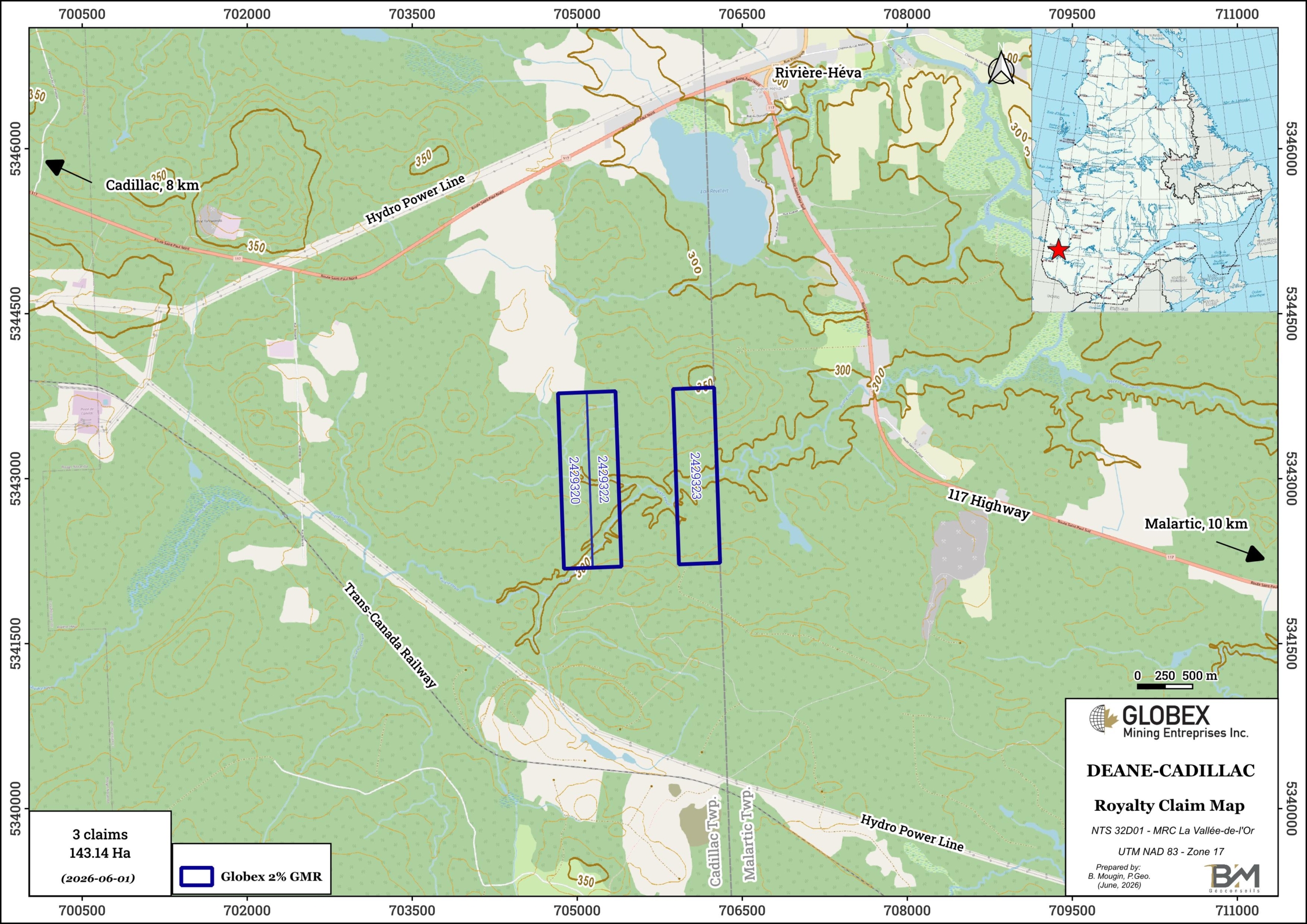
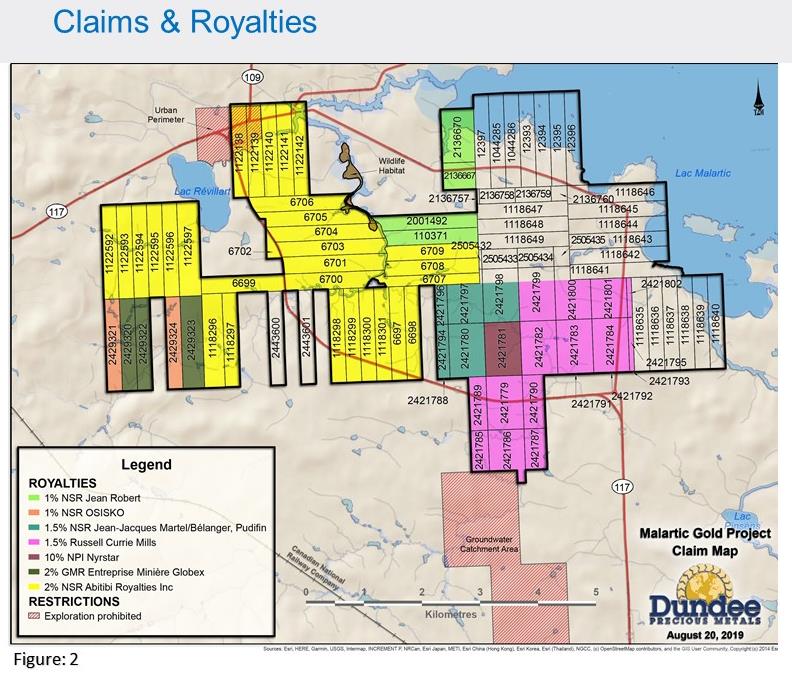
The Deane Cadillac property consists of 3 mining claims covering an area of 143.14 Ha in Cadillac township, northwestern Quebec, approximately 35 km west of Val-d’Or (Qc) and 57 km east of Rouyn-Noranda (Qc). The claims belong to Dundee Precious Metals inc. and Mines Abcourt inc. and Globex will retain a 2% Gross Metal Royalty (GMR) from any future production on these 3 specific claims.
The property is centred in a well-developed mining region with many resource industry support facilities and services. The towns of Rouyn-Noranda, Val-d’Or and Amos have populations of between 25,000 and 60,000 and are well known for their mining history. The region is associated with several active mines and numerous exploration companies. A full range of infrastructure, service companies, and experienced human resources are available in most nearby communities including Val d’Or, Malartic, and Rouyn-Noranda.
The project is readily accessible by national highway 117 and a high-quality rural road network. Two regional airports, located in the cities of Rouyn-Noranda and Val d’Or, provide regular connection with the main centers of the province (Montreal and Québec City). The Property also benefits of the proximity of two high voltage power lines and the Trans-Canada Railway.
Geology and Mineralization
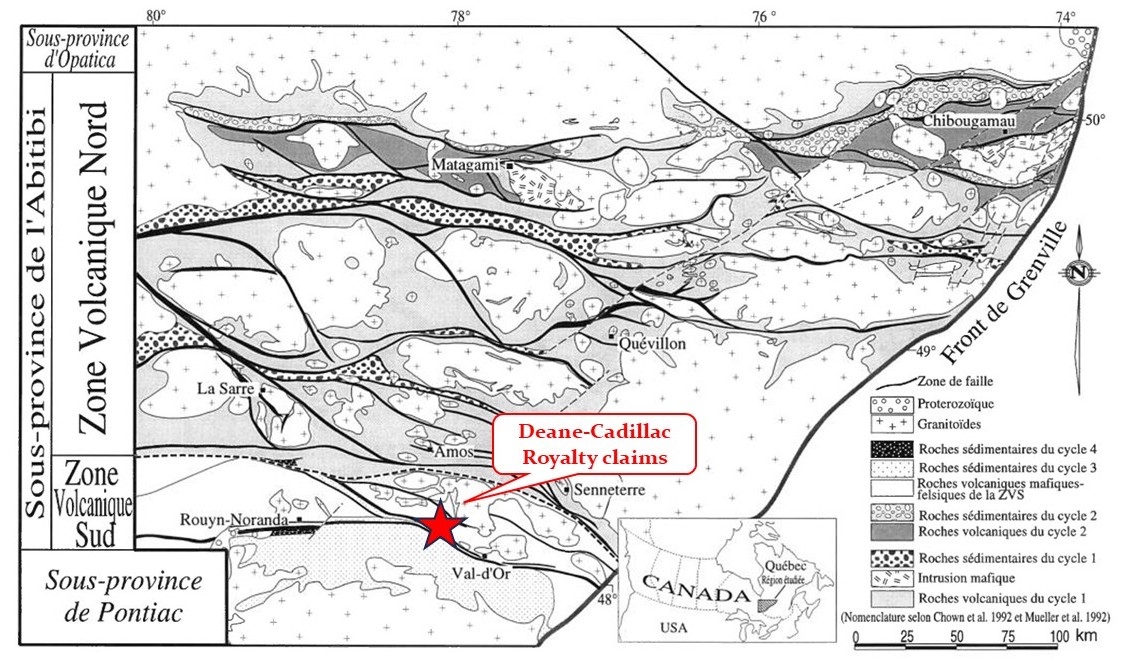
The Deane-Cadillac property is located 1 km north of the contact between the Abitibi and Pontiac subprovinces, separated by the Cadillac–Larder-Lake Deformation Zone (CLLDZ). The Abitibi Subprovince is an Archean greenstone belt which hosts some of the richest mineral deposits of the Superior Province whose total endowment, including Production, Reserves and Resources is estimated to be > 9,375 t Au (Dubé and Mercier-Langevin, 2020).
Volcanic and sedimentary rocks of the Cadillac area form a series of east-west-trending steeply dipping monoclinal panels. Sedimentary rocks, mainly wackes, of the Pontiac Group lie south of the CLLDZ. Most of the orebodies in the southern part of the Cadillac mining camp are hosted in rocks of the Piché Group (volcanic rocks interbedded with conglomerates, wackes, graphitic schists and pyritic cherts), which forms a thin band several tens of kilometres long that follows the trace of the CLLDZ (Evans, 2023).
All Archean rocks were deformed and verticalized during the Kenorean Orogeny (2.7 – 2.68 Ga). Regional metamorphism ranges from the greenschist facies to the upper greenschist facies. Non-deformed NE-oriented Proterozoic diabase dykes run throughout the area.
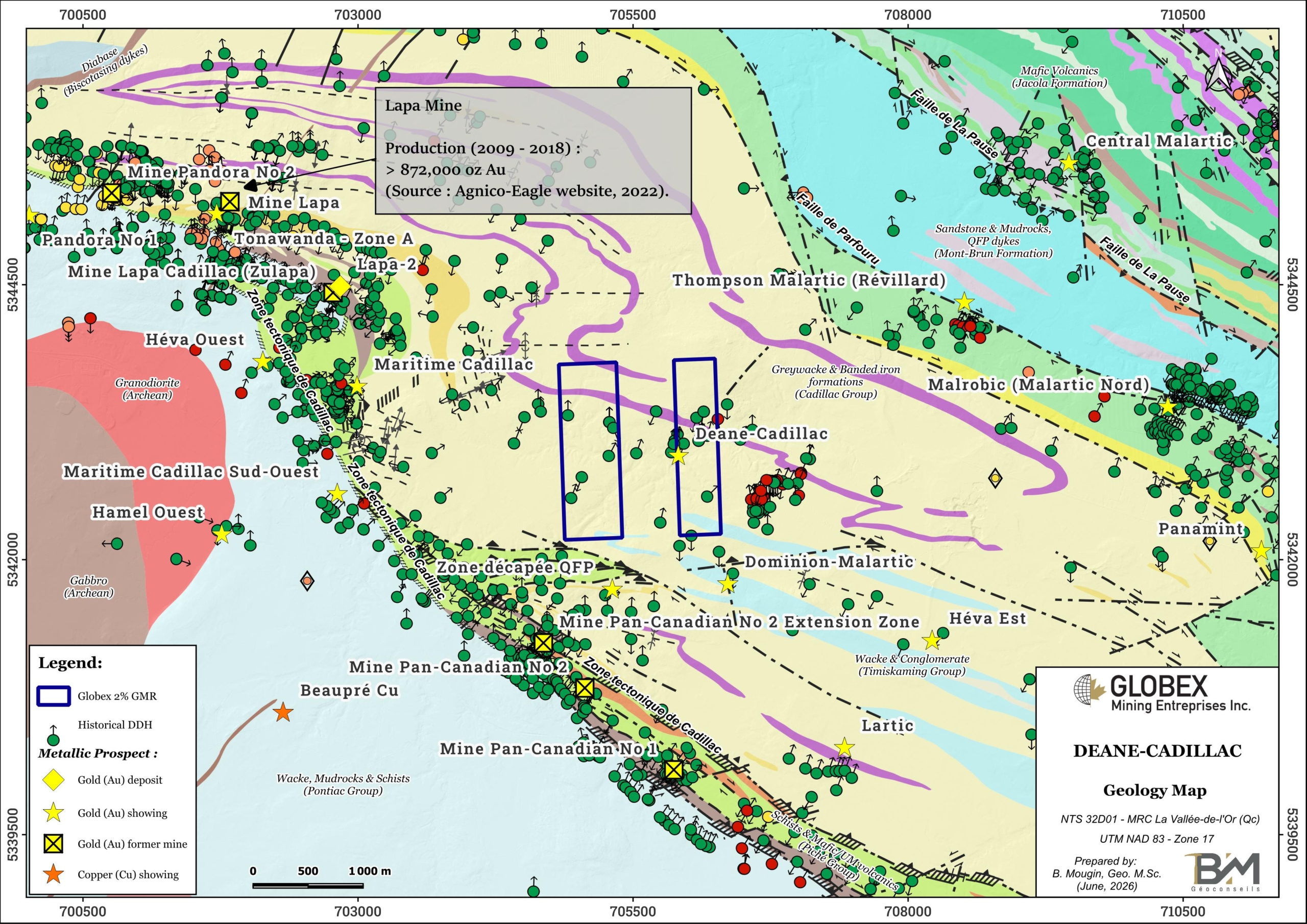
The Deane-Cadillac property is mostly underlain by metasediments of the Cadillac Group which dominantly consists in greywacke with intercalated argillites and oxide-iron formations. Conglomerates of the Timiskaming Group are observed locally. Strong folding has occurred in this area, as visible on historical magnetic data.
The Deane-Cadillac property is located at the heart of one of Canada’s most productive gold mining camps. Most of the gold mineralization in the Cadillac mining Camp is closely associated with the CLLDZ and its subsidiary structures. Approximately 40 gold deposits, which have produced over 60 million ounces of gold since the early 20th century, are associated with this major structure and its subsidiary faults (Evans, 2023 NI 43-101 Technical Report on the O’Brien Project).
The deposits are quartz-lode type, generally consisting of auriferous sulphide-bearing quartz-carbonate shear veins frequently containing free milling gold, disseminated pyrite haloes to the veins in shear zones and related structures and to a lesser extent, veins in extensional fractures, structural zones, and breccias. In general, the wallrock is well foliated and has a distinctive dark brown to brownish grey colour due to intense biotite alteration; wallrock alteration ranges from several centimetres to over a metre thick (Evans, 2023). Generally, zones of biotite alteration accompanied by silicification and sulphidation will yield gold values.
The Deane-Cadillac gold showing was discovered in 1930 by surface prospection. Mineralization consists of quartz-carbonate (±tourmaline) veins containing disseminated sulphides hosted in the sheared greywackes of the Cadillac Group. Intersections up to 3.43 g/t Au over 0.8 m and 19.5 g/t Au over 0.3 m returned from historical drilling (GM 00689). In addition to this showing, the property hosts another vein zone that has been tested by a trench over a length of more than 70 m.
History
The Deane-Cadillac showing was tested by DDH in 1946 ; borehole BM-12, drilled by Border Malartic on Lot 58 on the north bank of the Héva River, intersected an interval grading 3.43 g/t Au over 0.85 m (GM 00689).
In 1964, Dumont Nickel Corporation completed 9 drill holes (C-1 through C-9) with a cumulative length of 970.58 m. During this drilling campaign, a second significant gold intersection of 19.5 g/t Au over 0.3 m was intersected by drill hole C-9 (GM 15093). Mineralization consists of quartz veins containing pyrite and arsenopyrite, hosted within fine- to medium-grained greywacke. Locally, chalcopyrite grains are disseminated in both the greywacke and the sheared feldspathic porphyry. DDH C-1A intersected an iron formation that returned (28.7% Fe / 12.8 m). The same hole intersected 5.48 g/t Au over 0.3 m in the contact zone between an acidic tuff and an iron formation both intercalated within the grauwackes.
In 1983, Americ Mine Ltd. completed 7 boreholes on the two adjacent parcels located east of Parcel 58. Among these, drill hole (AM-2) was drilled at the eastern boundary of Lot 58, approximately 345 m south of the Héva River (GM 41595). This drill hole was drilled to test a VLF-EM16 anomaly, which was interpreted as a weakly mineralized shear zone affecting grauwackes.
A total of 21 DDH (3,149 meters) have been drilled on the Deane Cadillac property by previous owners between 1945 and 1983.
Recent work and developments :
In 2016, Globex carried out geological mapping and grab sampling on the Deane-Cadillac property, as well as compilation of historical work (GM 69781). Compilation of diamond drilling data highlighted some gaps in the sampling of historical DDH, with unsampled intervals.
The property was then sold to Khalkos Exploration inc. (now Pershimex Resources Corp.) with inclusion of a 2% GMR. Dundee Precious Metals inc. (DPM) in partnership with Pershimex have carried out some exploration works on the Malartic project. Between 2017 and 2019, DPM carried out historical drilling compilation, geological mapping and grab sampling, relogging and resampling of historical core, soil and till sampling programs, magnetic (Mag) and induced polarization (IP) surveys (GM 71764). Subsequent DDH intersected significant gold anomalies, but outside Globex’s royalty claims.
Resources and Potential
Past exploration of the Deane-Cadillac property demonstrated a favorable environment for lode gold mineralization. The Globex’s 2% GMR claims are now held jointly by Dundee Precious Metals and Abcourt Mines as part of the Malartic gold project.
As observed at the Lapa Mine, the units of the area of the Deane-Cadillac property are affected by strong folding. Further exploration should look more thoroughly at secondary structures and fold hinges which are known to concentrate sulphide mineralization.