
Des Herbiers Plus
Location, Access, Description
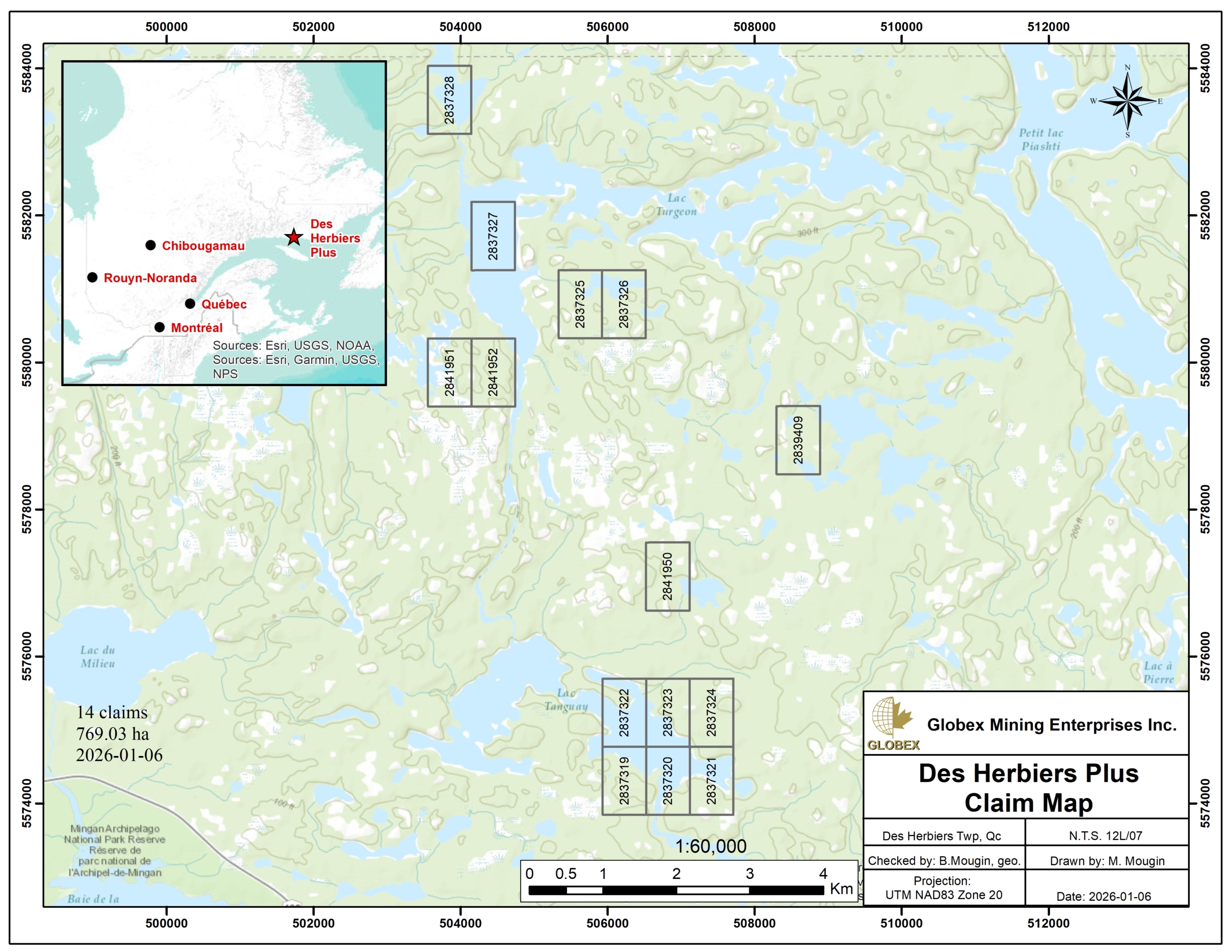
The Des Herbiers Plus Property is composed of 14 non-contiguous claim cells comprising 769.03 hectares in the Cote-Nord administrative region of Quebec Province. It is located about 50 km east of Havre-Saint-Pierre (Qc), and 5 km north of Baie-Johan-Beetz (Qc). The claims are 100% held by Globex and are not subject to any royalty or third-party interests.
Access to the property is easy along highway 138 from Montreal to Natashquan and then travelling on tractor roads. Topography is comprised of flat lying areas with bogs and low-lying hills. Access is also possible by helicopter or seaplane ; a hydrobase is located in Baie-Johan-Beetz and a regional airport is located in Havre-Saint-Pierre. A high-voltage power line runs at the southern edge of the property.
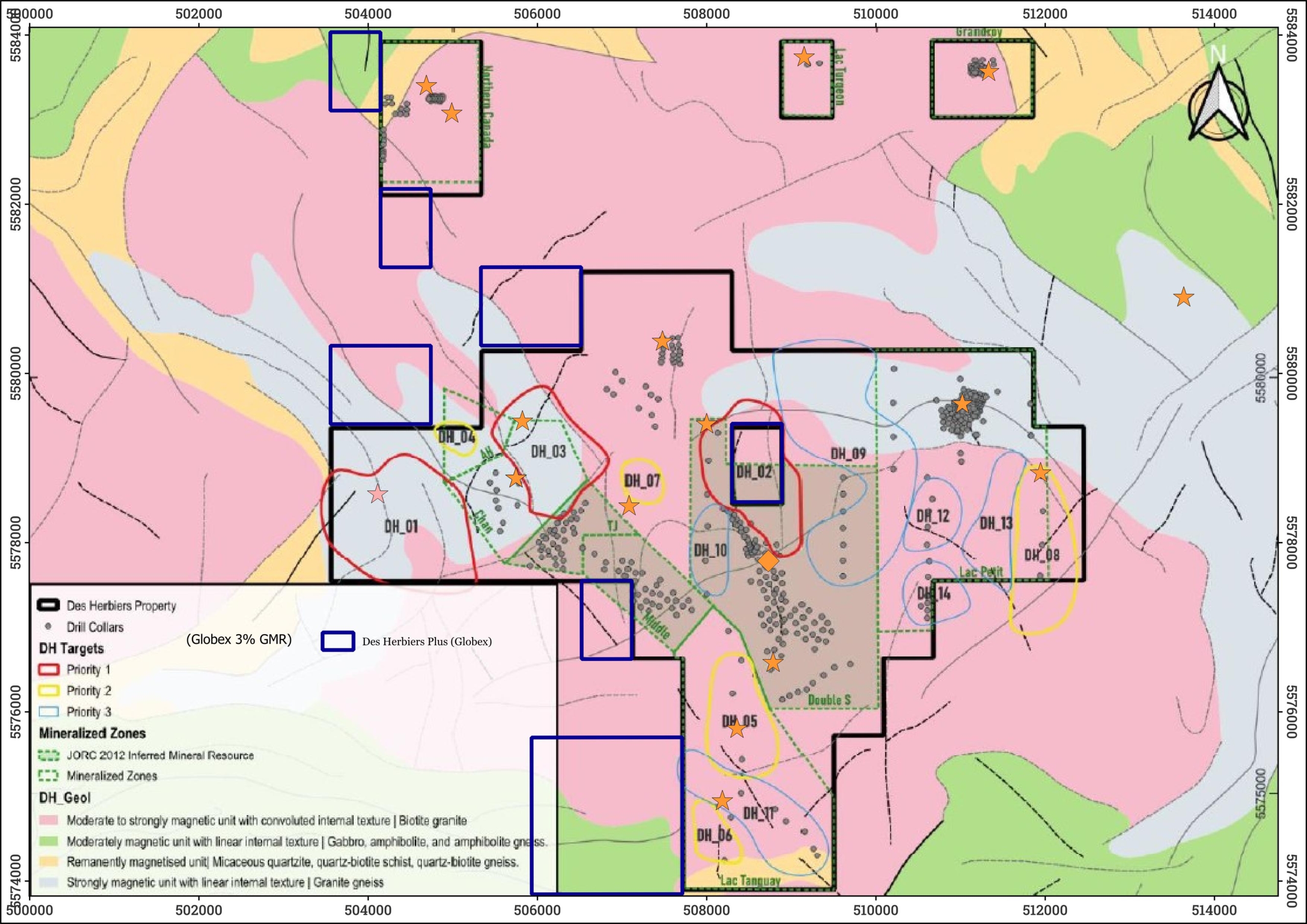
The area is essentially explored for uranium mineralization. A JORC 2012 Inferred Mineral Resource of 162 Mt @ 123ppm U3O8 is estimated on the adjoining Des Herbiers property of Infini Resources Ltd., on which Globex retains a 3% GMR.
Geology and Mineralization
The Des Herbiers Plus property belongs to the southern Allochtone unit of the Grenville Province of the Canadian Shield. The Allochtone is composed of rocks from the Paleoproterozoic to Mesoproterozoic era (1.6 to 0.985 Ga). Regional metamorphism is high grade, ranging from the upper amphibolite facies to the granulite facies (Moukhsil et al., 2013). Archean rocks underwent deformation during the Kenorean (D1) and Grenvillian (D2) orogenies. The Grenvillian orogeny generated isoclinal folds and NE-trending mylonitic deformation corridors. The Manicouagan impact also created a network of faults and a radial structure around the impact site (Moukhsil et al., 2013).
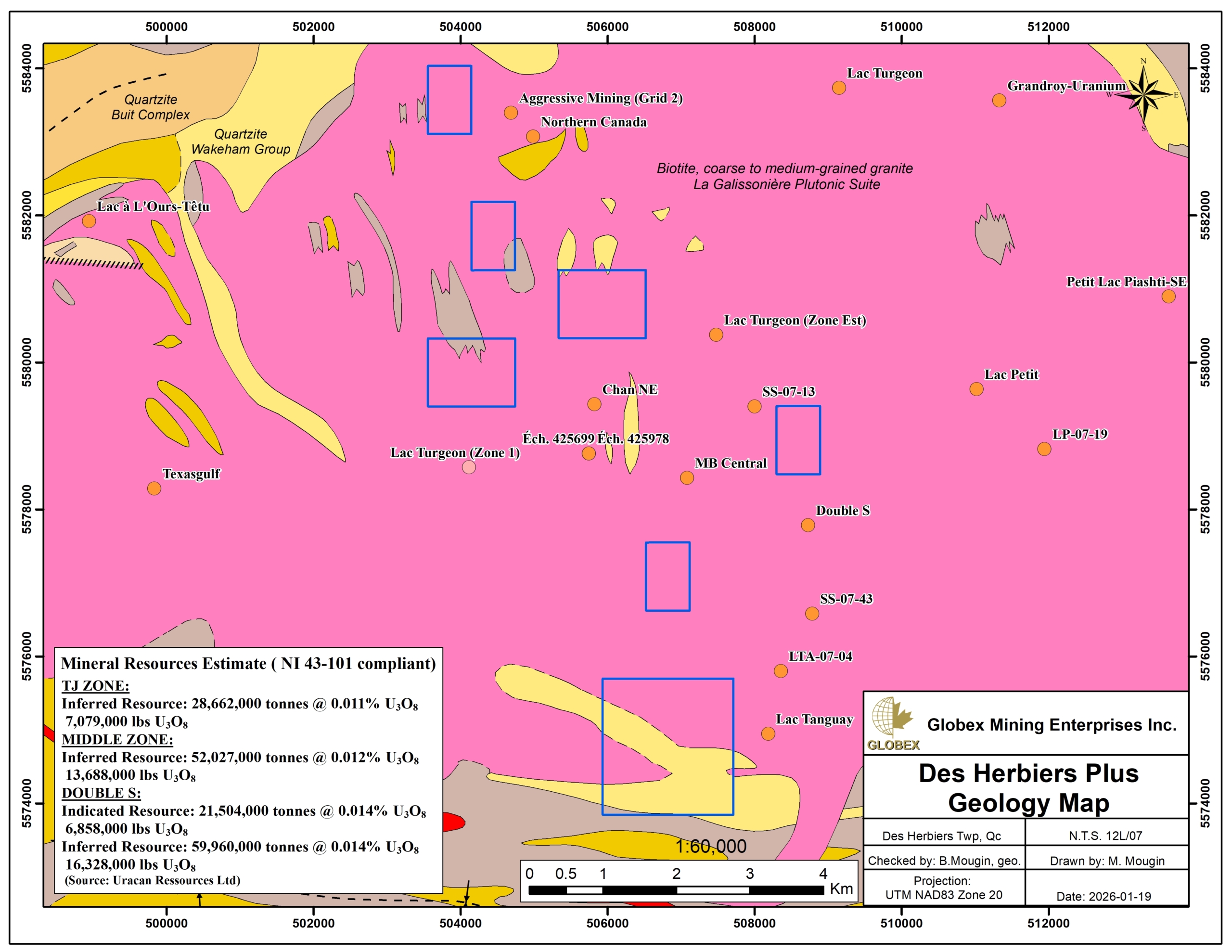
The local geology consists of granites, quartzites, gabbros, gneisses and metamorphosed sediments. Granitic rocks in the region are true granite, varying in colour from white to pink and granularity varying from very fine to medium-grained granite to extremely coarse-grained, very heterogeneous pegmatitic granite and pegmatite. The rocks underlying the immediate area of the property are comprised of biotite rich granitic rocks (La Galissonnière felsic Suite), quartzites and quartzo-feldspathic gneisses that are derived from strongly metamorphosed sandstones and arkoses (Wackeham Group), amphibole rich (ouralite) gabbros and gneisses (Robe Noire mafic Suite). Regional structures trend north to northwest.
Despite no metallic showing has been uncovered yet on the Des Herbiers Plus property, the area is underlain by geological units susceptible to contain significant uranium, REE, Thorium, Cesium and Niobium mineralisation of economic interest. The mineralization occurs in veins and disseminations linked to pegmatites, granitic gneisses and in meta-sedimentary rocks. As well as porphyritic granitoids carrying copper-gold and copper-molybdenum mineralization. Best intersections in historical work in the area of the Des Herbiers Plus property are presented in the table below :

Best intersections from historical work in the area of the Des Herbiers Plus property.
History
The region has been explored since the early 20th century. Feldspar pegmatites have been known in the Johan Beetz Bay area for many years and were mined in 1923-24. The Quebec Government mapped the area in 1957 (RG074) and 1973 (DP128). The discovery of uraninite and pitchblende in pegmatites of the Turgeon Lake Intrusive Complex (now labelled Suite felsique de La Galissonnière) in 1967 precipitated a major staking rush by a large number of junior companies.
The region has also been prospected for copper, then for silica, beryl, micas (Spar Mica mine in the 1950s) and fluorite, as well as for uranium in the 1960s and 1970s. SOQUEM explored the area’s potential for rare earth elements (REE), particularly a pegmatite dyke described as containing U, Th, Ce, and Y in 1988. Feldspar and quartz were mined along the coast.
The majority of historical work was centred around the Double S Zone, Middle Zone and TJ Zone. Limited diamond drilling was also conducted at Chan, Lac Tanguay, Lac Petit, Grandroy and Northern Canada Zones.
In 1976, Urangesellschaft Canada Ltd. undertook geophysical and soil geochemistry surveys, as well as 18 holes (1,772 feet) of percussion drilling on the Des Herbiers Plus property (GM32642). The best intersection obtained was 0.061% U308 over 49 feet in hole CZ-9, in the central part of the Turgeon Zone.
Uracan Resources Ltd conducted grab sampling, channel sampling along with extensive drilling between 2007 and 2009. Uracan reported a uranium mineral resource for TJ Zone, Middle Zone and Double S prospects during the 2008-2011 period using the Canadian Standards NI 43-101 (Uracan Resources Ltd., NI43-101 Technical Reports filed on the Canadian Securities Administrators SEDAR filing system on 21 August 2008, 9 April 2009, 11 June 2009, 24 June 2010 and 15 August 2011) :

Summary of Uracan JORC Mineral Resource Estimates between 2008 and 2011.
Recent developments :
In 2022, Brunswick Exploration conducted an exploration campaign on the Baie Johan Beetz property (which englobed Globex’s current Des Herbiers Plus property) with the objectives of determining the attitude and potential volume of the pegmatite bodies and verifying the presence of lithium (GM73226). No lithium enrichment vector could be detected.
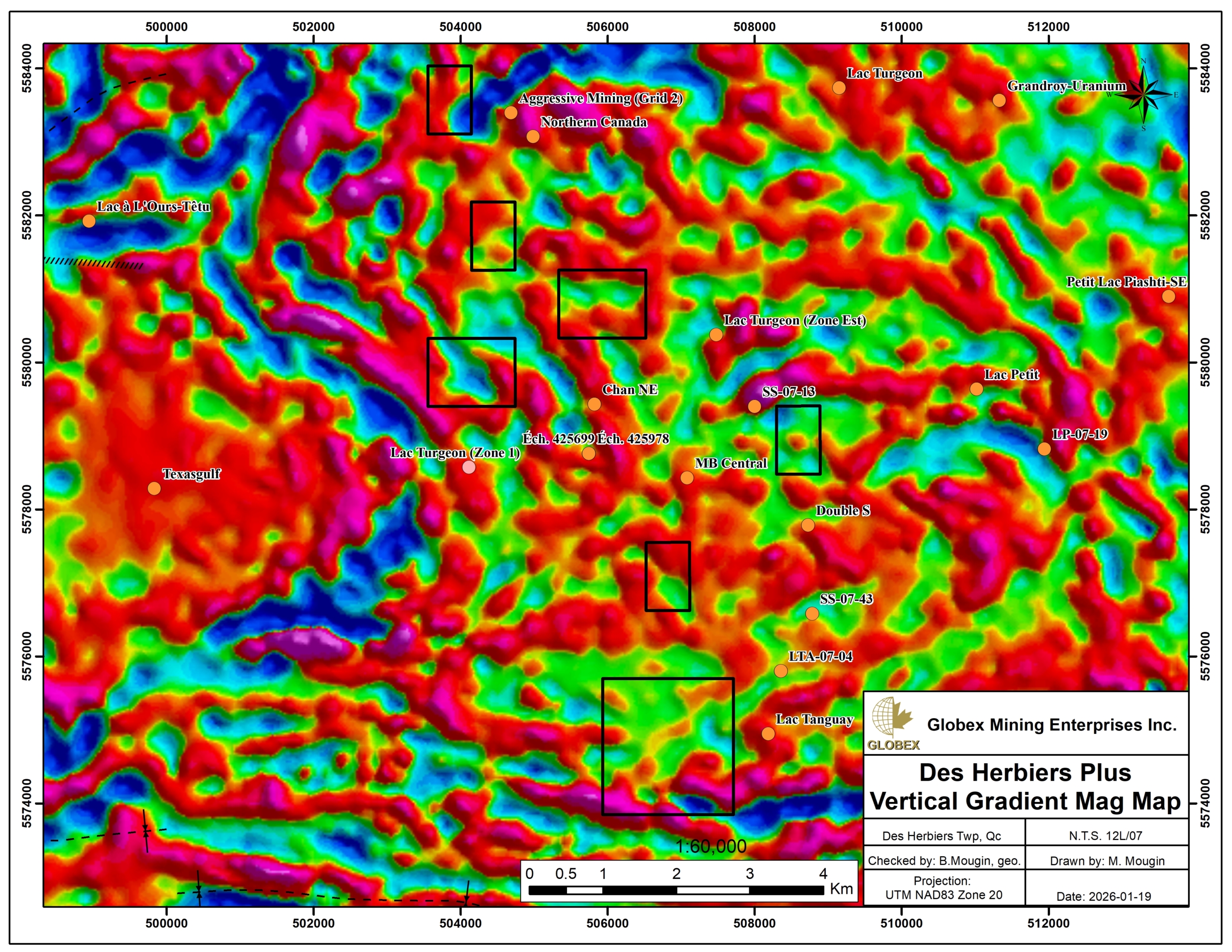
In 2023, the region was flown with a high-resolution Airborne magnetic and spectrometry survey conducted by Quebec MRNF (DP2023-02).
The same year, Infini Resources undertook re-interpretation of both airborne magnetic and radiometric data of 2023, and of historical diamond drilling on their Des Herbiers property (GM74064) which englobes Globex’s Des Herbiers Plus property. The re-processing and re-interpretation of the airborne magnetic and radiometric data provided a higher resolution dataset that mapped the complex geology and structure in detail. The reinterpretation using geophysical data combined with the integration of structural controls, surface geological data, diamond drilling and surface geochemical data outlined 14 new target areas.
Resources and Potential
Historical exploration and drilling (> 50,000 metres in more than 400 drill holes) in the area have revealed an abundance of low grade, near surface, bulk tonnage uranium. The Des Herbiers property holds potential to further develop the known mineralized zones, as well as to discover new mineralization. The field and geophysical observations suggest that the large Suite felsique de La Galissonnière remains the priority target.
The area of the Des Herbiers Plus property is also underlain by geological units like porphyritic granitoids, susceptible to host copper-gold and copper-molybdenum mineralization. Exploration is still active in this area ; Infini Resources is currently working on completing a detailed evaluation of historical exploration work undertaken on the Des Herbiers Project with a view to expanding the current resource.
Future developments could indicate continuity of mineralization at Des Herbiers on the Des Herbiers Plus property and encourage Infini Resources to acquire the claims.