Eagle Mine
Location, Access, Description
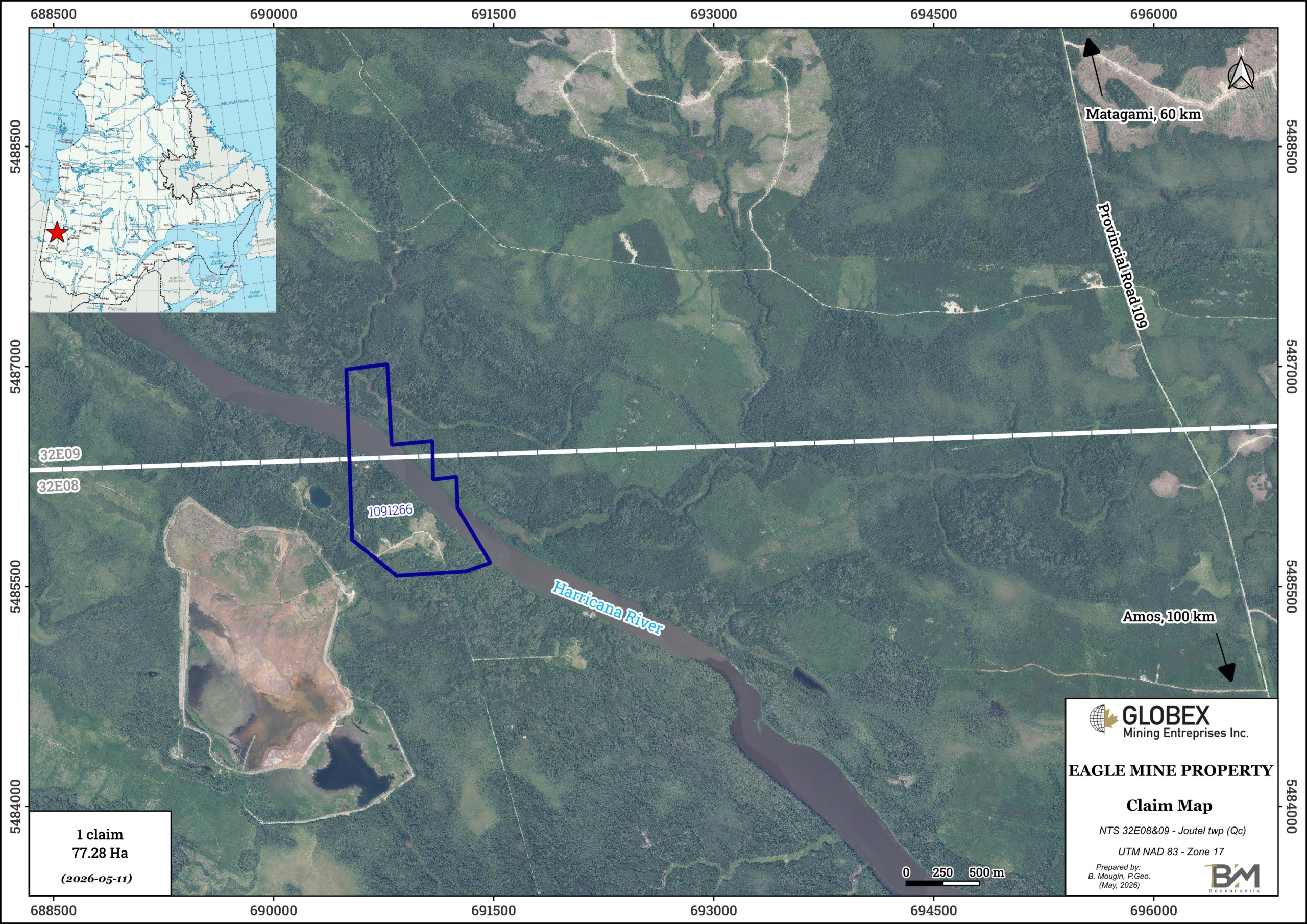
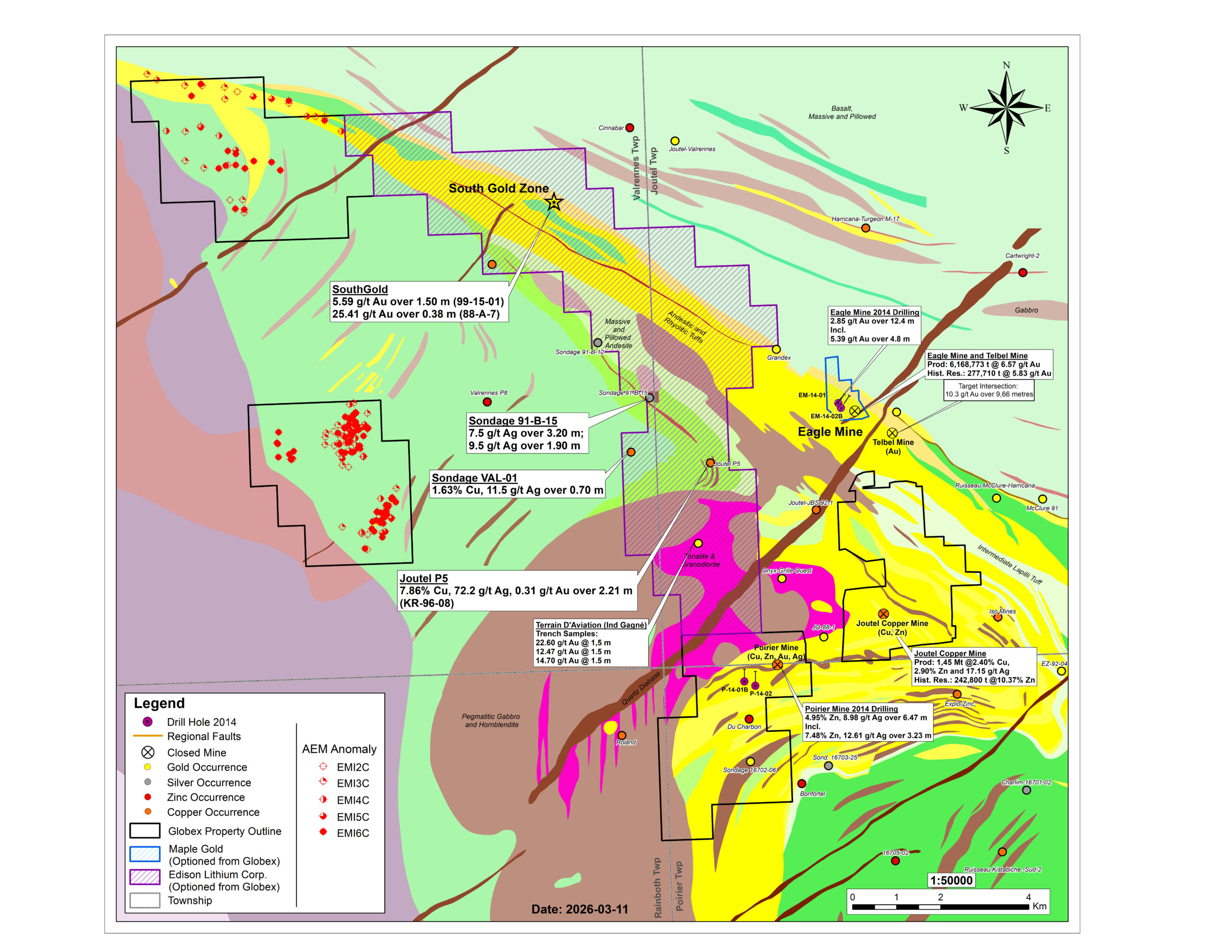
The Eagle Mine property is located in Eeyou-Istchee James Bay Territory (Qc), a few kilometers west of the former Joutel mining town. The property consists of 1 mining claim covering 77.08 Ha which corresponds to the former Eagle Gold Mine mining concession. The property is easily accessible by Provincial Road 109 connecting Amos to Matagami as well as by an all-weather gravel road.
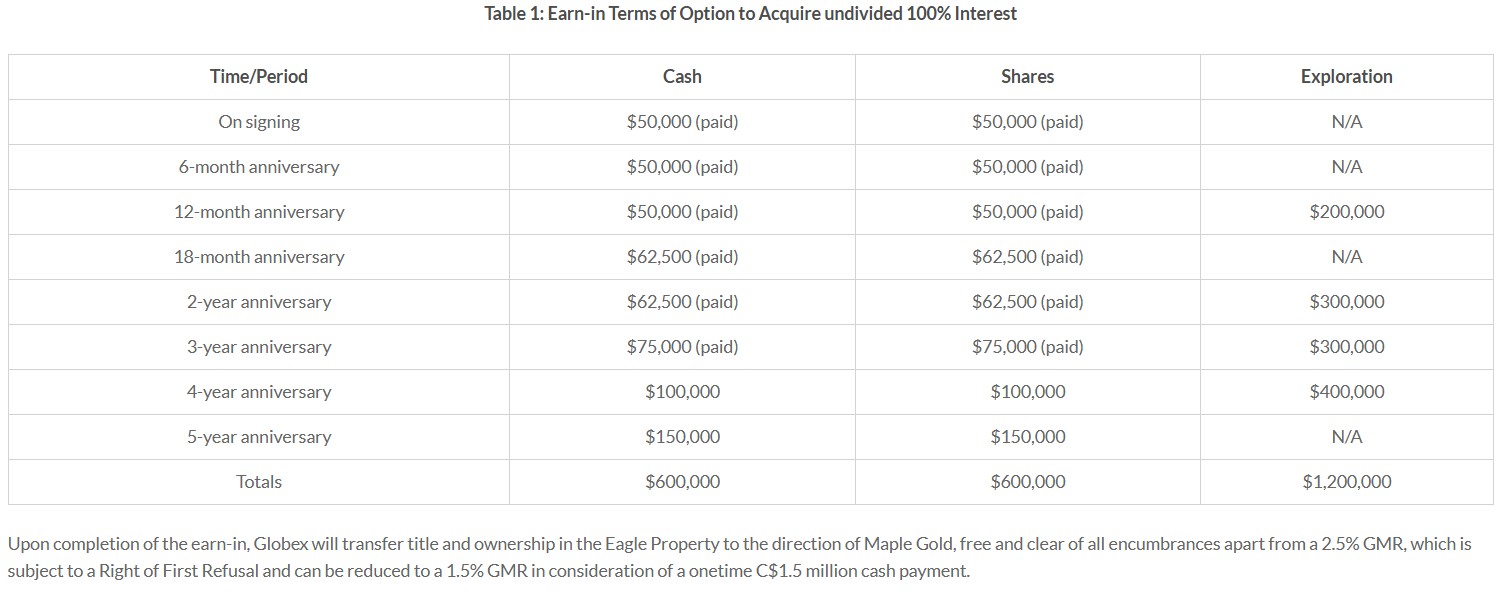
In 2021, Maple Gold entered into an option agreement with Globex Mining Enterprises Inc. (“Globex”) to acquire a 100% interest in the Eagle Mine Property. After Maple completes the option agreement commitments Globex will retain a 2.5% Gross Metal Royalty (GMR) on the Eagle Gold Mine property subject to a one percent GMR buyback for $1,500,000 prior to commercial production :
Skilled labour, equipment providers and contractors who are able to facilitate exploration activities are abundant in the area, being available in Matagami, Amos, Val-d’Or, or Rouyn-Noranda. Adjacent to highway 109, is a set of high-voltage power lines running between Amos and Matagami.
Geology and Mineralization
The Joutel mining camp is located in the western part of the Northern Volcanic Zone (Chown et al., 1992) of the Abitibi Subprovince of the Archean Canadian shield. Regional geology of the Joutel area is composed of a N-S homoclinal series of bimodal volcanic and volcanoclastic rocks with polarity toward east (Legault and al., MB2000-10). All these rocks are SE-oriented and were verticalized and metamorphosed to the greenschists / amphibolite facies after three major tectonic events during Archean and Paleoproterozoic.
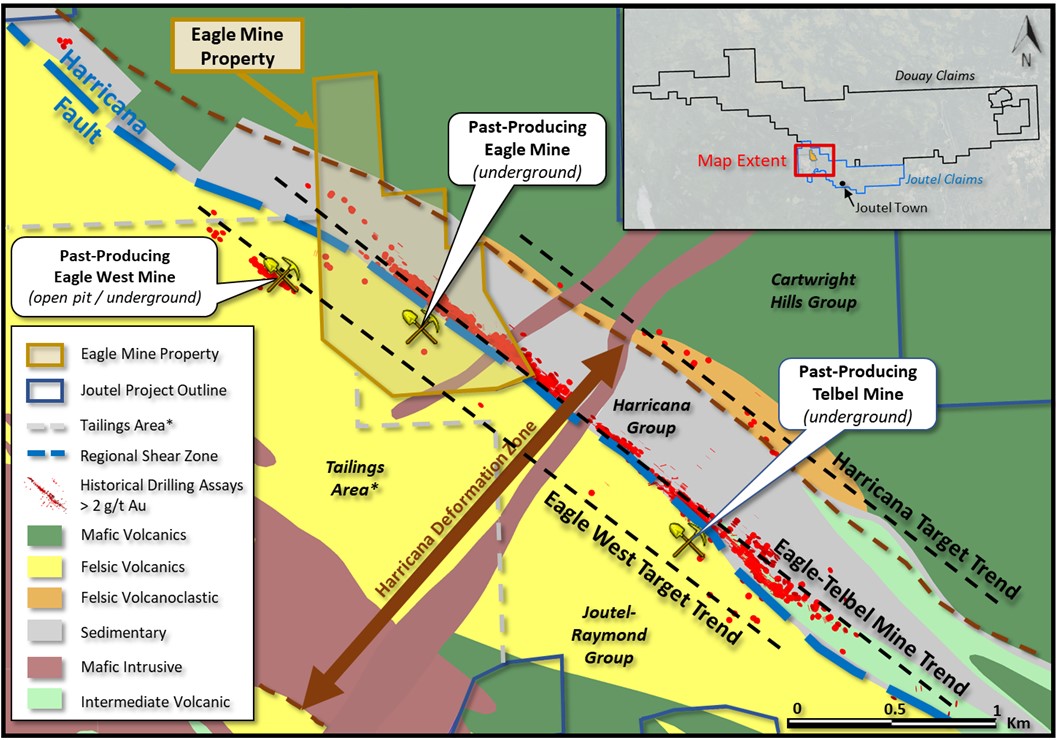
The Eagle mine is located on the north flank of the regional NW-trending McClure-Plamondon Anticline which has folded the thick sequence of dominantly felsic flows and pyroclastics units of the Joutel Formation. The felsic volcanics are unconformably overlain to the north by the thick package of clastic sediments of the Harricana Basin composed of graphitic argillites and greywackes. This major lithological contact also coincides with a major west- to northwest-trending regional, locally auriferous, deformation zone referred to as the Cameron Deformation Corridor extending for tens of km to the west beyond the Ontario border and similarly extends to the east into Desjardins Twp. This deformation zone on the Eagle Mine property affects both the underlying Joutel volcanics and overlying the Harricana sedimentary sequence. The Eagle Mine lies less than 150 m south of this major break.
Archean rocks of the area are cut by NE-trending Paleoproterozoic Biscotasing Dykes.
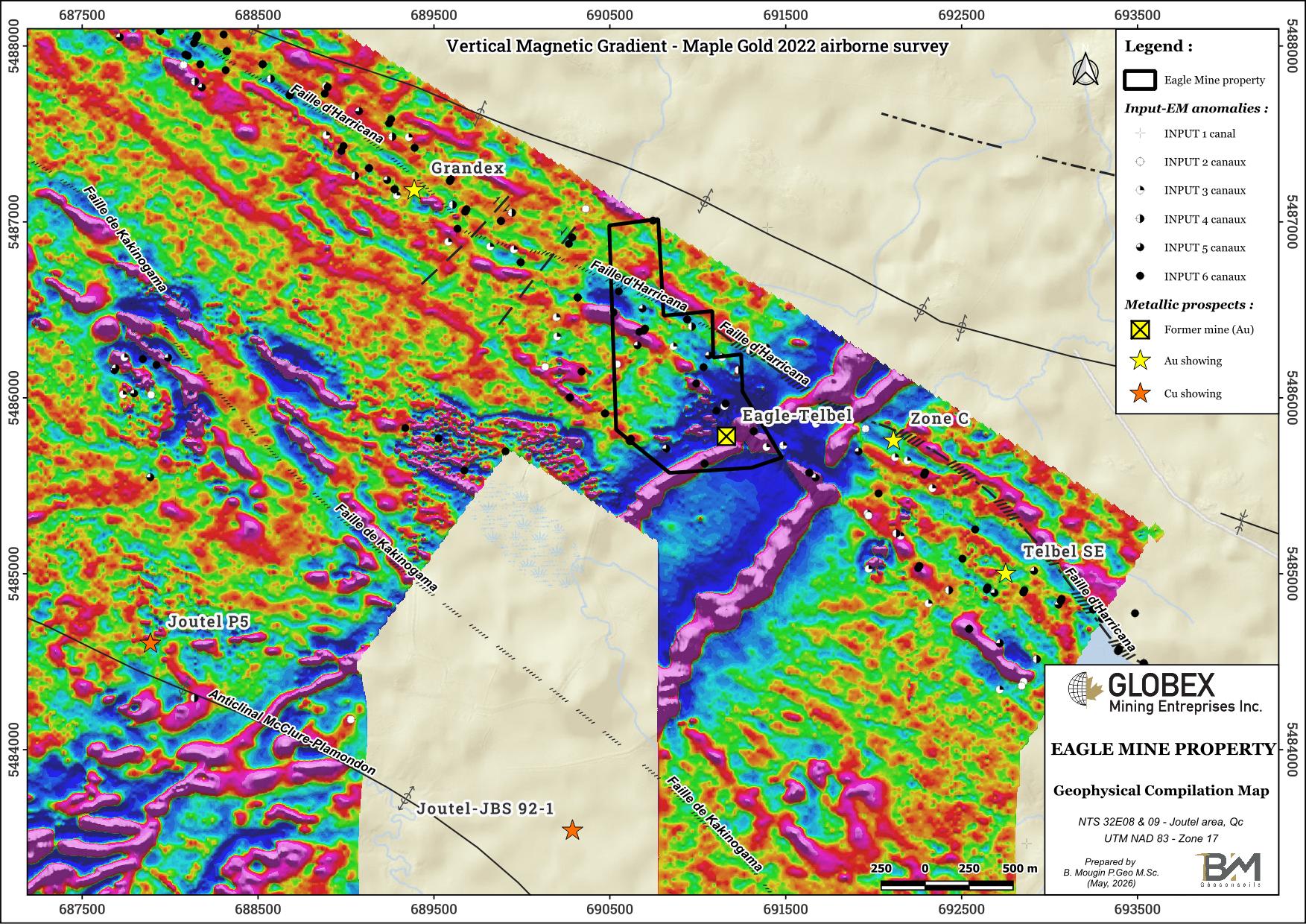
The Kakinogama and Harricana shear zones crosse the entire property in a NW-SE direction and both associated with numerous gold and base metals showings and deposits at a regional scale. The McClure-Plamondon anticline strikes south of the property and it is associated too with base metal mineralization including the former Joutel Copper Mine. The property is surrounded by the synvolcanic Mistaouac Pluton to the west, the Valrennes mafic Complex to the south and by the syntectonic Marest Pluton to the east, each of which could have been a source of mineralized hydrothermal fluids.
Past producing mines in the area include Joutel Formation volcanogenic massive sulphide (VMS) type mineral deposits such as the Globex-owned Poirier Mine (4.39 Mt @ 1.97% Cu, 1.84% Zn, 4.66 g/t Ag*), and the Globex-owned Joutel Mine (1.17 Mt @ 2.16% Cu*) (*production tonnes & grades referenced from L.M. Dubé, 1990, Quebec Ministère des ressources naturelles report ET-90-12, Géologie de la région de Joutel) as well as gold deposits including the Globex-owned Eagle Mine, flanked by Telbel to the east and the West Eagle Pit immediately to the west. All three deposits collectively produced approximately 1.1 Moz of gold from approx. 6.2 Mt, grading 5.8 g/t Au (ref.; Agnico web site History page and Canadian Mining Handbook data from 1974 to 1993).
The gold-bearing zones at Eagle Mine occur in lithologies that are heavily silicified, pyrite-rich, and intruded by ankerite/dolomite veins and veinlets. The felsic tuffs and rhyolites are generally moderately to heavily sericitized (GM 68833). The mineralization consists of pyrite, pyrrhotite, chalcopyrite, arsenopyrite, and disseminated gold. The gold is closely associated with the pyrite.
History
Regional exploration in the area including conventional airborne EM surveys followed by diamond drilling dates back to the late 1950’s. The Eagle Mine had a production shaft that extended to approximately 950 metres, with production by Agnico-Eagle Mines beginning in 1974 before operations shifted to Telbel.
In 1990, Agnico resumed exploration drilling on their property guided largely by results from new IP surveys. This subsequent phase of drilling lead to the discovery of the Eagle West Pit Zone, located 150 m west of Globex’s property. Exploitation of the Telbel/Eagle/Eagle West Pit deposits by Agnico continued until 1993; the Joutel Mining Complex produced approximately 1.1 million ounces of gold (from roughly 5 million tonnes of ore at an average grade of 6.5 g/t Au) between 1974 and 1993. (Agnico-Eagle and Maple Gold websites).
Recent work and developments :
Globex has carried out several diamond drilling (DDH) programs in the Joutel Mining Camp since 2008, as well as a historic work compilation in 2020 (GM71933) and a high-resolution airborne magnetics survey in 2021 (GM72395).
From 2008 to 2015, Globex completed six widely spaced infill and step-out drill holes, including hole EM-14-001, which returned 12.4 m of 2.9 g/t Au from 347 to 359 m downhole, with a high-grade interval of 4.8 m at 5.4 g/t Au. Globex’s drill core from this period, which was later repatriated by Maple Gold, revealed multiple sulfide horizons, with variable iron carbonate and quartz mineralization, primarily within a strongly deformed sedimentary and pyroclastic package. Similar alteration and mineralization were observed within weakly deformed subvolcanic mafic intrusives. This historical data laid the groundwork for Maple Gold’s ongoing exploration efforts.
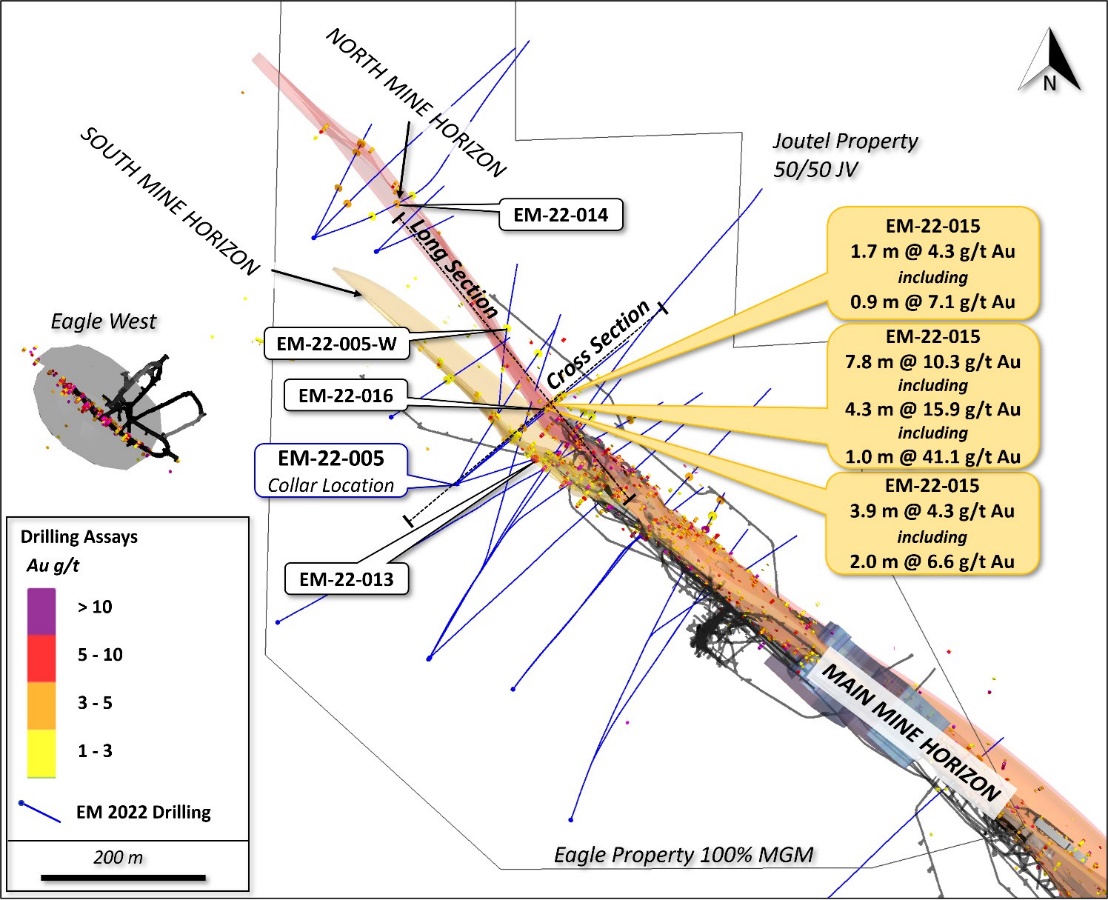
In 2022, Maple Gold completed a compilation of historical data, new downhole electromagnetic (“EM”) survey, and a regional airborne geophysical survey (GM72756). The company then conducted three drilling phases totaling 13,822 m across 28 drill holes (GM73829). Drill holes intersected multiple sub-parallel mineralized horizons of semi-massive to massive sulphides at depth, over significantly greater widths than were previously defined.
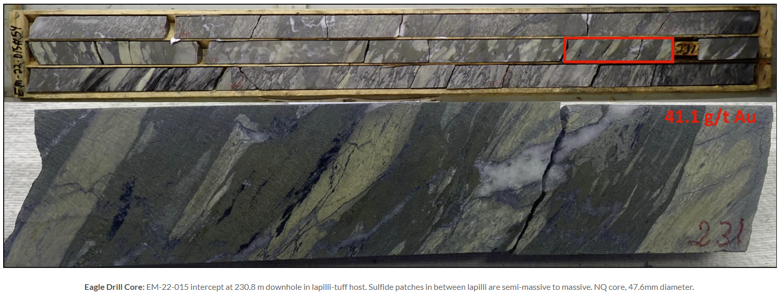
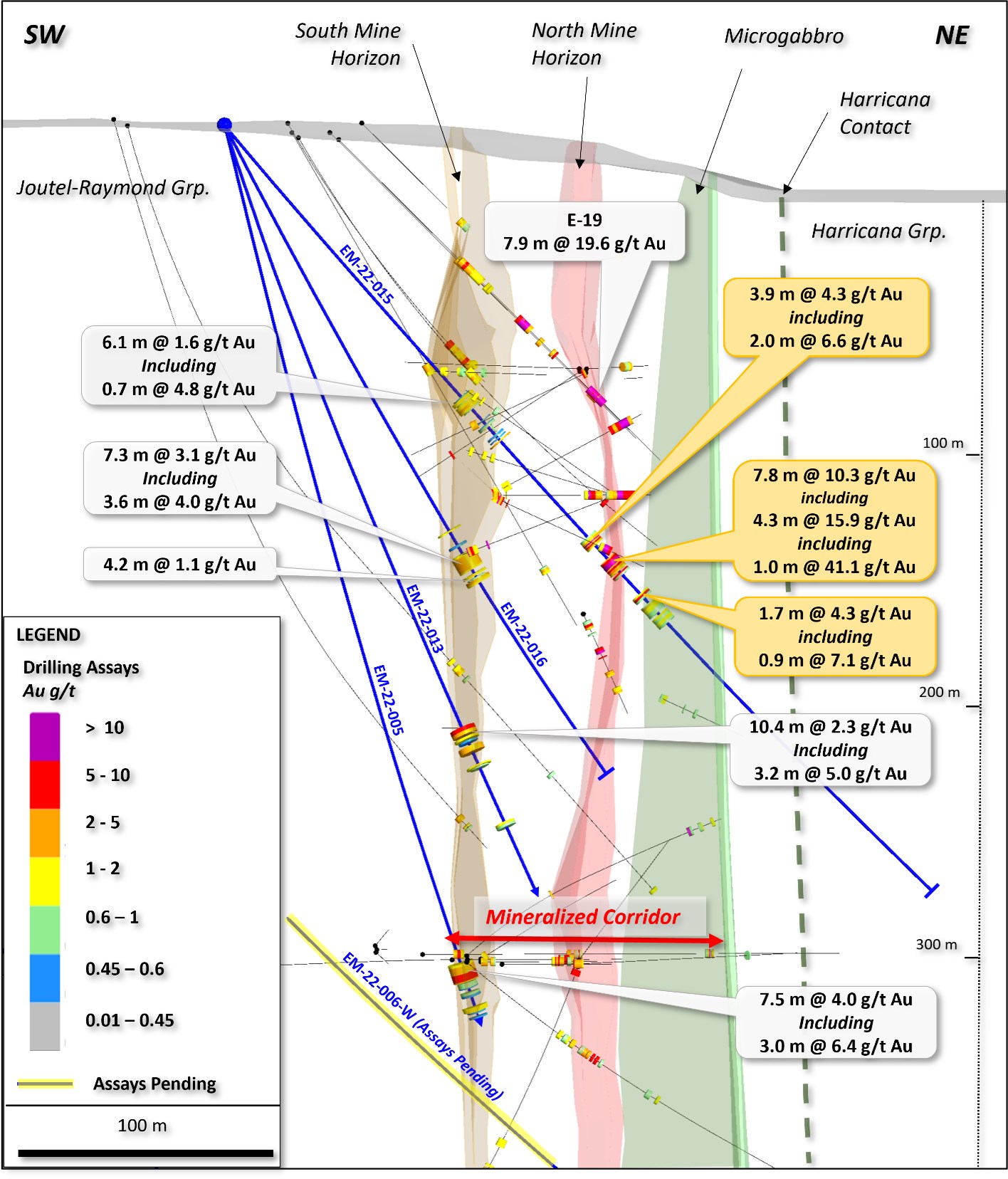
A total of > 45,000 meters across 136 DDH are listed in Sigeom public data on the Eagle Mine property. Best DDH intersections by Maple Gold in 2022 are presented in the table below :
Table 1: Best intersections from Maple Gold 2022 drilling.
| DDH | Au (g/t) | Length (m) |
| EM-22-005 | 4.0 | 7.5 |
| EM-22-009 | 11.4 | 3.0 |
| EM-22-013 | 2.3 | 10.4 |
| EM-22-015 | 10.3 | 7.8 |
| EM-22-016 | 3.1 | 7.3 |
On April 27, 2026, Maple provided an update on a number of projects including the Eagle Gold Mine. Following an inquiry regarding the current updated status of known gold resources specifically as regards Globex’s royalty, Maple provided the following Mineral Resource Estimate (MRE) on the Eagle Mine property :
- Indicated Resource : 500,000 tonnes grading 5.40 g/t Au ( 73,000 oz. Au)
- Inferred Resource : 3,000,000 tonnes grading 4.07 g/t Au (386,000 oz. Au)
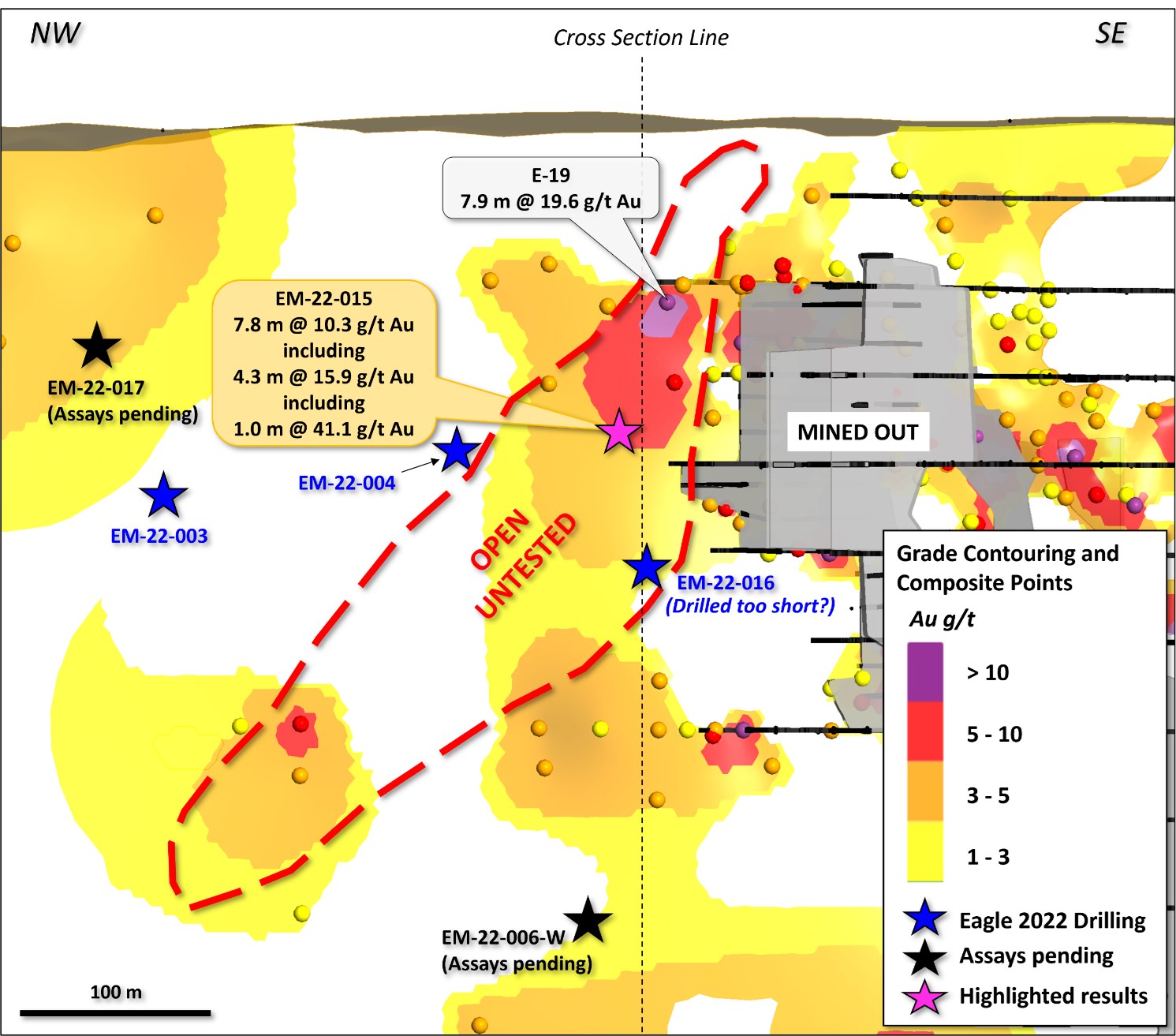
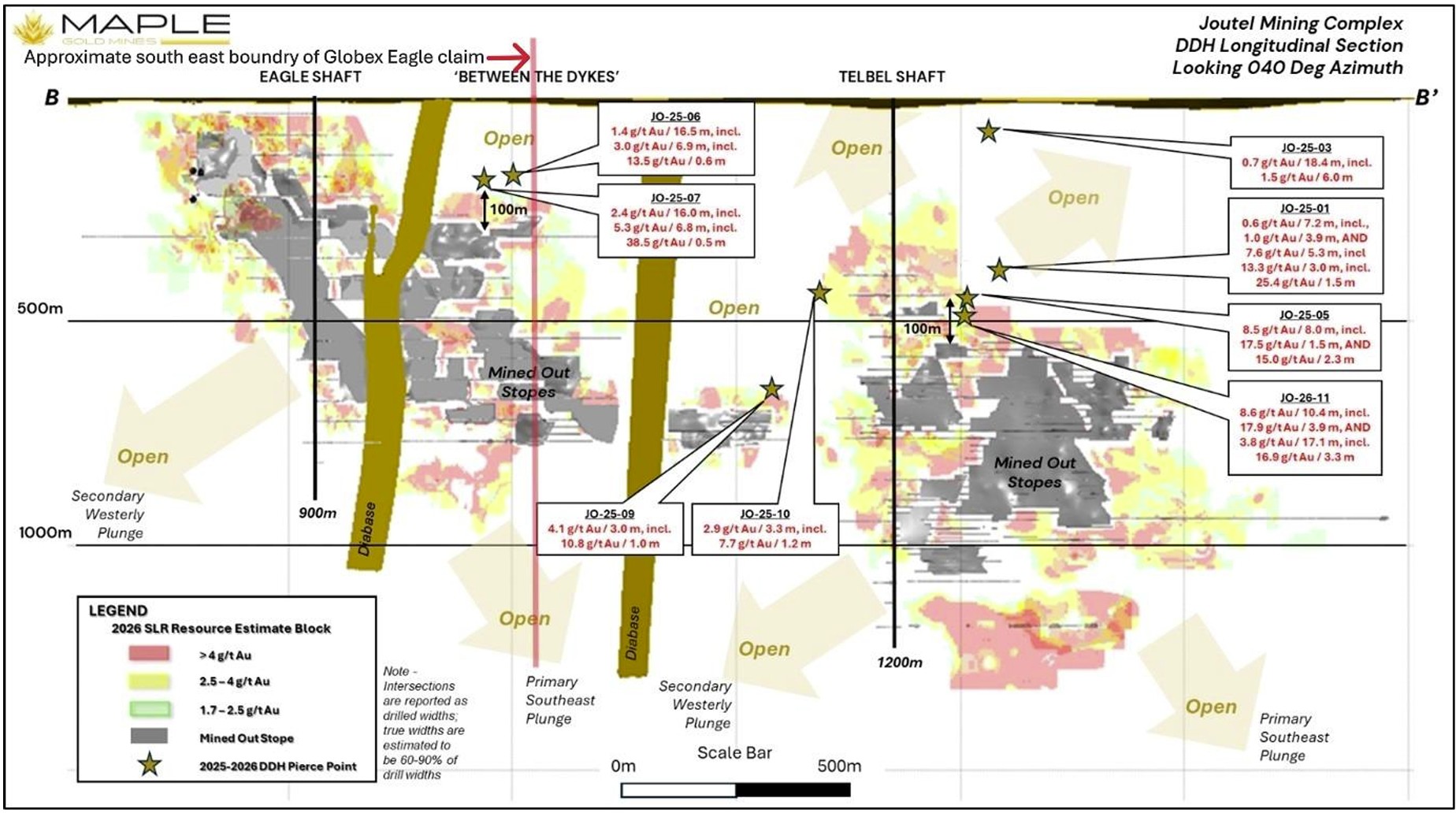
Drilling by Maple Gold in 2025 indicates that the orebody is open both toward surface in certain areas and to depth along strike:
Resources and Potential
Recent work by Maple Gold confirmed the continuity of mineralization and the potential significance of multiple horizons and splays northwest of the former Eagle Mine and supports that multiple sub-parallel gold horizons exist beyond what was historically mined at Eagle.
Maple Gold have expanded target areas along a broader mineralized corridor over a stratigraphic thickness that now exceeds 100 metres in width. There is an apparent concentration of >10 g/t gold starting near surface and extending down-plunge to the EM-22-015 intercepts along the North Mine Horizon, in an area with limited drilling that remains open further down-plunge.