
Electron Lithium
Location, Access, Description
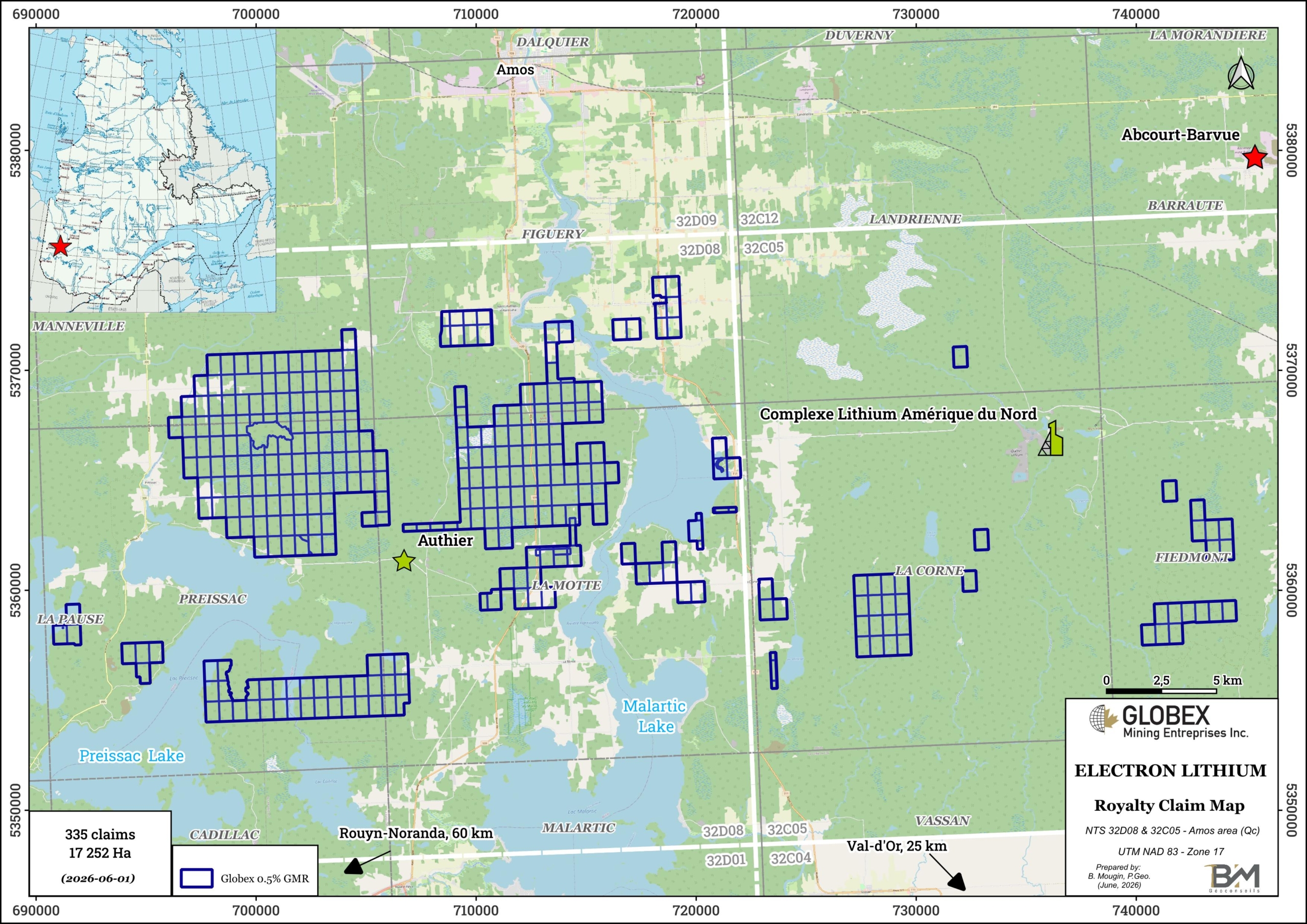
The Electron Lithium property consists of 335 mining claims covering an area of 17 252 Ha south of Amos, Abitibi-Temiscamingue. The property is centred in a well- developed mining region with many resource industry support facilities and services. The towns of Rouyn-Noranda, Val-d’Or and Amos have populations of between 25,000 and 60,000 and are well known for their mining history.
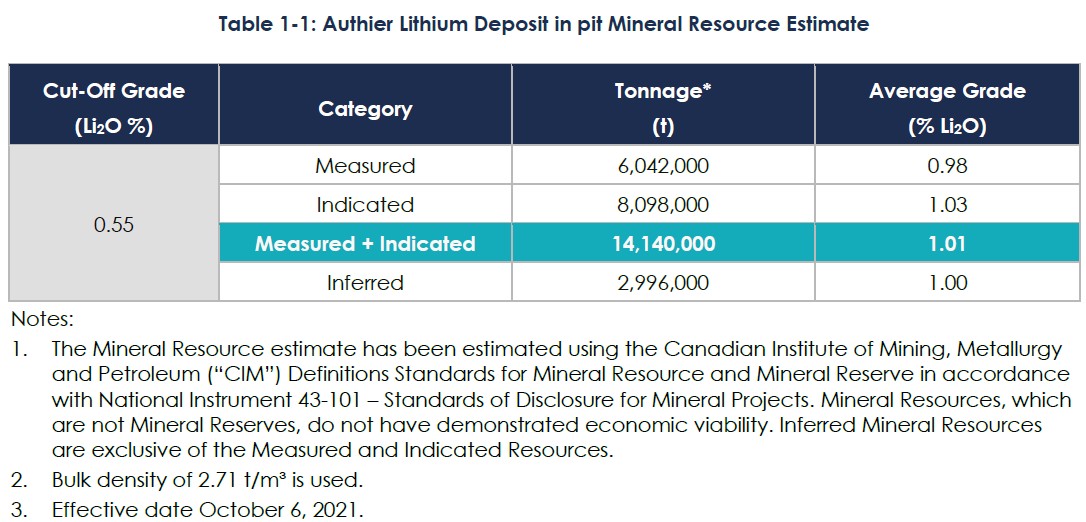
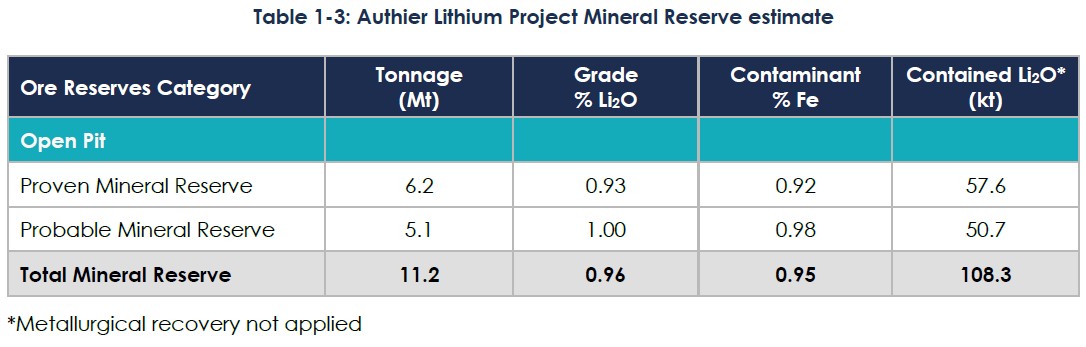
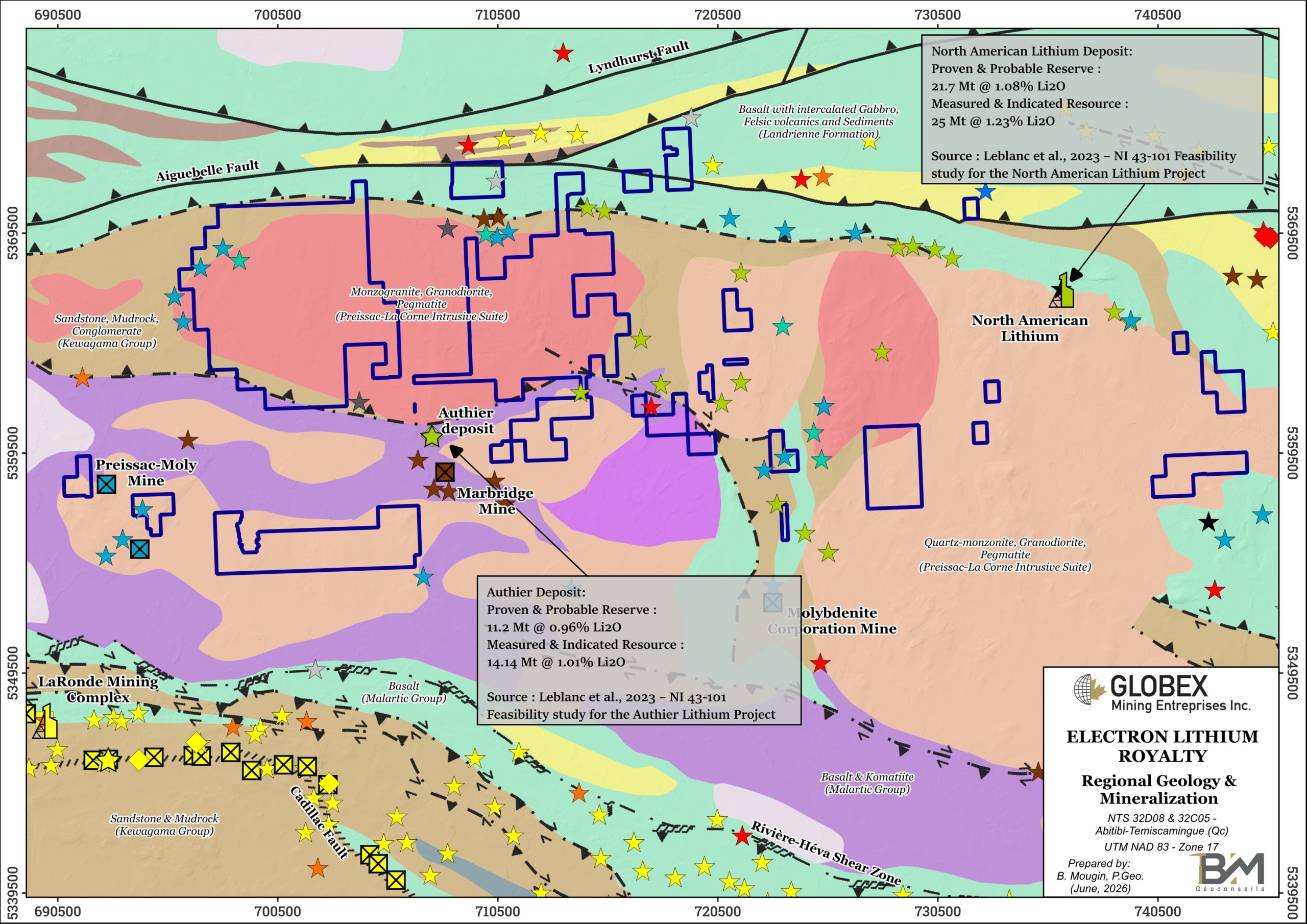
The claims belong to Linear Minerals Corp. and are located within a recognized lithium district : the Authier deposit of Sayona Quebec Inc. hosts Proven and Probable Reserve of 11.2 Mt @ 0.96% Li2O, and Measured and Indicated Resource of 14.14 Mt @ 1.01% Li2O (Leblanc et al., 2023 – NI 43-101 Feasibility study for the Authier Lithium Project) ; the North American Lithium deposit of Sayona Quebec Inc. hosts Proven and Probable Reserve of 21.7 Mt @ 1.08% Li2O, and Measured and Indicated Resource of 25 Mt @ 1.23% Li2O (Leblanc et al., 2023 – NI 43-101 Feasibility study for the North American Lithium Project).
Globex will retain a 0.5% Gross Metal Royalty (GMR) on any future production on these 335 claims. Globex also hosts 0.5% to 1.5% GMR on several other assets in the area.
Geology and Mineralization
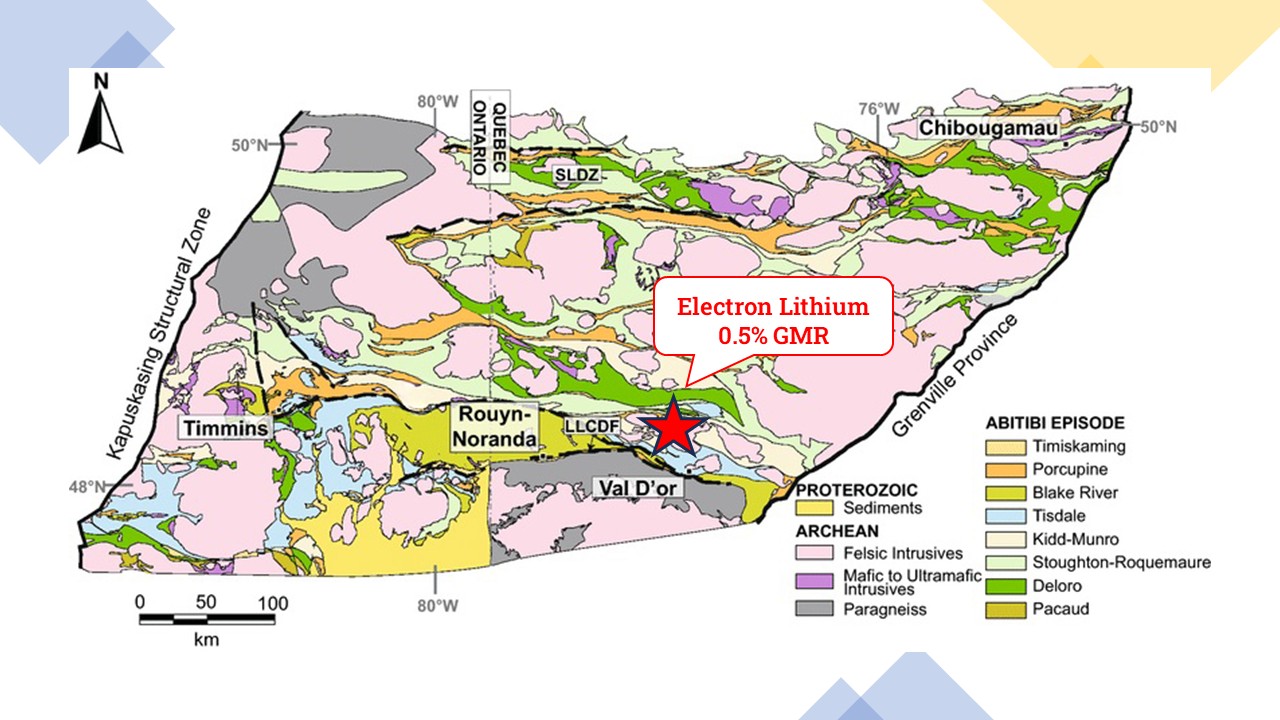
The Electron Lithium project is located within the Abitibi Subprovince of the Canadian Shield. The Abitibi Subprovince is an Archean greenstone belt which hosts some of the richest mineral deposits of the Superior Province.; it is divided into two distinct parts (Chown et al., 1992): the South Volcanic Zone (SVZ) and the North Volcanic Zone (NVZ), separated by the Destor-Porcupine-Manneville fault.
The property covers volcanic and sedimentary rocks of the Malatric, Kinojévis and Kewagama Groups, within a large lithotectonic block delimited to the north by the Aiguebelle fault and to the south by the Rivière-Héva shear corridor. Rocks of the area are squeezed between the La Motte, Preissac, and La Corne batholiths, respectively of monzogranitic, granitic and granodioritic compositions.
Rocks were strongly deformed and present evidences of a moderately east-dipping stretching lineation. The La Motte Anticline (Imreh, 1984) is an overturned fold inclined to the south. Regional metamorphism generally exhibits a green schist facies and can reach an amphibolite facies near large intrusions.
The most valuable commodity present in the area is lithium. Mineralisation is hosted within spodumene-bearing pegmatite intrusions. The Authier project hosts two separate mineralised pegmatite systems, including:
- Authier Main – 1,100 metres long striking east-west, with an average thickness of 25 metres (ranging from 4 metres to 55 metres), dipping 40 to 50 degrees to the north. The deposit outcrops in the eastern sector and then extends up to 10 metres under cover in the western sector. The deposit remains open in all directions; and
- Authier North – 500 metres long striking east-west, with an average thickness of 7 metres (ranging from 6 metres to 8 metres), dipping at 15 degrees to the north. The Authier North pegmatite appears at shallow levels (15 to 25 metres vertical depth). The deposit remains open in all directions.
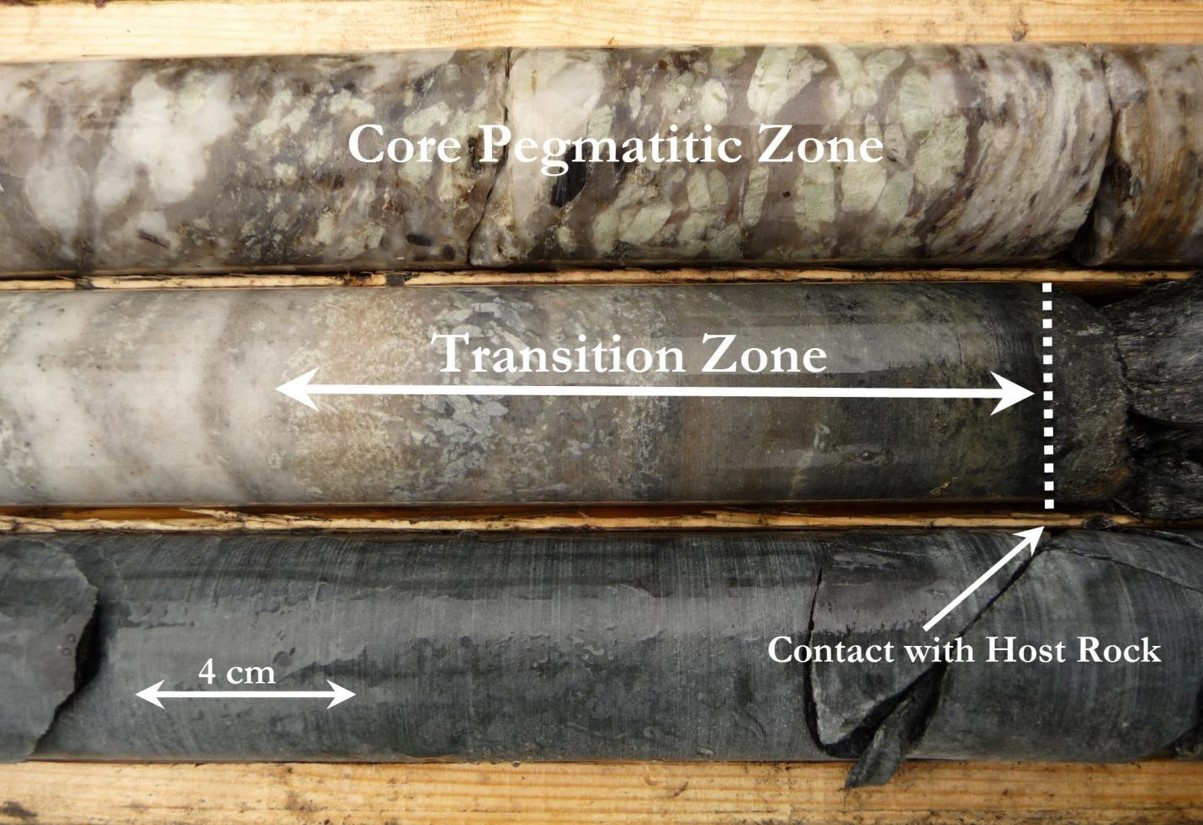
The lithium mineralisation at the Authier project is related to multiple pulses of spodumene bearing quartz-feldspar pegmatite. Higher lithium grades are related with high concentrations of mid-to-coarse spodumene crystals (up to 4 cm long) in a mid-to-coarse grained pegmatite facies :
JORC Mineral Resource
In 2023, Sayona Mining Ltd. (now Sayona Quebec Ltd.) released a positive NI 43-101 Feasibility Study for the Authier Lithium Project (Leblanc et al., 2023). Estimation of Mineral Resource and Reserve are presented in tables below :
The Marbridge shear zone is also associated with several Ni (±Cu ±EGP) prospects, including the Marbridge former mine (historical production of 703,027 tonnes grading 2.28% Ni for a total of 12,000 tonnes Ni and 543 tonnes Cu).
Molybdenum mineralization is also present in the area; Mo-Bi mineralization is confined within pegmatites, pegmatitic quartz veins, and gray to white quartz veins which occupy tension fractures resulting from the emplacement of the Preissac-La Corne Intrusive Suite.
History
Exploration for pegmatites in the Preissac-La Motte area began in the early 1900s; the presence of molybdenite was first reported in 1901 (RG 160). The primary focus was initially on molybdenum. In 1942, the discovery of spodumene pegmatite at the site that would become the Québec Lithium Mine sparked interest in lithium. Exploration for lithium increased with the development of the Québec Lithium Mine in the 1950s and declined with the mine’s closure in 1965, partly due to falling prices and a declining market for the metal (GM 65011). In 1957, the discovery of the nickel deposit at the Marbridge Mine, which was mined from 1962 to 1967, sparked a boom in nickel (RG 160). In the early 2000s, interest in lithium increased.
Recent work and developments :
In recent years, Sayona Québec Inc. has been working to bring the North American Lithium and Authier projects to more advanced stages of development. NI 43-101 mineral reserve estimate as well as positive feasibility studies were released in 2023 for each of these two projects.
Resources and Potential
Given the large number of metallic prospects known in the area, the Electron Lithium claims appear to be located in a very favorable geological environment to lithium and other rare metal (tantalum, beryllium) mineralization in granitic pegmatites.
Globex thus holds attractive royalties in an area where further significative discoveries are still possible, as demonstrated by the Authier and North American Lithium deposits.