
Feldspar
Location, Access, Description
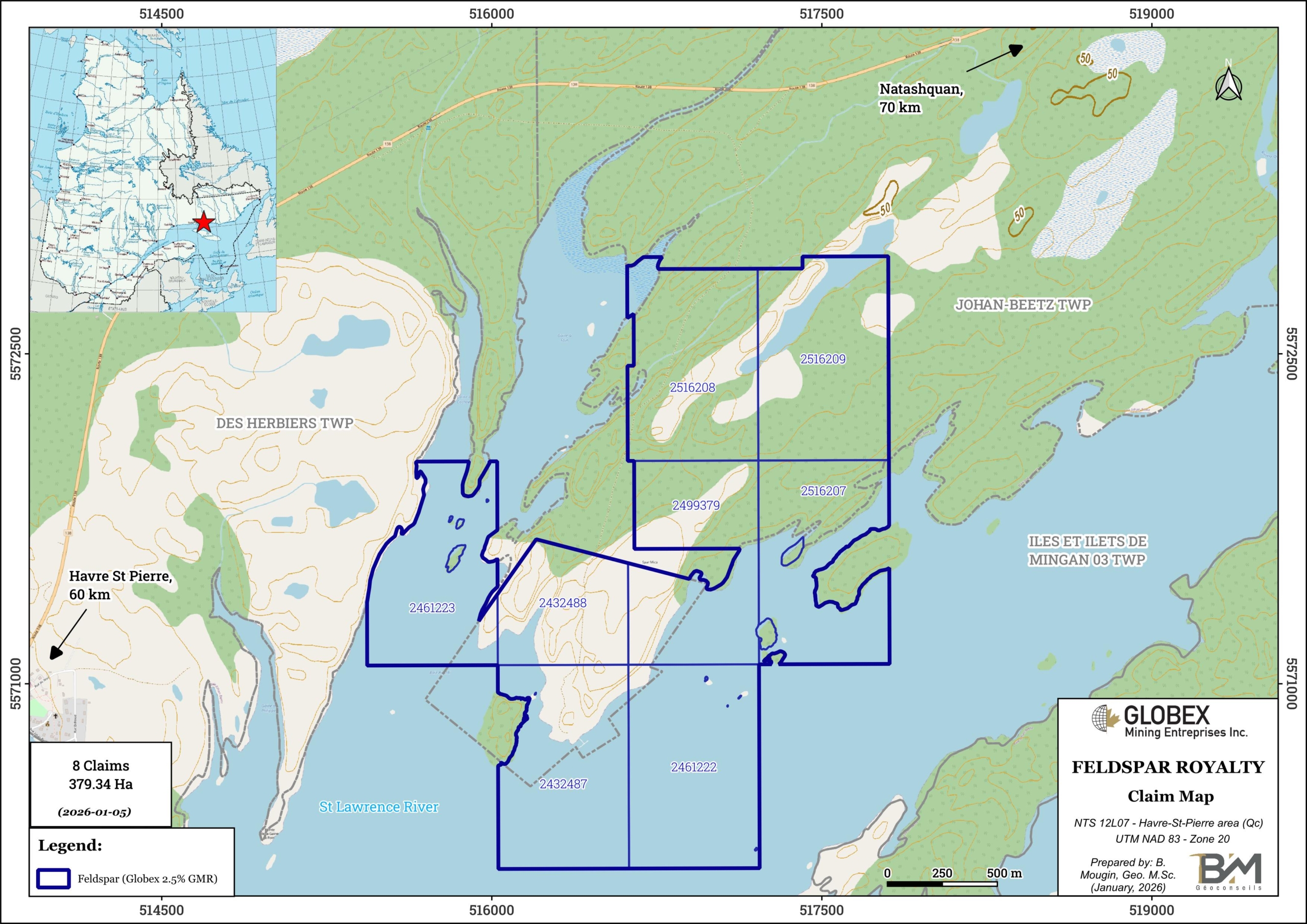
The property consists of 8 mining claims totalling 379 ha in Johan Beetz and Iles and Islets de Mingan 03 townships, Cote Nord, Quebec. They are located directly on the north shore of the Gulf of St. Lawrence, 2.5 km east of the village of Johan Beetz. Globex acquired the Johan Beetz feldspar property by staking in 2015.
Access to the property is by highway 138, which connects the town of Johan Beetz to the towns of Havre St. Pierre, 60 km to the west and Sept Iles, 280 km west. A tertiary road named Rue du nord traverses the claims north to south to the Gulf of Saint Lawrence coastline. Havre St. Pierre (pop. 3,337 in 2021) is the loading port for the Quebec Iron & Titanium (QIT) Lac Allard open mining pit operation.
Feldspar consists of aluminum silicates combined with varying percentages of potassium, sodium and calcium and it is the most abundant mineral of igneous rocks. The two types of feldspar that are important components of mineralization on the property are soda (Na) feldspar (7 % or higher Na2O) and potassic (K) feldspar (8% – 10% or higher K2O). Potassic feldspar is a more valuable mineral and commands a premium in the ceramic, white ware and glaze industries.
Geology and Mineralization
The Johan Beetz Feldspar property is located in the Eastern part of the Grenville Province at the south end of the Wakeham Supergroup. The Allochtone unit of Grenville consists of strongly metamorphosed Archean and Precambrian rocks forming dome and basin structures. Metamorphism can reach the granulite grade.
The local geology is made of granites, quartzites, gabbros, gneisses and metamorphosed sediments. Granitic rocks in the region are true granite, varying in colour from white to pink and granularity varying from very fine to medium-grained granite to extremely coarse-grained, very heterogeneous pegmatitic granite and pegmatite.
The property is almost exclusively covered by a pegmatite assemblage intercalated with strongly foliated amphibolite, probably metamorphosed pelitic sediments. The pegmatite dykes show massive and coarse grained textures with feldspar, quartz and both white and dark micas (muscovite and biotite) generally present. The Johan Beetz Feldspar deposit consists of coarse pegmatites varying from pink potassic feldspars in the western portion to finer white sodic feldspars in the eastern part with buff colored mixed feldspar in the central part. Micas and minor minerals account for 1-5% of the pegmatite and quartz from 20-30% with feldspar making up the remainder (GM70006).
The Feldspar property area is also underlain by geological units susceptible to contain significant uranium, REE, Thorium, Cesium and Niobium mineralisation of economic interest. The mineralization occurs in veins and disseminations linked to pegmatites, granitic gneisses and in meta-sedimentary rocks, as well as porphyritic granitoids carrying copper-gold and copper-molybdenum mineralization.


History
Industrial scale and quality feldspar has been known to occur in pegmatites in the Baie Johan Beetz area for a century. Numerous attempts were made through time to evaluate the deposit for commercial production. From 1956 to 1959, a mine, mill and seaport were operated for the production of feldspar concentrates for the glass industry. After three years of operation, mining ceased due to operational issues.
Three phases of drilling have been completed historically ; in 1955 and 1959 by Spar Mica and in 1991 by Canspar Resources. Several mineral resources or reserves have been quoted in literature related to the property. These resources were estimated prior to the application of National Instrument (NI) 43-101 Standards of Disclosure for Mineral Projects and are to be considered historic in nature. The following table is taken from McGuinty (2016) :

The region has also been prospected for copper, then for silica, beryl, micas (Spar Mica mine in the 1950s) and fluorite, as well as for uranium in the 1960s and 1970s. SOQUEM explored the area’s potential for rare earth elements (REE), particularly a pegmatite dyke described as containing U, Th, Ce, and Y in 1988. Feldspar and quartz were mined along the coast.
More detailed information about history of the Feldspar property is presented in the Technical Report on Johan Beetz Feldspar Project by B. McGuinty in 2016 (GM70006).
Recent developments :
In 2016, McGuinty prepared a Technical Report of the Johan Beetz Feldspar Project for Walmer Capital Corp (GM70006) which provides detailed information on the property location, geology, mineralization and work history.
In 2017, Globex undertook diamond drilling on the Feldspar property (GM73899) ; 19 HQ diameter vertical holes (585.3 metres) were drilled. Large diameter core has been required as provision for subsequent metallurgical testing.
In 2022, Brunswick Exploration conducted an exploration campaign north of the property with the objectives of determining the attitude and potential volume of the pegmatite bodies and verifying the presence of lithium (GM73226). No lithium enrichment vector could be detected.
In 2023, the area was flown with a high-resolution Airborne magnetic and spectrometry survey conducted by Quebec MRNF (DP2023-02).
In 2024, EnerSpar Corp. contracted IOS Services Geoscientifiques to carry out preliminary metallurgical testing on core material from the 2017 drilling program, in order to evaluate if former production issues could be solved (GM73899).
Resources and Potential
As for Girard (2024), subsequent mineralogical and metallurgical work is recommended in order to properly characterize the mineralogy of the pegmatite in the Johan Beetz property, iron deportment, liberation analysis and to evaluate appropriateness of separation methods to reduce iron content.