Fiedmont
Location, Access, Description
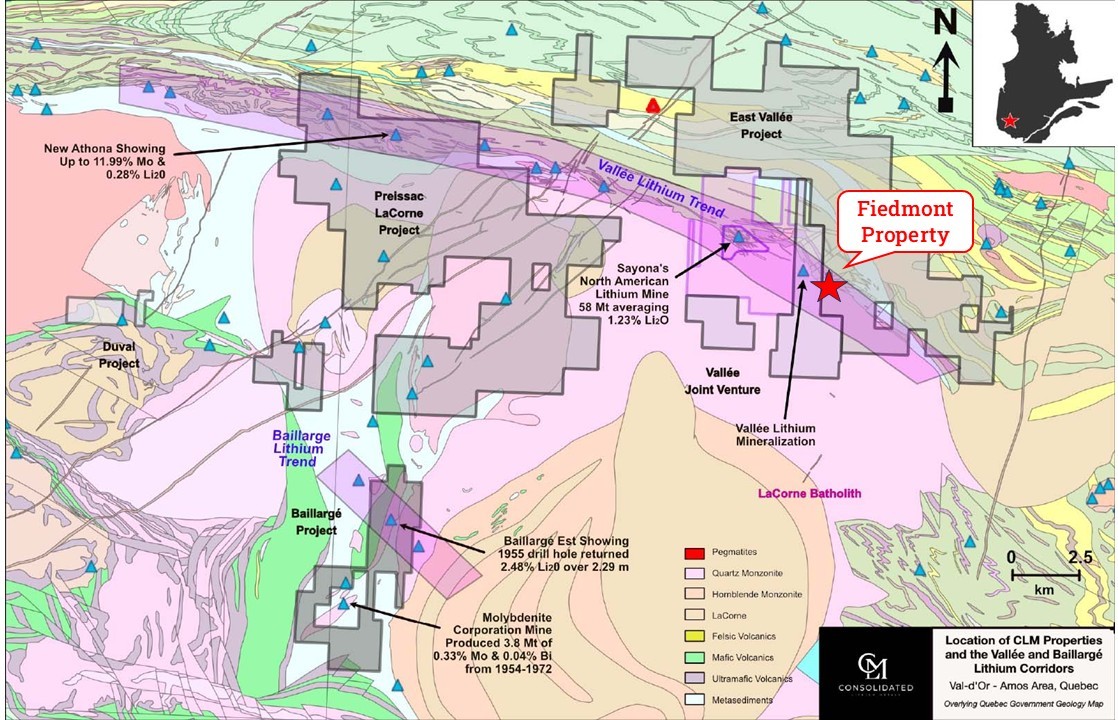
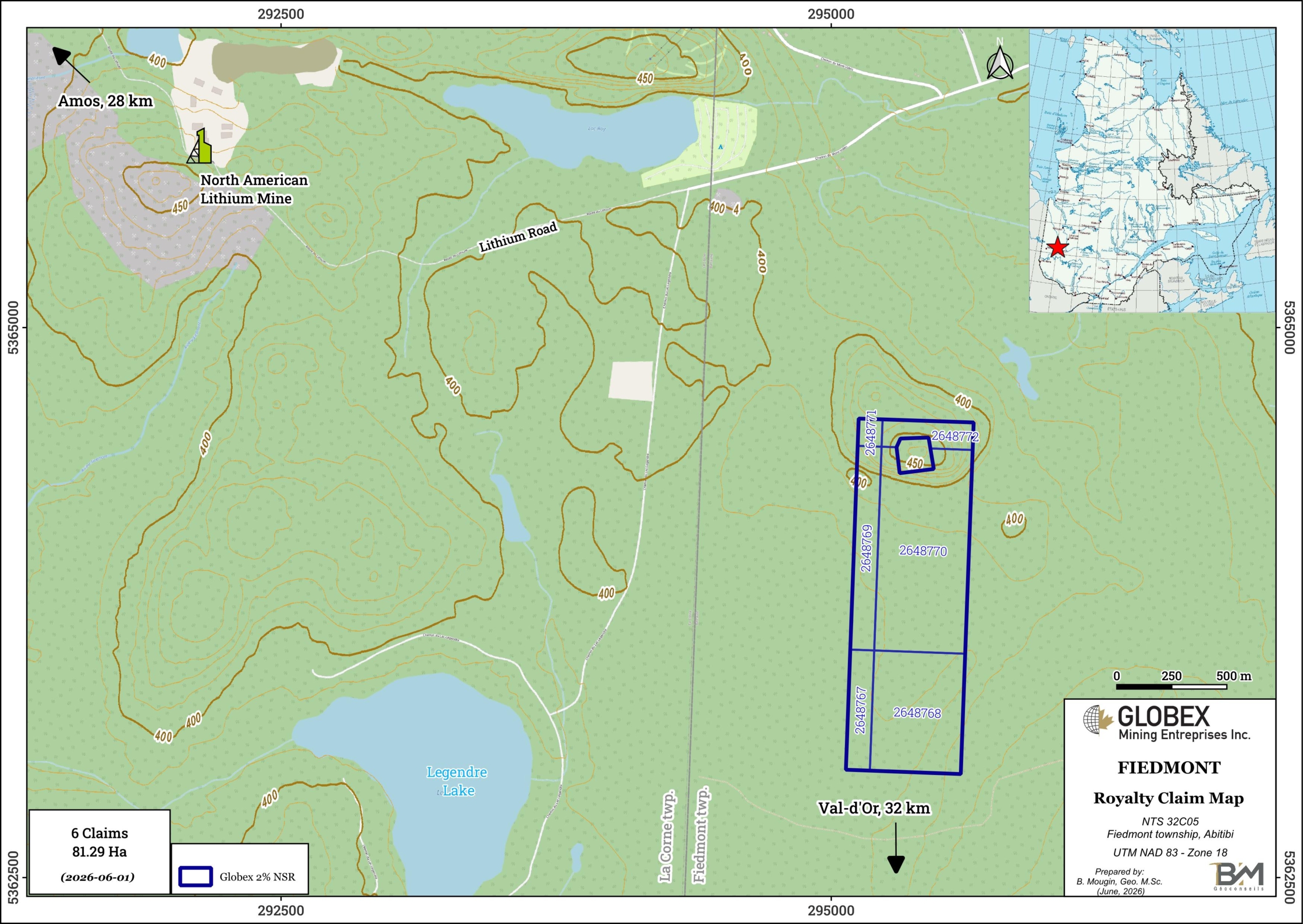
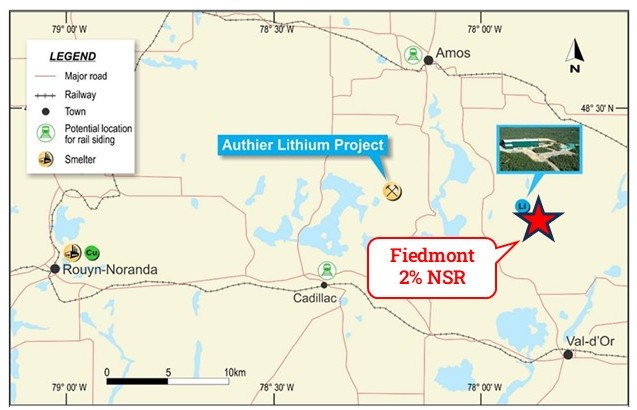
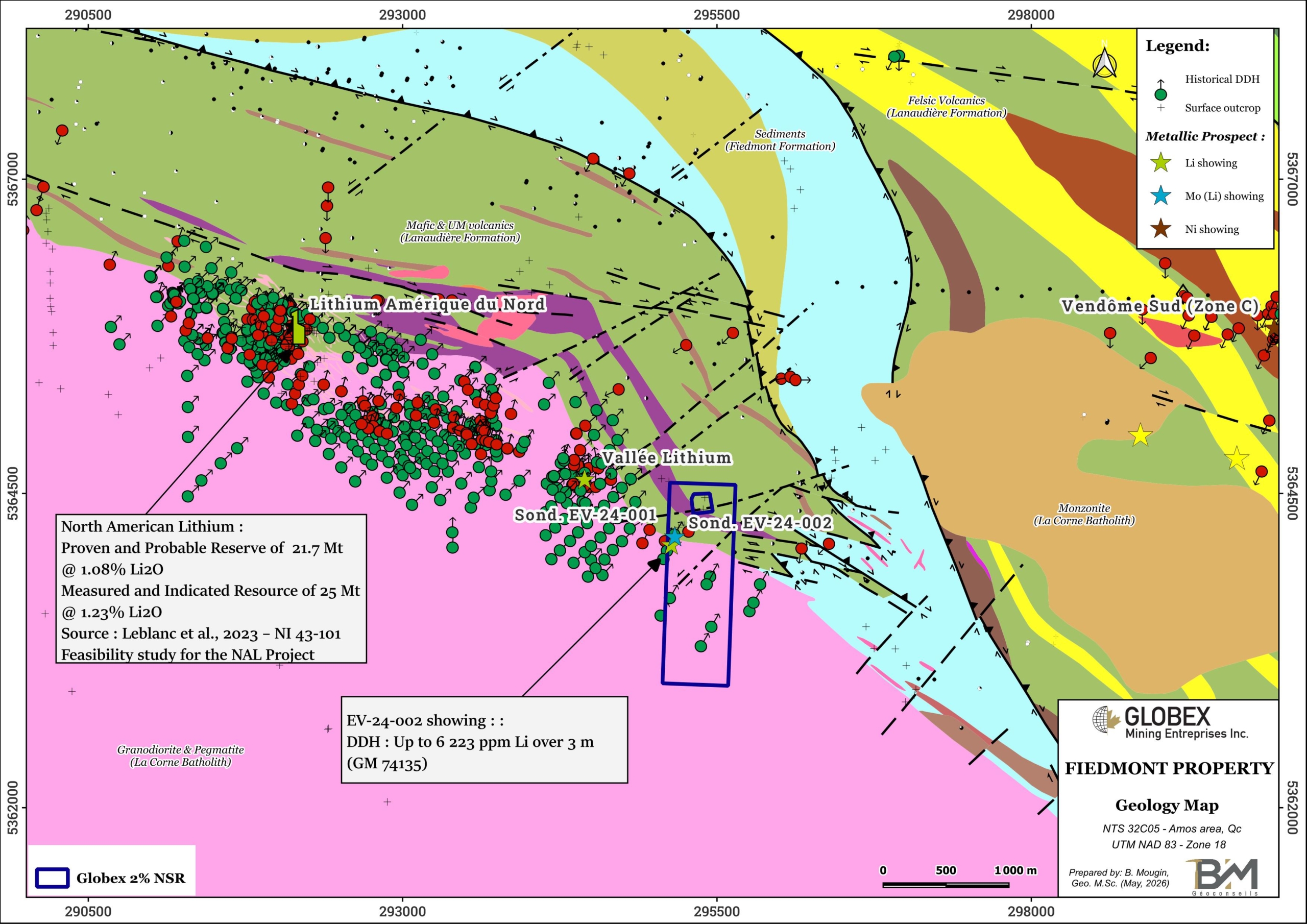
The Fiedmont property consists of 6 mining claims covering an area of 86.29 Ha in Fiedmont township, northwestern Quebec, approximately 28 km SE of Amos (Qc) and 32 km north of Val-d’Or (Qc).
The claims are located 3 km east of the North American Lithium Project of Sayona Quebec Inc. The North American Lithium deposit hosts Proven and Probable Reserve of 21.7 Mt @ 1.08% Li2O, and Measured and Indicated Resource of 25 Mt @ 1.23% Li2O (Leblanc et al., 2023 – NI 43-101 Feasibility study for the NAL Project). The Fiedmont property has been sold to Consolidated Lithium Metals Inc., and Globex will retain a 2% Net Smelter Royalty (NSR) on any future production on these 6 specific claims.
The property is centred in a well- developed mining region with many resource industry support facilities and services. The towns of Rouyn-Noranda, Val-d’Or and Amos have populations of between 25,000 and 60,000 and are well known for their mining history. The project is readily accessible by national highway and a high-quality rural road network.
Geology and Mineralization
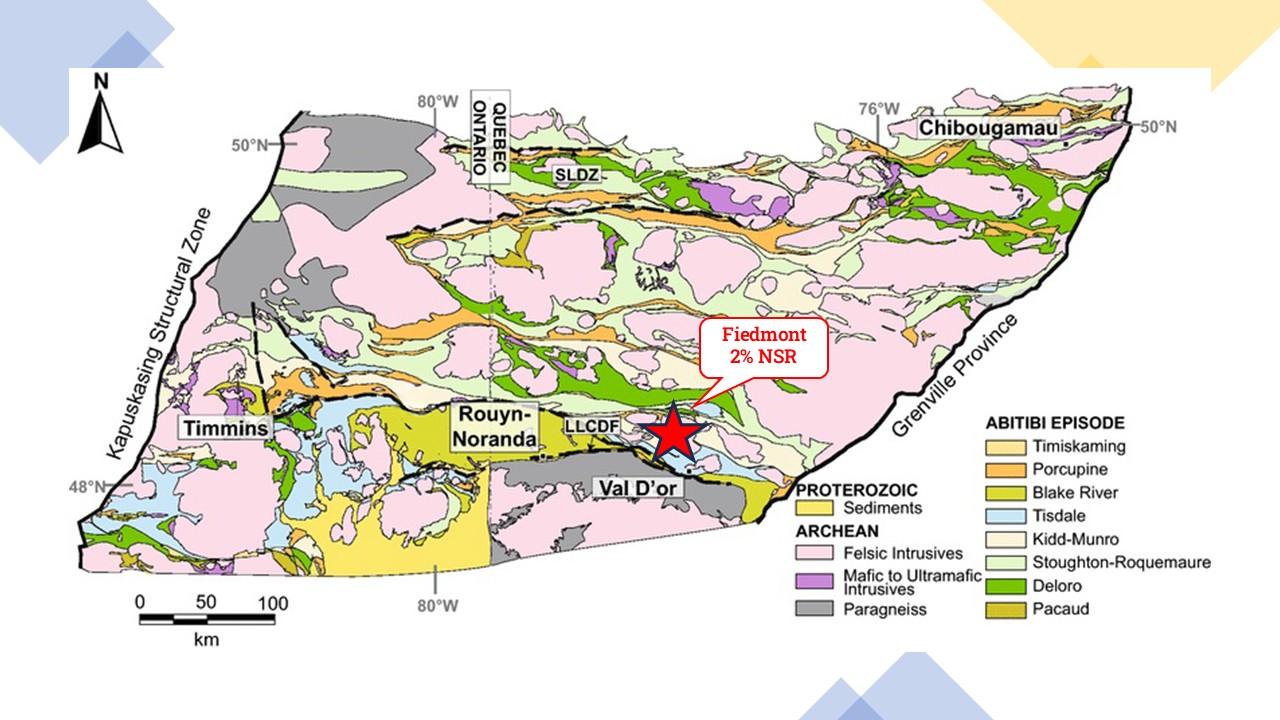
The Archean Preissac-La Corne batholith is a syn- to post-tectonic intrusion that was emplaced in the Southern Volcanic Zone of the Abitibi Greenstone Belt of the Superior Province of Québec. The batholith intruded along the La Pause anticline into the ultramafic to mafic lavas of the Kinojevis (2,718 Ma; Corfu 1993) and Malartic groups, and biotite schist of the Kewagama Group. The batholith is bounded to the north by the Manneville fault and to the south by the Cadillac fault and the eastward extension of the Porcupine-Destor fault.
The Preissac-La Corne batholith is a composite body comprising early metaluminous gabbro, diorite, monzonite and granodiorite (ca. 2,650-2,760 Ma: Steiger and Wasserburg 1969, Feng and Kerrich 1991) and four late peraluminous monzogranitic plutons (Preissac, Moly Hill, La Motte and La Corne) and associated pegmatites and quartz veins (ca. 2,621-2,655 Ma: Gariépy and Allègre 1985, Feng and Kerrich 1991). The final intrusive activity in the area was the Proterozoic diabase dykes. The regional metamorphic grade is greenschist facies and close to the batholith is hornblende hornfels facies contact metamorphism.
The Fiedmont property is settled onto the regional contact zone between mafic and ultramafic (UM) volcanic rocks of the Kinojévis Group and felsic intrusions of the La Corne Batholith. Sediments of the Caste Formation are present in faulted contact with volcanic rocks of the Lanaudière Formation immediately east of the property. Volcanic and sedimentary rocks of the area are characterized by a strong deformation and penetrative foliation with a WNW-ESE general trend. The La Corne Batholith is composed predominantly of intrusive calc-alkaline metaluminous foliated rocks whose composition varies from diorite to granodiorite; the La Corne Batholith also includes a halo of pegmatites mineralized in Li, Be, Ta, and Mo.
In the Preissac-La Corne region, there are many pegmatites and aplites that seem to have been formed within fractures, joints, and dykes. Historical exploration work has identified numerous lithium-bearing dykes in the area of the property. The Li mineralization consists of spodumene and lepidolite crystals (±Mo, ±Be, ±Ta) within sodium pegmatites associated with fracturing of the La Corne Batholith. The pegmatites are located on either side of the batholith’s contact zone and are generally oriented parallel to it. The prospective dykes are usually pegmatitic, and composed of albitic plagioclase and k-feldspar (25 to 40%), quartz (30 to 40%), spodumene (5 to 20%), muscovite (0 to 5%) and a series of accessory minerals including beryl, garnet, columbo-tantalite, lepidolite, molybdenite and bismuthinite. The width of the dykes and irregular masses varies from 5 cm to 40 meters with lateral extensions reaching over 500 meters.
It should also be noted that molybdenite mineralization is not confined to pegmatites but rather limited to so-called hydrothermal veins formed by quartz, K-feldspars, muscovite and molybdenite located inside but on the edge of muscovite-bearing monzogranite facies with ±garnet from Preissac, La Motte and Moly Hill plutons.
The reference deposit of the area is the North American Lithium deposit which is located about 3 km west of the property, on which a positive feasibility study was released by Sayona Quebec in 2023. The Valley Lithium Showing was initially defined in 1956 by 12 drill holes (GM 04209) intersecting grades up to of 2.97% Li2O over a core length of 4.8 meters. The granodiorite contains enclaves of mafic volcanic rocks and mafic intrusive rocks from the Kinojevis Group.
The Fiedmont property hosts two mineral prospects located at the interface between the southern volcanic zone of the Abitibi Greenstone Belt and the Preissac-La Corne Plutonic Suite : the Sond. EV-24-001 showing (Mo ±Li) and the Sond. EV-24-002 showing (Li ±Cs). Both showings have been discovered in diamond drilling in 2024 (GM 74135) within pegmatites associated to the Preissac-La Corne Suite. DDH EV-24-002 intersected up to 6 223 ppm Li over 3 m in a spodumene-bearing pegmatite.
History
Exploration for pegmatites in the Preissac-La Motte area began in the early 1900s; the presence of molybdenite was first reported in 1901 (RG 160). The primary focus was initially on molybdenum. In 1942, the discovery of spodumene pegmatite at the site that would become the Québec Lithium Mine sparked interest in lithium. Exploration for lithium increased with the development of the Québec Lithium Mine in the 1950s and declined with the mine’s closure in 1965, partly due to falling prices and a declining market for the metal (GM 65011). In 1957, the discovery of the nickel deposit at the Marbridge Mine, which was mined from 1962 to 1967, sparked a boom in nickel (RG 160). In the early 2000s, interest in lithium increased.
Past exploration work on the Fiedmont property took place primarily from the early 1950s to the mid-1980s. Various mapping and grab sampling campaigns, trenching and rock stripping, geophysical surveys, and diamond drilling have identified numerous granitic pegmatite dikes containing spodumene (±molybdenum, ±tantalum, ±beryllium). Previous works showed that pegmatites are found within a multi-kilometric belt along the north contact of the Batholith within both meta-volcanic and meta-sedimentary sequences.
Recent work and developments :
In 2023, Consolidated Lithium carried out soil sampling on the East Vallee Project (GM 73767). Weak to moderate Li anomalies were observed on Globex’s royalty claims :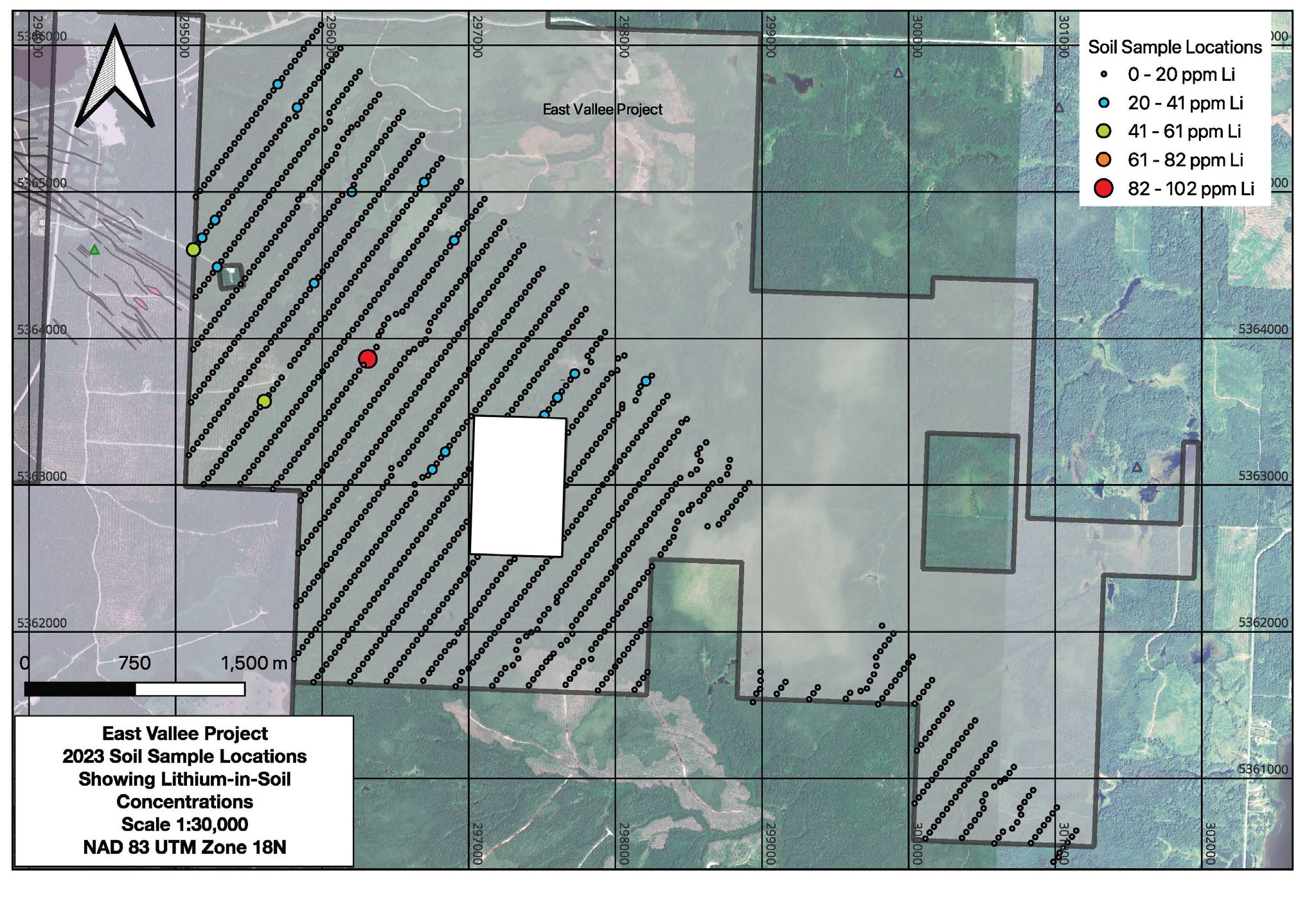
In 2024, the company conducted a 12 holes (2,289 m) DDH program, with 9 holes (1,701 m) located on Globex’s Royalty claims. The EV-24-002 drill hole intersected a spodumene pegmatite at a depth of 100 meters, returning 9.5 meters at 0.75% Li₂O, including 3.0 meters at 1.34% Li₂O (GM 74135). Gold assaying results were not conclusive.
Resources and Potential
The Fiedmont property straddles the favourable La Corne Batholith and metasediment contact. Although the regional metallogenic context is clearly identified here, the main challenge for exploration in this area comes from the limited number of outcrops, coupled with the fact that the mineralization in presence has no specific geophysical signature.
Consolidated Lithium is still exploring its East Vallee project with the aim to make a major discovery in an environment of known lithium and other rare metals mineralization with significant opportunity for new discoveries.