
Grandroy
Location, Access, Description
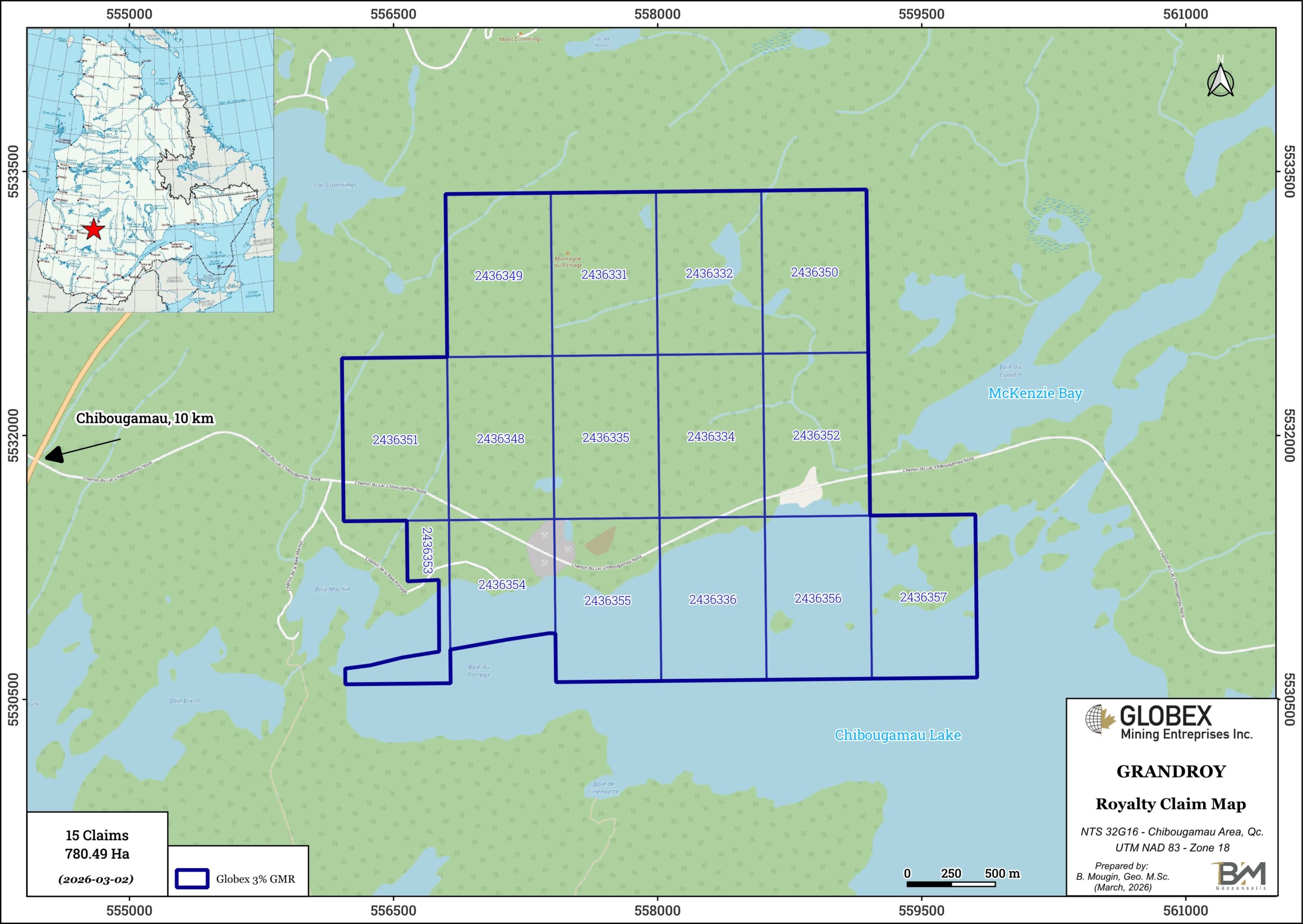
The Grandroy property is located in Eeyou-Istchee James Bay Government, Northern Québec, Canada (NTS 32G16), approximately 10 km southeast of Chibougamau. It consists of 15 contiguous claims covering a total area of 780.49 hectares along the north shoreline of Lac Chibougamau. The Project is easily accessible in vehicle by all-weather gravel roads connecting to regional highway #167.
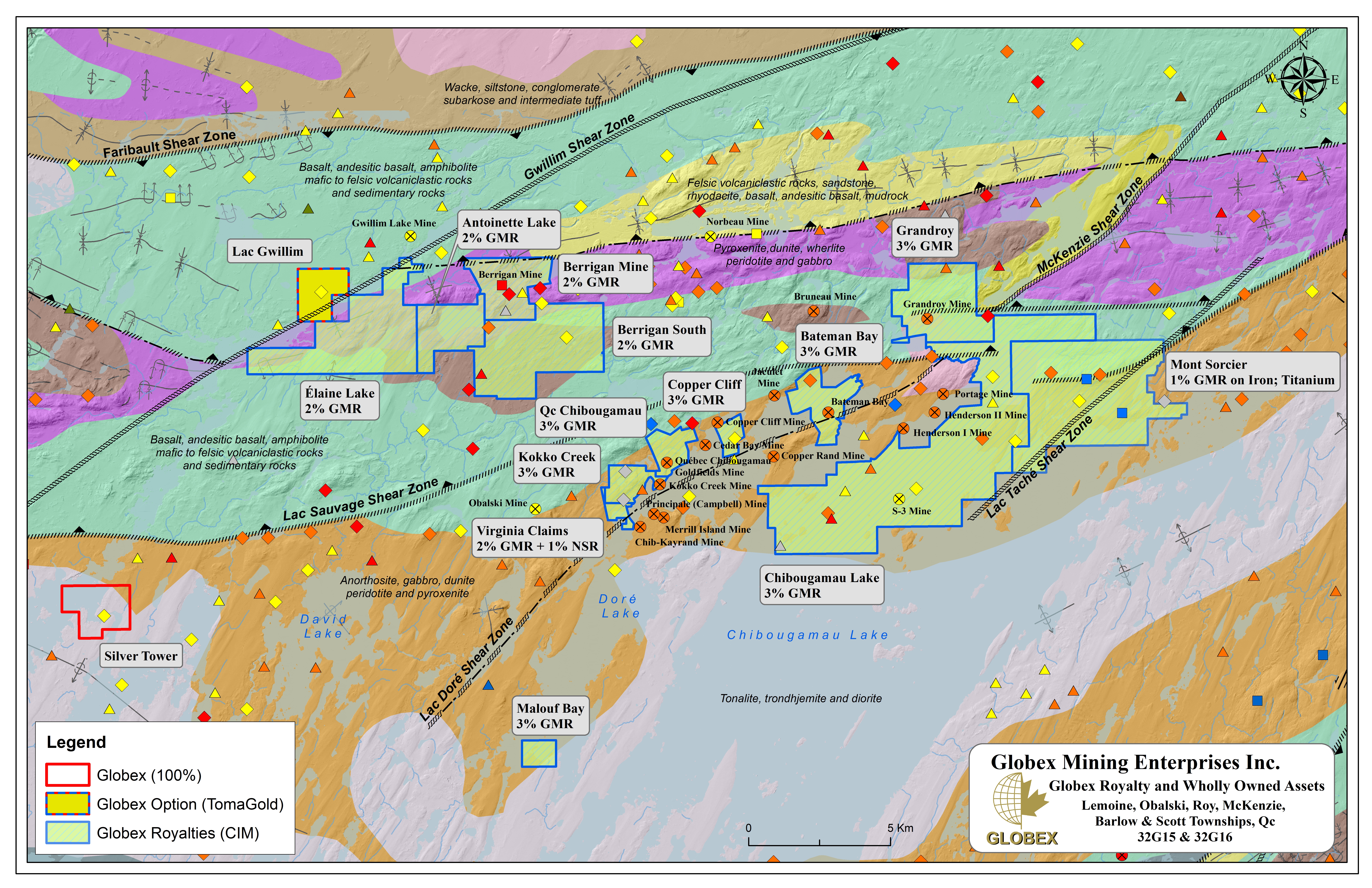
The claims have been stacked by Globex and then transferred in 2012 to Chibougamau Independent Mines (CIM), a subsidiary of Globex ; TomaGold optioned the property from CIM in 2023 (as well as several other properties of CIM ; see the General Map of Globex’s assets in the Chibougamau area), and Globex will retain a 3% Gross Metal Royalty (GMR) on it.
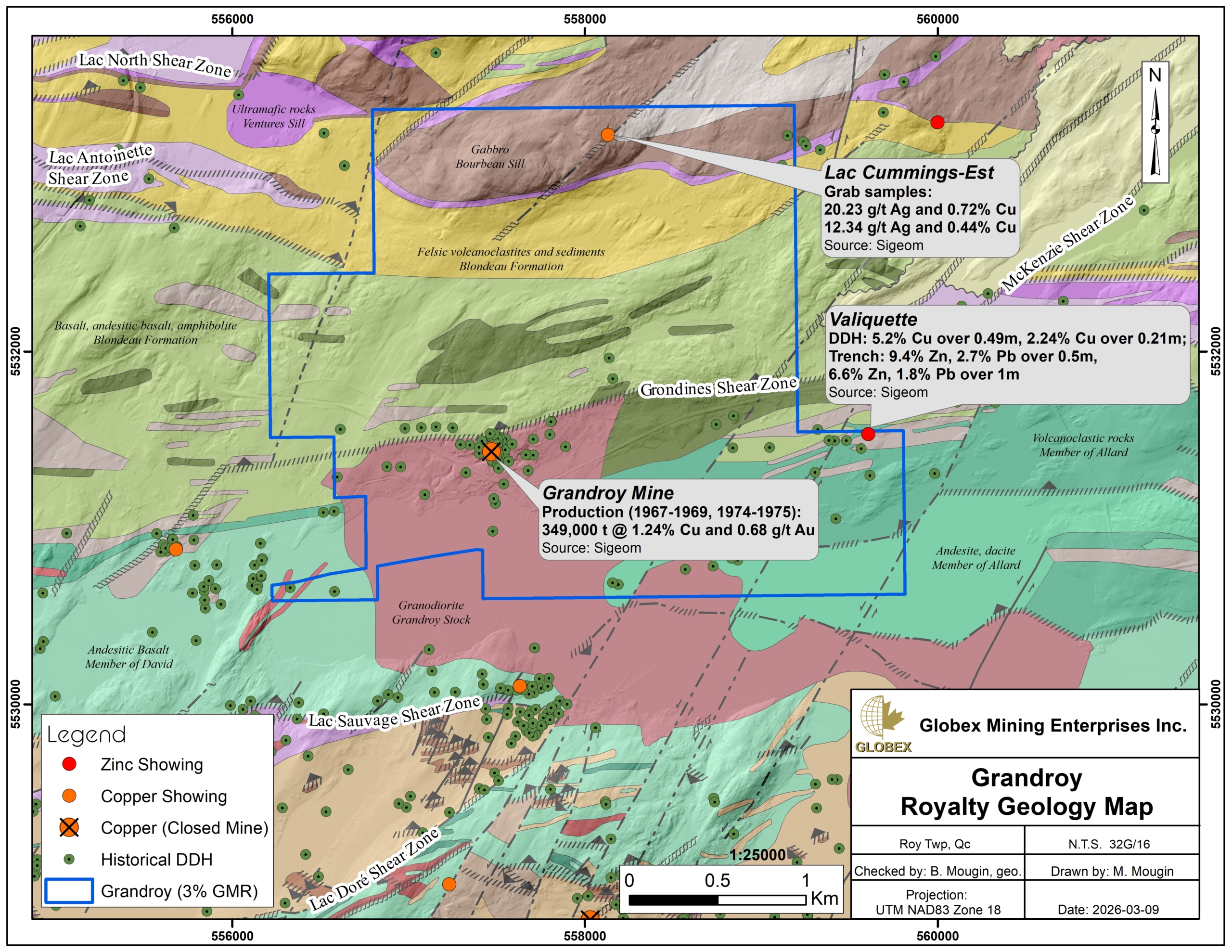
The Grandroy former copper mine is located within the limits of the property; historical production between 1967 and 1975 is estimated to 349.24 Kt grading 1.24% Cu and 0.75 g/t Au (Houle, 2019). Remaining historical resource (non NI 43-101 compliant) of 181,000 t grading 1.5% Cu have been estimated in 1980 (Amrhar, 2019).
Geology and Mineralization
The Grandroy property is located in the Superior Province of the Canadian Shield. The Abitibi Sub-province is known for its prolific and diverse rich mineral deposits; total gold production of the Abitibi Greenstone Belt (AGB) since the beginning of the 20th century is estimated at over 210 million ounces (Moz) Au (Dumas, 2024).
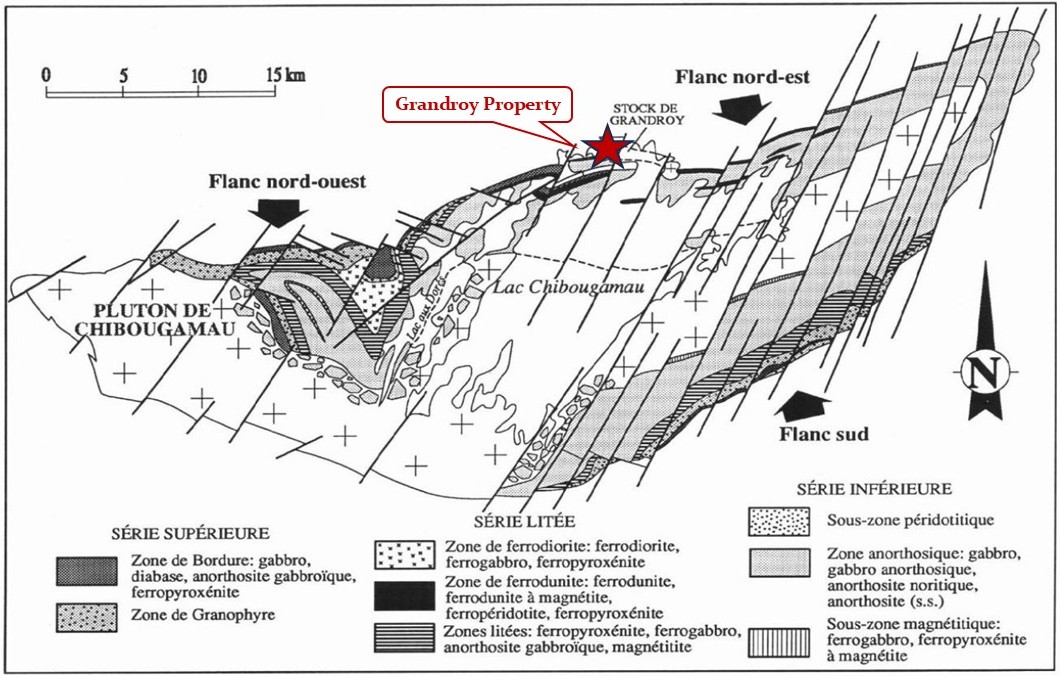
The Chibougamau region hosts some of the eldest rocks of the AGB. The property area is largely underlain by rocks of the Roy Group which comprises predominantly basalt and andesitic basalt, mafic to felsic volcaniclastic rock, dacite, rhyolite, banded iron formations (BIF), chert, and argillite. The anorthosite Doré Lake Complex and the Chibougamau Pluto were emplaced into this volcano-sedimentary package, and both played a major role as regional mineralized features, and the vast majority of mines in the Lake Chibougamau area are located within or near these two intrusions.
All rock units in the area were affected by multiple deformation events and are folded into a succession of east-west trending anticlines and synclines. Lithological units tend to have steep to subvertical dips. Faults and shear zones in the region strike dominantly northeast and east. Regional metamorphism is at the greenschists grade.
The Chibougamau Mining District is located in the northeastern part of the Abitibi Greenstone Belt and hosts a variety of deposit styles; Leclerc et al. (2012) documented volcanogenic massive sulphide (“VMS”) deposits, magmatic Fe-Ti-V and Ni-Cu ± PGE mineralization, early polymetallic (Au-Ag-Cu-Zn-Pb) vein deposits (to which the Property mineralization might belong), Chibougamau-type Cu-Au-veins, shear zone-hosted Au deposits, and Opemiska-type Cu-Au veins. Total production of the Chibougamau mining camp since the beginning of the 20th century is estimated at 1,624.9 Mlbs Cu and 3.22 Moz Au (Houle, 2019).
The former Grandroy mine is hosted in the Grandroy Stock which is composed of graniodiorite intruding volcanics of the Roy Group. The mineralization appears to be Cu-Au-Mo porphyry type and consists of chalcopyrite, gold, molybdenite, pyrite, magnetite, and hematite either disseminated or associated with quartz veins and stockwork. Mafic and ultramafic (UM) sills of the Cummings Suite (gabbro, peridotite, pyroxenite) are present in the northern part of the property; these rocks are also associated with significant potential for Ni-Cu-Co-Cr mineralization; the Bourbeau vein hosts the former Cooke gold mines in Chapais and Norbeau in Chibougamau (Dubé and Guha, 1989).
History
The Chibougamau region has been the site of numerous historical works. The reader is referred to CIM 2019 exploration report (Amrhar, 2019) for more details about past exploration on the property.
About 103 DDH (more than 13,500 metres) have been documented on the Grandroy property in Quebec public data (Sigéom) prior to its acquisition by Globex.
Recent developments :
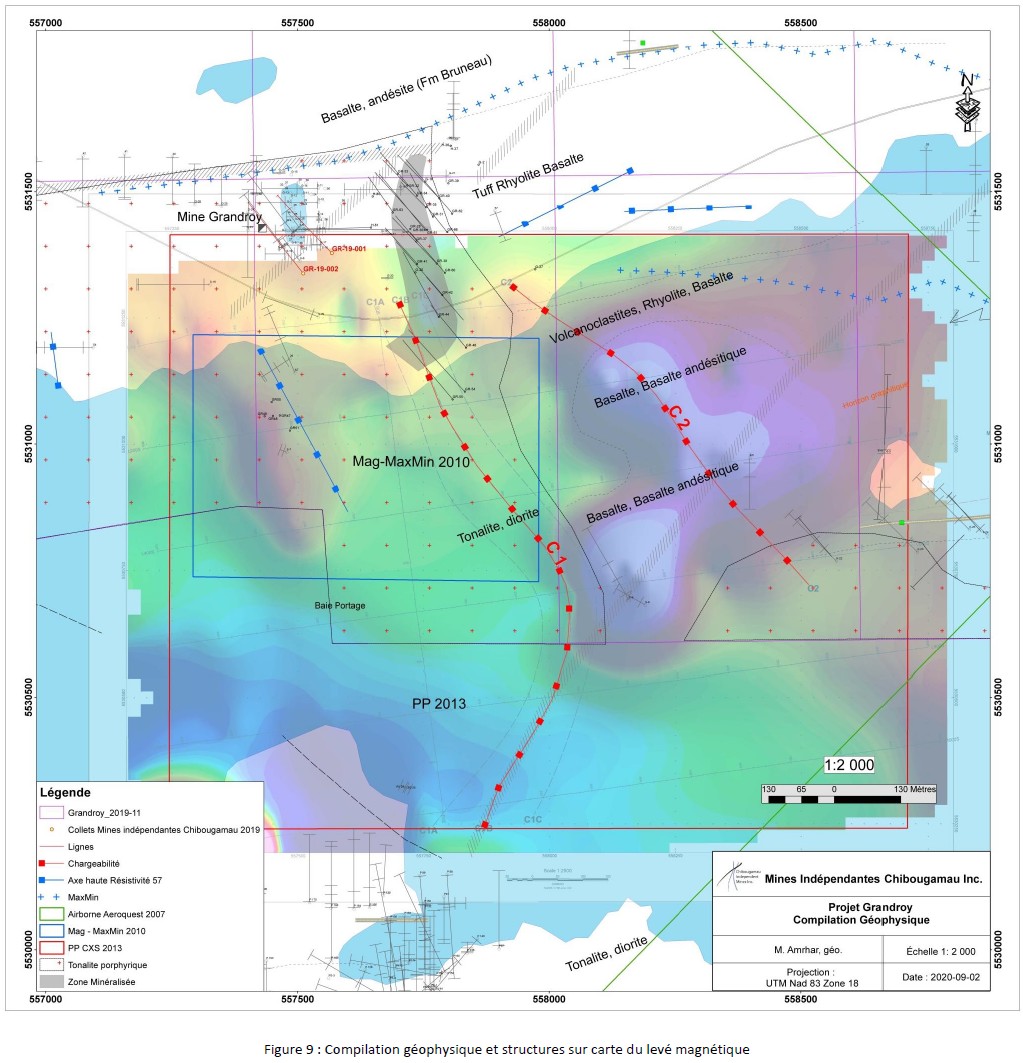
Between 2007 and 2013, CIM carried-out magnetic (GM63489, GM65036) electromagnetic (EM) and Induced Polarization (IP) surveys (GM67759) which highlighted two interesting NW-SE-oriented IP anomalies concordant with resistivity and/or magnetic highs; these anomalies does not appear to have been tested in DDH.
In 2012, CIM filed a NI 43-101 Technical Report and Evaluation of Potential of the Lac Chibougamau properties (Larouche, GM67657).
In 2019, CIM undertook diamond drilling (2 DDH, 567 metres) in the former Grandroy mine area in order to test the in-depth extensions of historical Cu-Au intersections (GM72337). Drilling intersected altered and fractured granodiorite injected with variable quantity of quartz-carbonate veins and quartz-feldspar porphyry dykes (QFP). Best assay from this program is 0.34 g/t Au and 1,976 ppm Cu over 0.5 m.
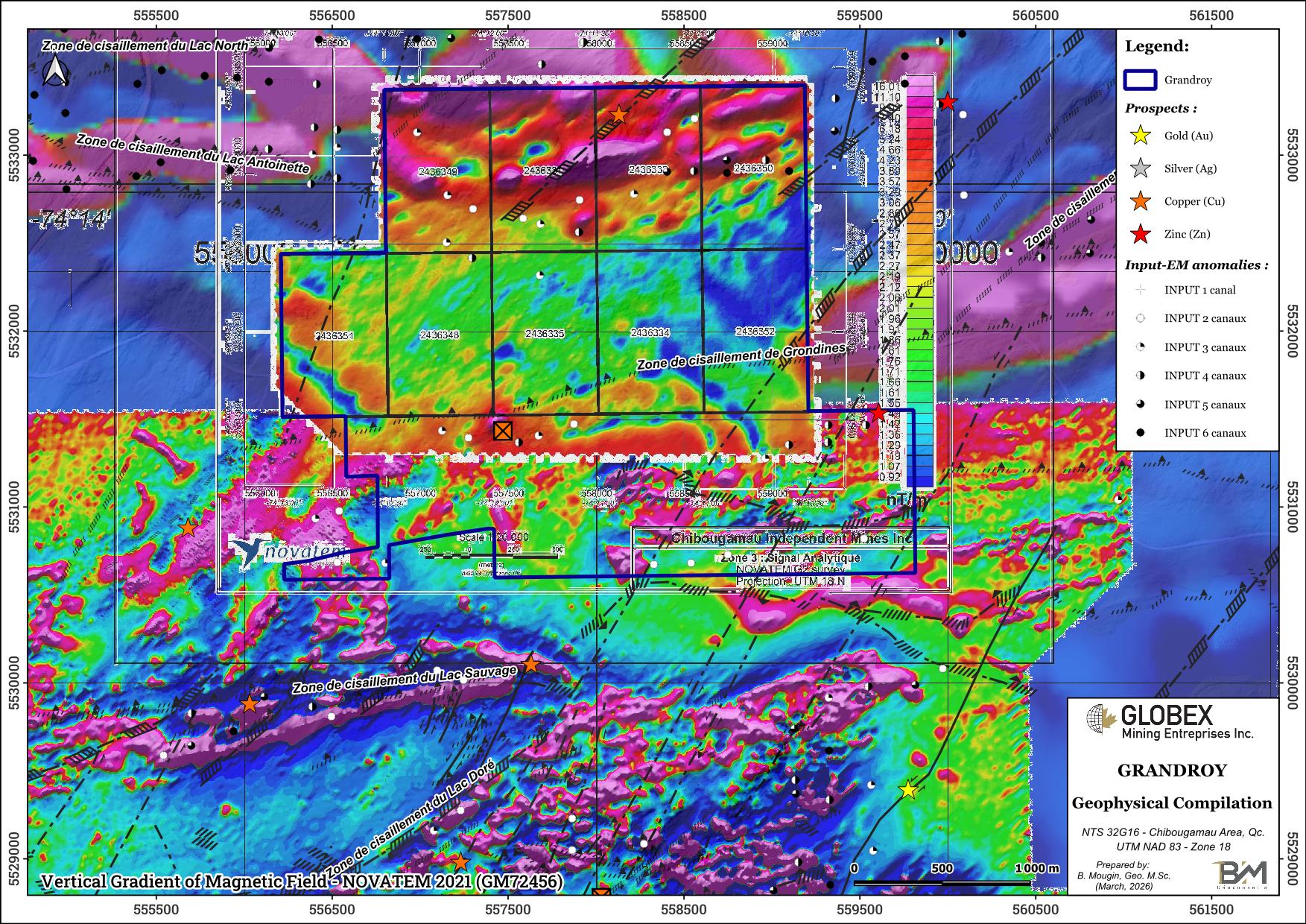
In 2021, CIM requested the services of NOVATEM to fly a very-high resolution airborne magnetic survey over several of its properties in the Chibougamau area (GM72456), including the Grandroy claims.
TomaGold optioned two (2) blocks of properties from CIM in 2023, including the Grandroy claims (CIM Press Release dated August 14, 2023). No work appears to have been carried out by TomaGold on the property at this time.
Resources and Potential
Historical work in the area identified a regional favorable context for several commodities including gold, silver, copper and zinc. The property potential is supported by favourable geological and structural setting and the presence of well-documented metallogenic and litho-tectonic elements such as the layered anorthositic Lac Doré Complex, and other structures and alteration. This potential is attested by the presence of several former mines in the direct vicinity of the Grandroy property (Grandroy, Mine S-3, Bateman Bay, Copper Cliff, Copper Rand, Henderson…); Cu was the principal commodity extracted with minor quantities of Zn, Ag and Au.
Further exploration work is required in order to better characterize the full potential of the Grandroy property. In particular, Amrhar (2019) recommends the drilling of three (3) DDH in order to test some IP anomalies highlighted by the survey of 2013.