
Kokko Creek
Location, Access, Description
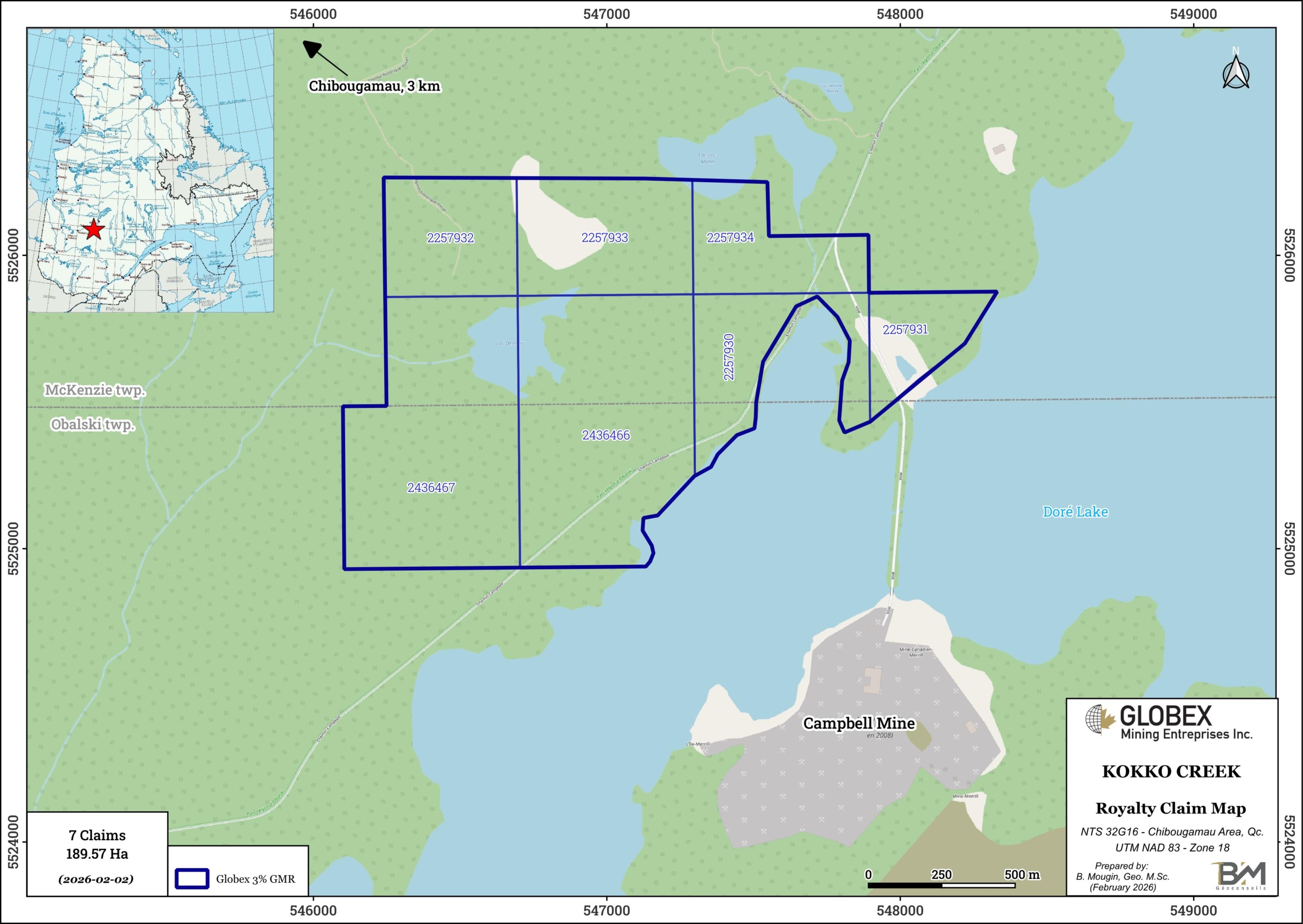
The Kokko Creek property is located in Eeyou-Istchee James Bay Government, Northern Québec, Canada (NTS 32G16), approximately 3 km southeast of Chibougamau, along the north shoreline of Lac aux Dorés. It consists of 7 contiguous claims covering a total area of 189.6 hectares in McKenzie and Obalski townships. The Project is easily accessible in vehicle by all-weather gravel roads connecting to regional highway #167.
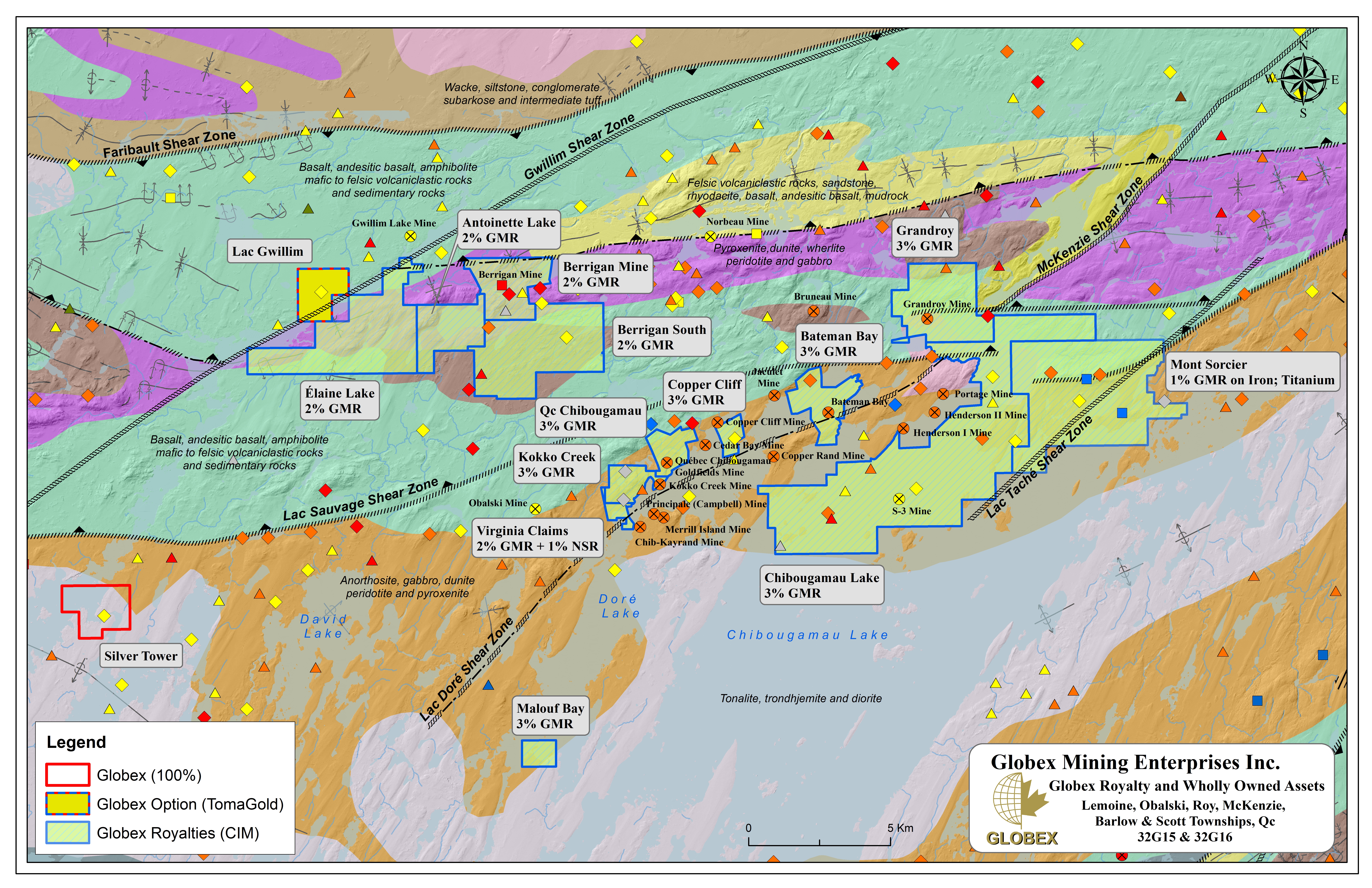
The claims have been stacked by Globex and then transferred in 2012 to Chibougamau Independent Mines (CIM), a subsidiary of Globex ; TomaGold optioned the property from CIM in 2023 (as well as several other properties of CIM ; see the General Map of Globex’s assets in the Chibougamau area), and Globex will retain a 3% Gross Metal Royalty (GMR) on it.
Geology and Mineralization
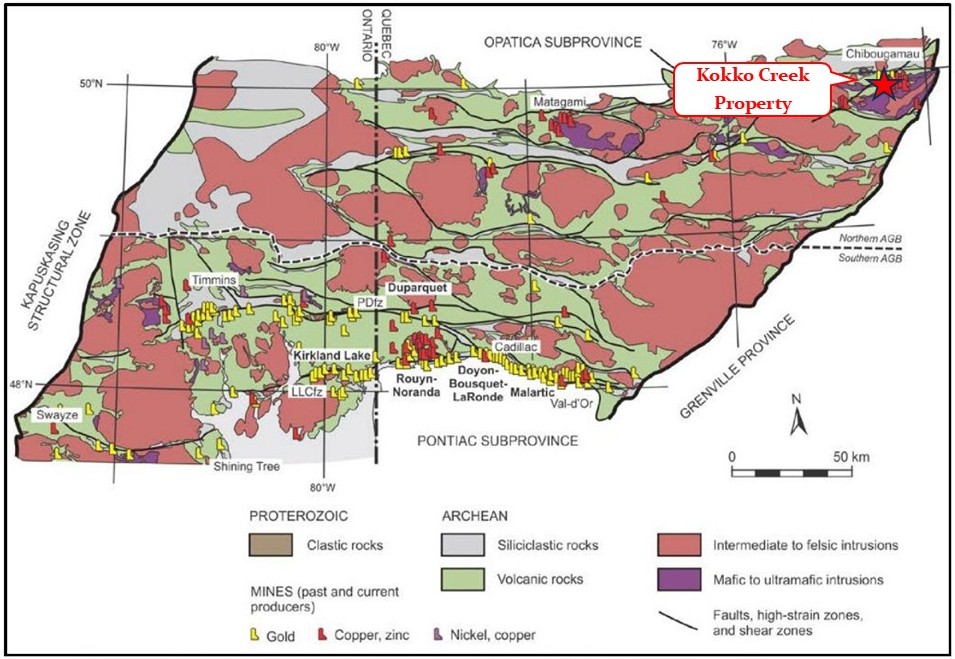
The Kokko Creek property is located in the Superior Province of the Canadian Shield. The Abitibi Sub-province is known for its prolific and diverse rich mineral deposits; total gold production of the Abitibi Greenstone Belt (AGB) since the beginning of the 20th century is estimated at over 210 million ounces (Moz) Au (Dumas, 2024).
The Chibougamau region hosts some of the eldest rocks of the AGB; the area is dominated by a stacking of Archean mafic volcanic rocks intercalated with a few felsic units and some sedimentary units, intruded by two large batholiths : the anorthosite Doré Lake Complex, and the Chibougamau Pluto composed of tonalite and granodiorite. These two intrusions played a major role as regional mineralized features, and the vast majority of mines in the Lake Chibougamau area are located within or near these two intrusions. Regional metamorphism is at the greenschists grade.
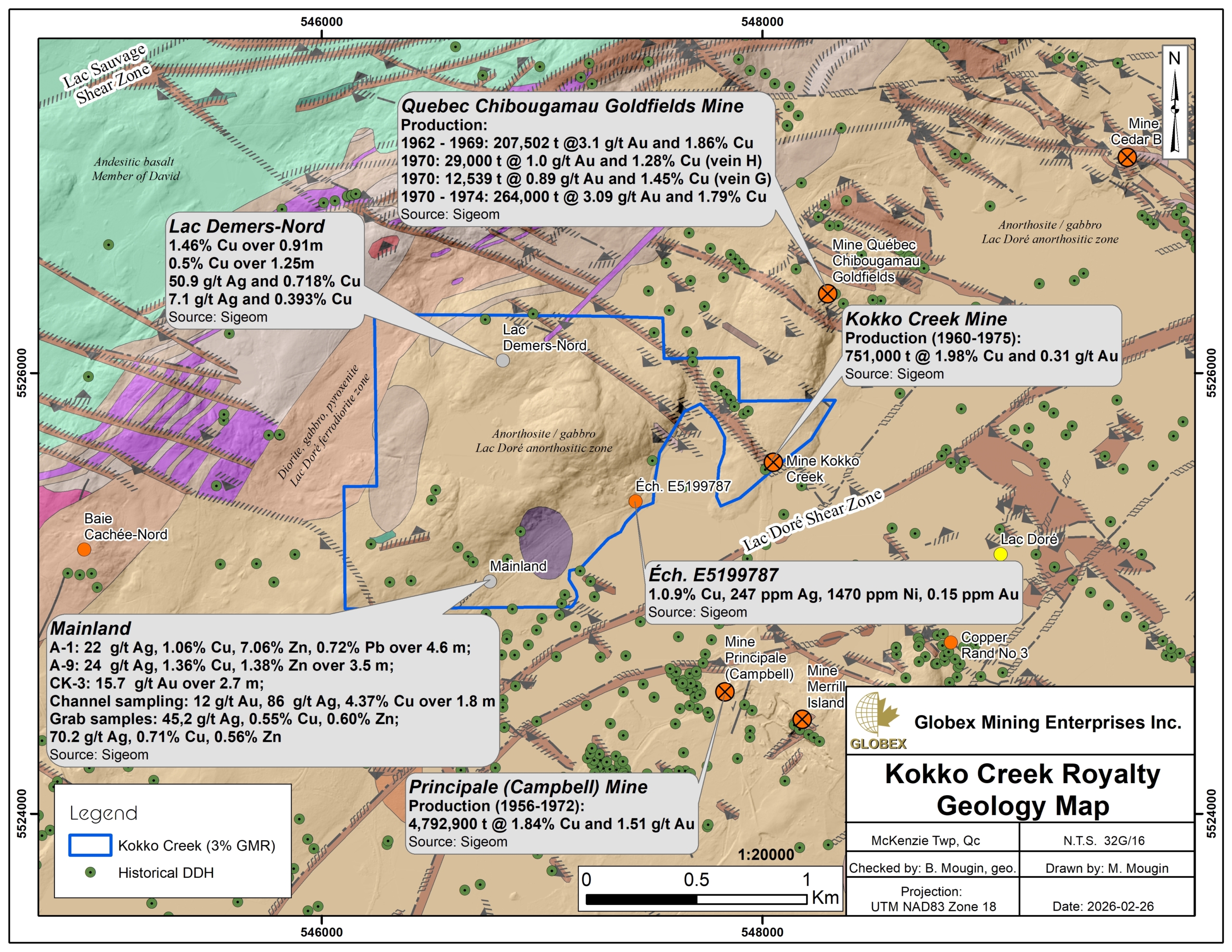
The property area is mostly underlain by anorthosite and gabbroic anorthosite of the Lac Doré mafic to ultramafic intrusive Complex adjacent to the Lac Chibougamau Batholith, located further to the SE. The Kokko Creek property covers an area of altered gabbroic anorthosite associated to the Lac Doré Complex. The rock formations present within property limits are dominated by variably sericitized, massive anorthosite and anorthositic gabbro, always coarse grained.
The Chibougamau Mining District is located in the northeastern part of the Abitibi Greenstone Belt and hosts a variety of deposits styles; Leclerc et al. (2012) documented volcanogenic massive sulphide (“VMS”) deposits, magmatic Fe-Ti-V and Ni-Cu ± PGE mineralization, early polymetallic (Au-Ag-Cu-Zn-Pb) vein deposits (to which the Property mineralization might belong), Chibougamau-type Cu-Au-veins, shear zone-hosted Au deposits, and Opemiska-type Cu-Au veins. Total production of the Chibougamau mining camp since the beginning of the 20th century is estimated at 1,624.9 Mlbs Cu and 3.22 Moz Au (Houle, 2019).
Mineral production from the Chibougamau Mining Camp was derived largely from mesothermal Cu-Au veins. Most of the past producing mines are located within the anorthositic gabbro phase of the Lac Doré Complex. When the Chibougamau Pluton intruded the bedrock, the Lac Doré anorthosites were fractured and filled with metal-bearing hydrothermal fluids. Mineralization is present in most part of the Kokko Creek property in the form of fracture and vein controlled pyrite (Leblanc and Larouche, 2013).
At the former Kokko Creek Mine, the mineralized zone occurs along a northwest trending, steeply dipping shear zone injected by quartz- feldspar porphyry dyke. The mineralized zone has been traced over more than 600 m horizontally and locally reaches widths of 12.0 m. The sulphide minerals are chalcopyrite, pyrrhotite, pyrite and very minor sphalerite. Chloritization, silicification and carbonatization are the most common types of alteration observed.
History
Discovery of metallic mineralization in this area dates back to 1906 with the discovery of sulphide mineralization by John Kokko. Numerous exploration programs (mapping, sampling, geophysics, rock stripping, diamond drilling…) have been undertaken by successive owners ; more details about the history of exploration on the property is presented in CIM 2013 work report by Leblanc and Larouche (2013).
The Kokko Creek mine located in the eastern part of the property produced 751,000 t of ore grading 1.98% Cu and 0.31 g/t Au between 1960 and 1975.
Limited diamond drilling have been done on the Kokko Creek property prior to its acquisition by Globex. A total of 6,072 linear metres in 27 DDH have been documented in Quebec public data (Sigéom); most of the drilling dates back to 1974 and earlier.
Recent developments :
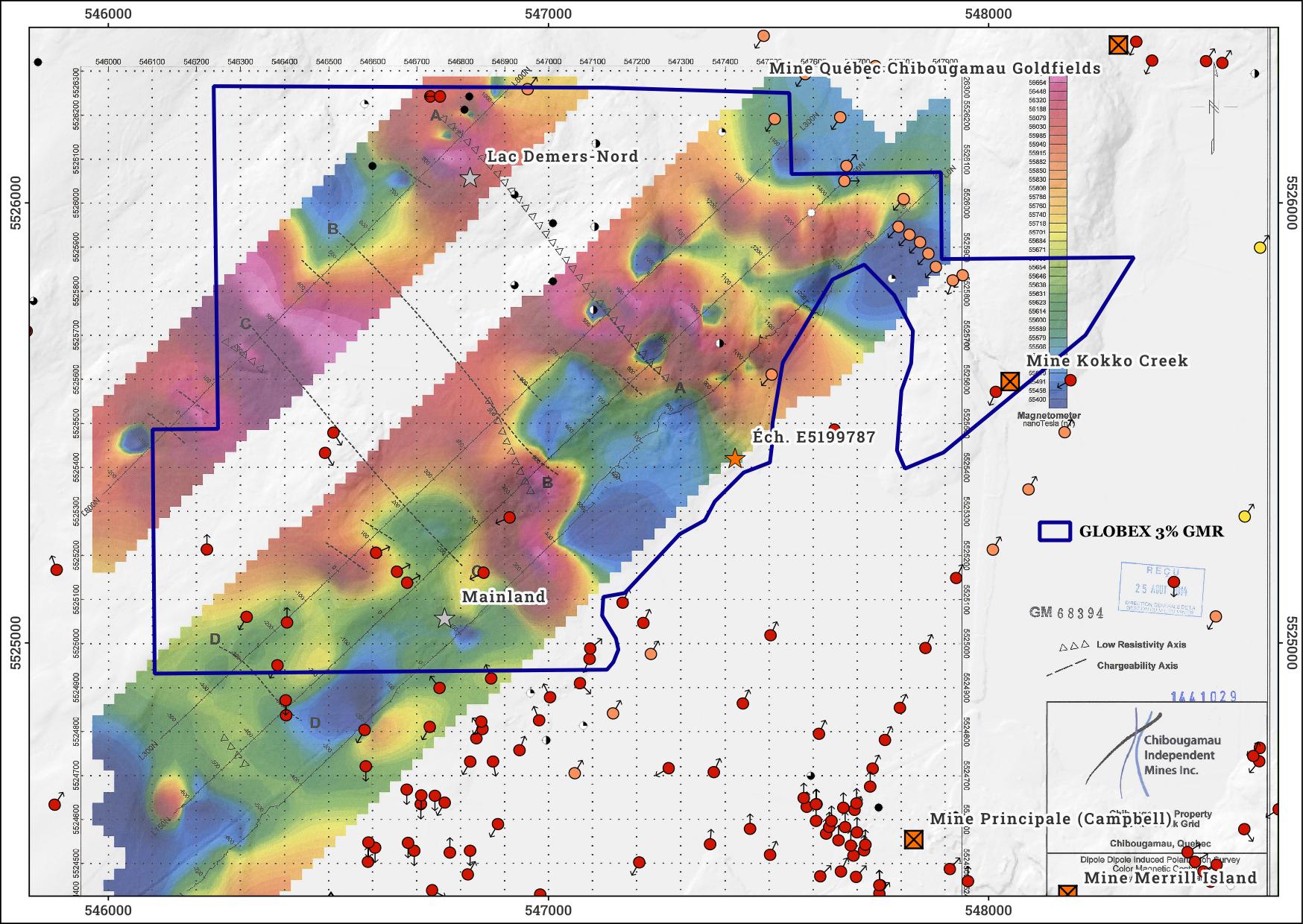
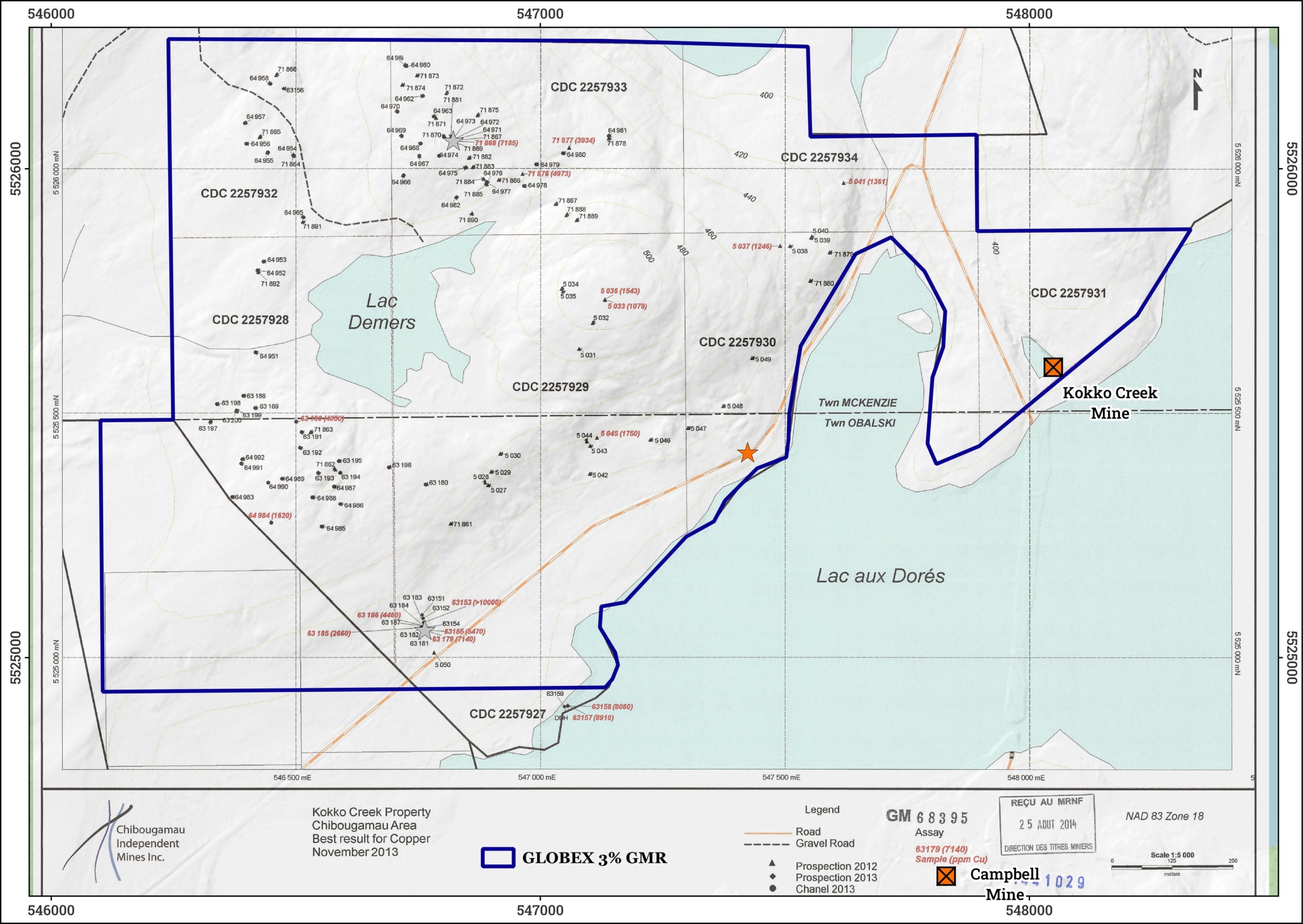
In 2012, CIM carried out line-cutting, prospection and ground magnetometry which highlighted the presence of two anomalous areas in Cu, Zn and Ag (GM67231); grab samples returned anomalies up to 50.9 g/t Ag and 7,185 ppm Cu (0.72%). Then CIM followed-up with ground Induced Polarization (IP) surveying in 2013 which highlighted a deep anomaly which could be associated to the presence of significant sulfides nearby (GM68394). Channel-sampling was performed on several areas of interest and intersected up to 70.2 g/t Ag, 7,140 ppm Cu, 5,640 ppm Zn and 170 ppb Au over 1.0 m (GM68395); best anomalies are essentially located on the Mainland showing, in the southern part of the property. No follow-up work has been undertaken to date on these targets.
In 2021, CIM requested the services of NOVATEM to fly a very-high resolution airborne magnetic survey over several of its properties in the Chibougamau area (GM72456), including the Kokko Creek claims.
TomaGold optioned two (2) blocks of properties from CIM in 2023, including the Kokko Creek claims (CIM Press Release dated August 14, 2023). No work appears to have been carried out by TomaGold on the Kokko Creek property at this time.
Resources and Potential
Historical work in the area identified a regional favorable context for several commodities including gold, silver, copper and zinc. The property potential is supported by favourable geological and structural setting and the presence of well-documented metallogenic and litho-tectonic elements such as the layered anorthositic Lac Doré Complex, and other structures and alteration. This potential is attested by the presence of several former mines in the direct vicinity of the Kokko Creek property (Kokko Creek, Campbell, Chib-Kayrand, Québec-Chibougamau Goldfields, Copper Rand…); Cu was the principal commodity extracted with minor quantities of Zn, Ag and Au.
Future exploration work on the Kokko Creek property should begin with field verifications on the historical IP anomalies as well as on the Input-EM anomalies concordant with resistivity lows in the north-central part of the property which could be caused by mineralized structures.
Follow-up by rock stripping should also be done on the best areas sampled by CIM in 2012 and 2013.