
Lac Croche
Location, Access, Description
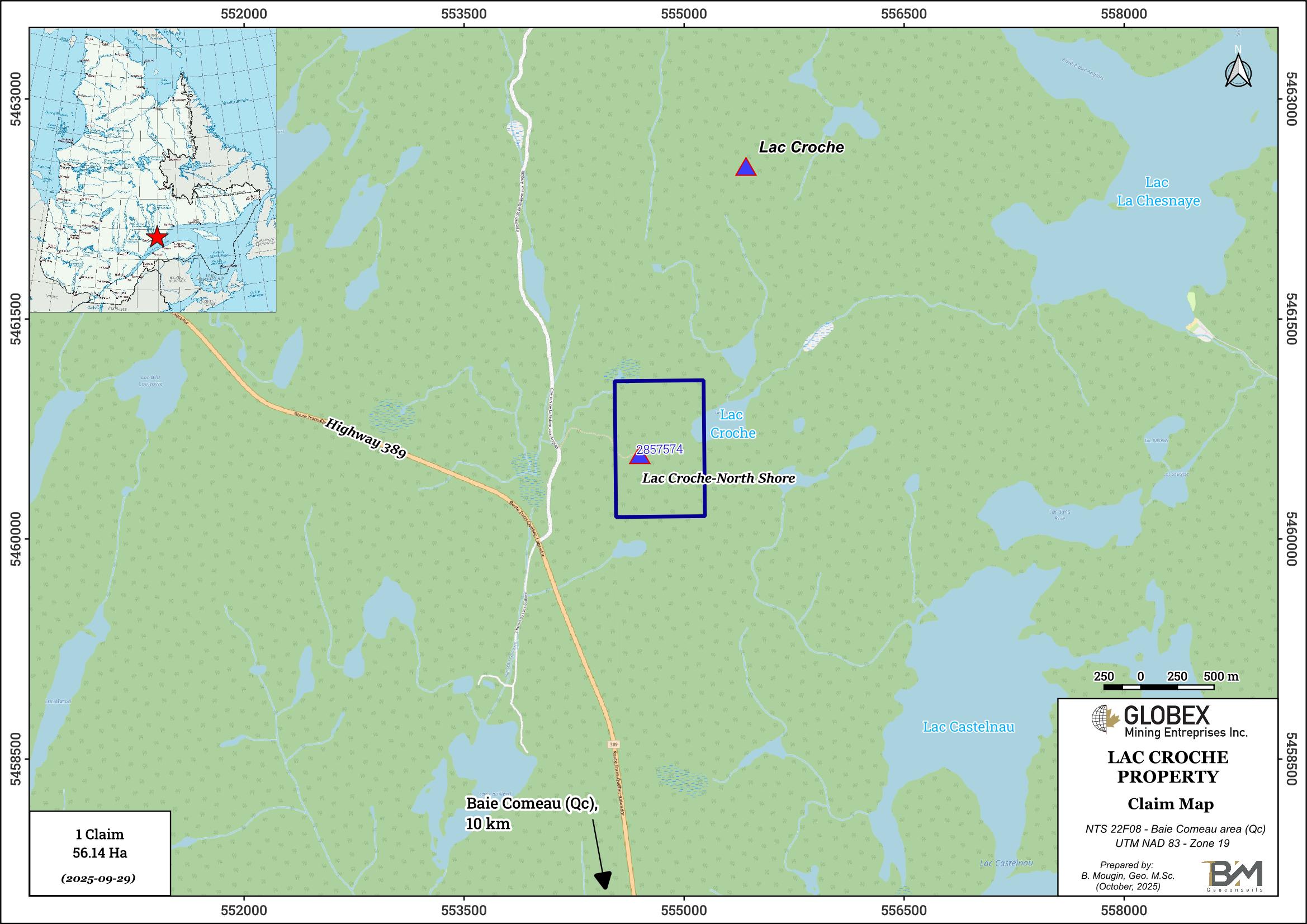
The Lac Croche property is located in the Laflèche township, about 10 km north of Baie-Comeau (Qc), northern Quebec. The property consists of 1 mining claim totaling 56.14 Ha. Globex is 100% owner of the property which is not subject to any third-party interests.
The property is accessible in vehicle from Baie-Comeau via a network of gravel roads and forestry trails. Access is also possible by boat. Numerous commodities can be found in Baie-Comeau regarding contractors, skilled labor, equipment rental, as well as sleep and food accommodation of remote workers. A high-voltage power line also runs 5 km west of the property.
Geology and Mineralization
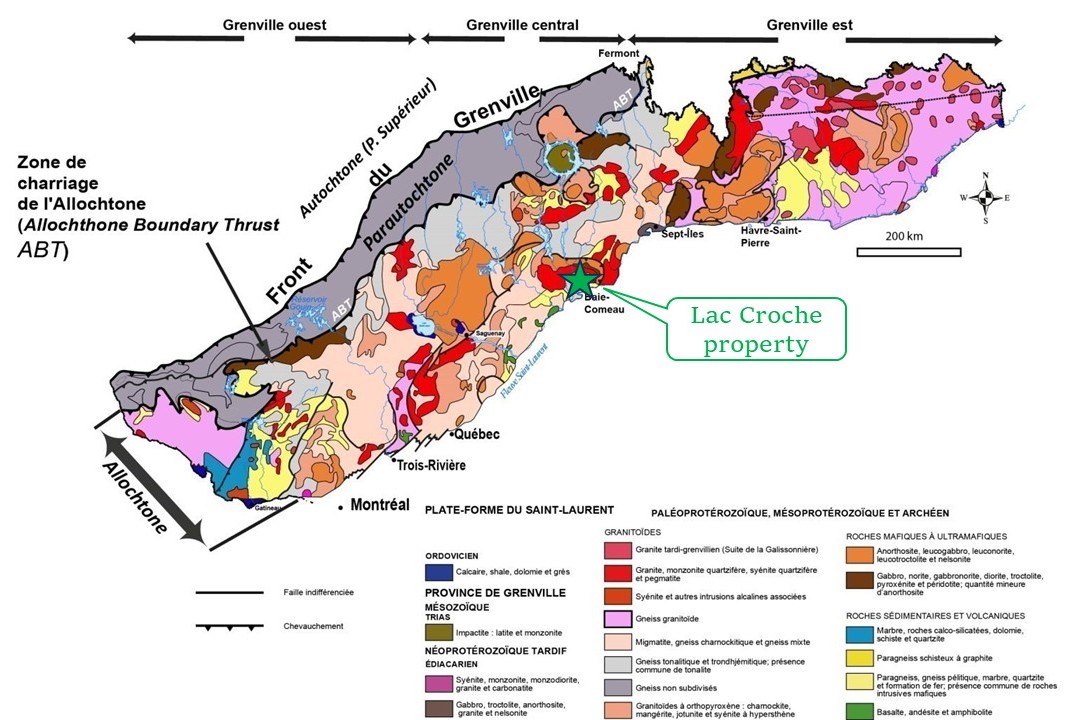
The property is located in the Allochtone unit of the Grenville Province, made up of all the Grenville rocks lying south of the Parautochthonous (Rivers et al., 2012). The Allochtone is composed of metamorphosed detrital, pelitic and carbonate rocks of Paleoproterozoic to Mesoproterozoic age (1.6 to 0.985 Ga ; Rivers et al., 1989 ; Friedman and Martignole, 1995 ; Martignole and Calvert, 1996).
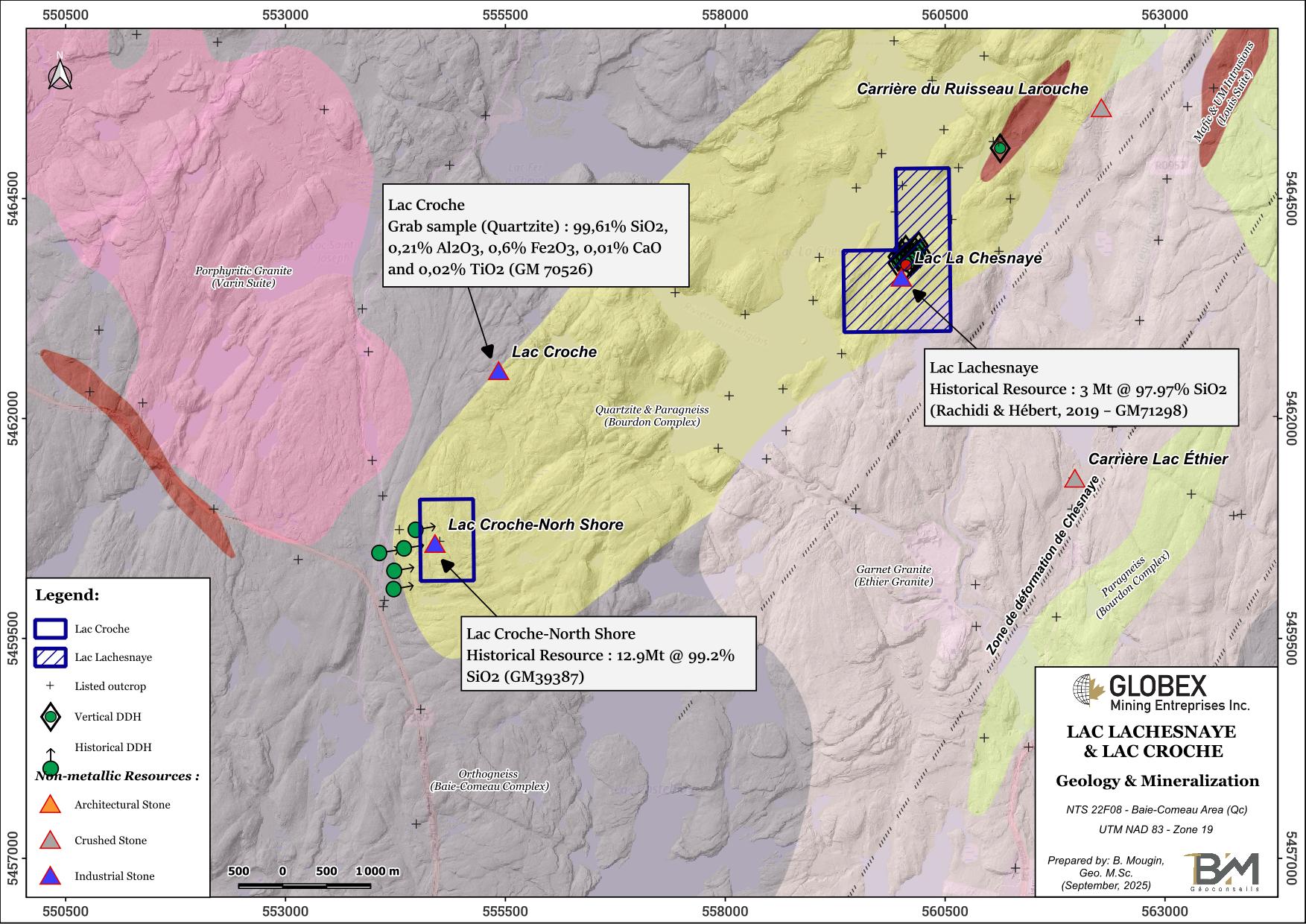
Rocks of the Lac Croche area are composed of orthogneiss of the Baie-Comeau Complex, paragneiss and quartzite of the Bourdon Complex, intruded by mafic to ultramafic (UM) rocks of the Louis Suite and the Ethier garnet-bearing granite (RG2009-03).
The Lac Croche property is essentially set on paragneiss and quartzite of the Bourdon Complex. The quartzite unit forms horizons up to several hundred meters thick, interbedded within the paragneisses.
Metalloegeny
Following Moukhsil et al (RG2009-03), several types of mineralization have been identified in the region of Baie-Comeau, including: 1) Fe-Ti mineralization in gabbronorites associated or not associated with anorthositic suites, 2) Fe-Ti-P mineralization in gabbronorites; 3) Ni-Cu mineralization in mafic to ultramafic igneous rocks; 4) U-Th ± rare earth mineralization in leucogranites and pegmatites; and 5) rare earth mineralization in pegmatites. The region is also valued for its sites enriched in industrial minerals such as silica and sillimanite.
History
Discovery of high silica contents in quartzite of the Lac Croche area dates back to 1933 by Québec North Shore Paper. The area has been the subject of numerous studies, but it was not until 1969-70 that the first reserve estimates appeared. Corporation des Minerais Universels already established a resource of more than 3.5 Mt with a silica content of 98.5% SiO2 (GM30063) and predicted 15 years of mining at a rate of 272,000 tons per year. After additional DDH (5 holes, 993.04 m), Amtec Inc. performed new calculations in 1981, increasing the resource to more than 12.9 Mt with a silica content of 99.2% SiO2 (GM39387).
In the fall of 1994, Vogue Resources took an interest in the Lac Croche property and conducted detailed geological mapping and collected 94 grab samples (GM54173). Laboratory assaying revealed an average silica content of 99.08% SiO2 and relatively high contaminant levels.
Subsequent grab sampling (GM69435, GM72325) and bulk sampling (GM73145) carried out between 2014 and 2023 definitely attest of an economic potential.
Resources and Potential
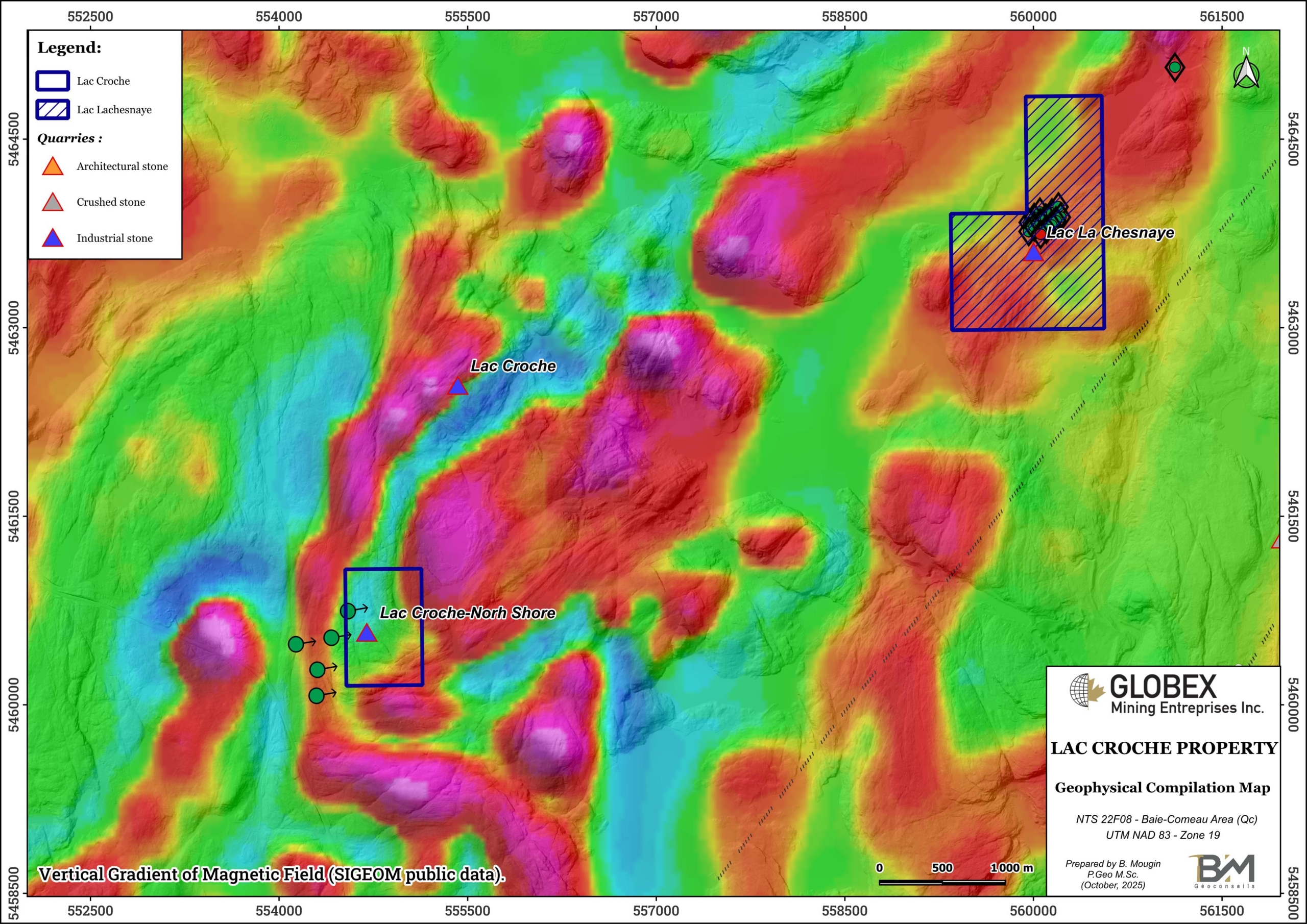
Quartzite of the Lac Croche area returned very high silica contents but impurities (feldspar, mica, etc.) are locally high. Historical Resource of 12.9Mt @ 99.2% SiO2 has been estimated in 1981 at Lac Croche-North Shore, based on 5 DDH. Further exploration is required in order to better define the volume of rock with a high silica content.
The Lac Lachesnaye property of Globex is located a few km NW of the Lac Croche property in strike within the same rock units. Historical Resource of 3Mt @ 97.97% SiO2 is estimated at Lac La Chesnaye.