
Lac Escale
Location, Access, Description
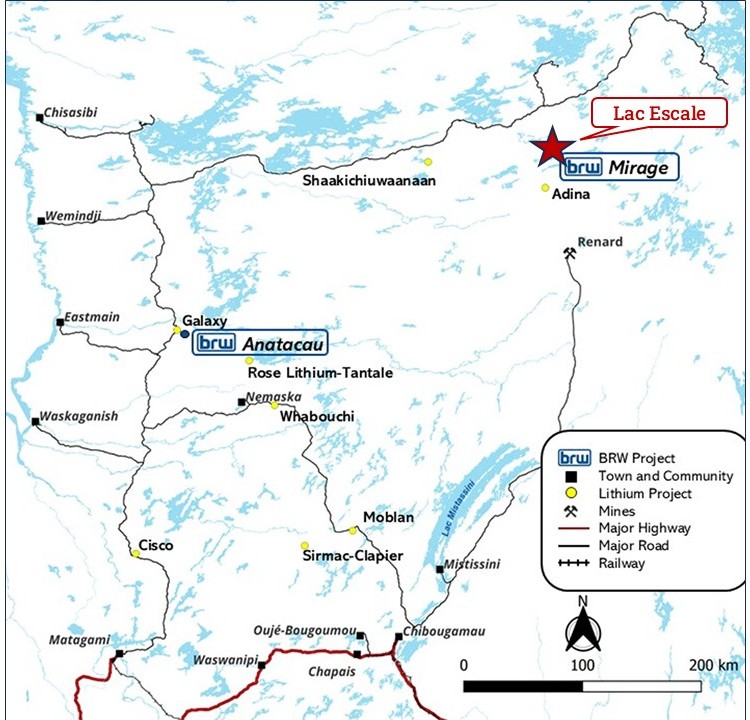
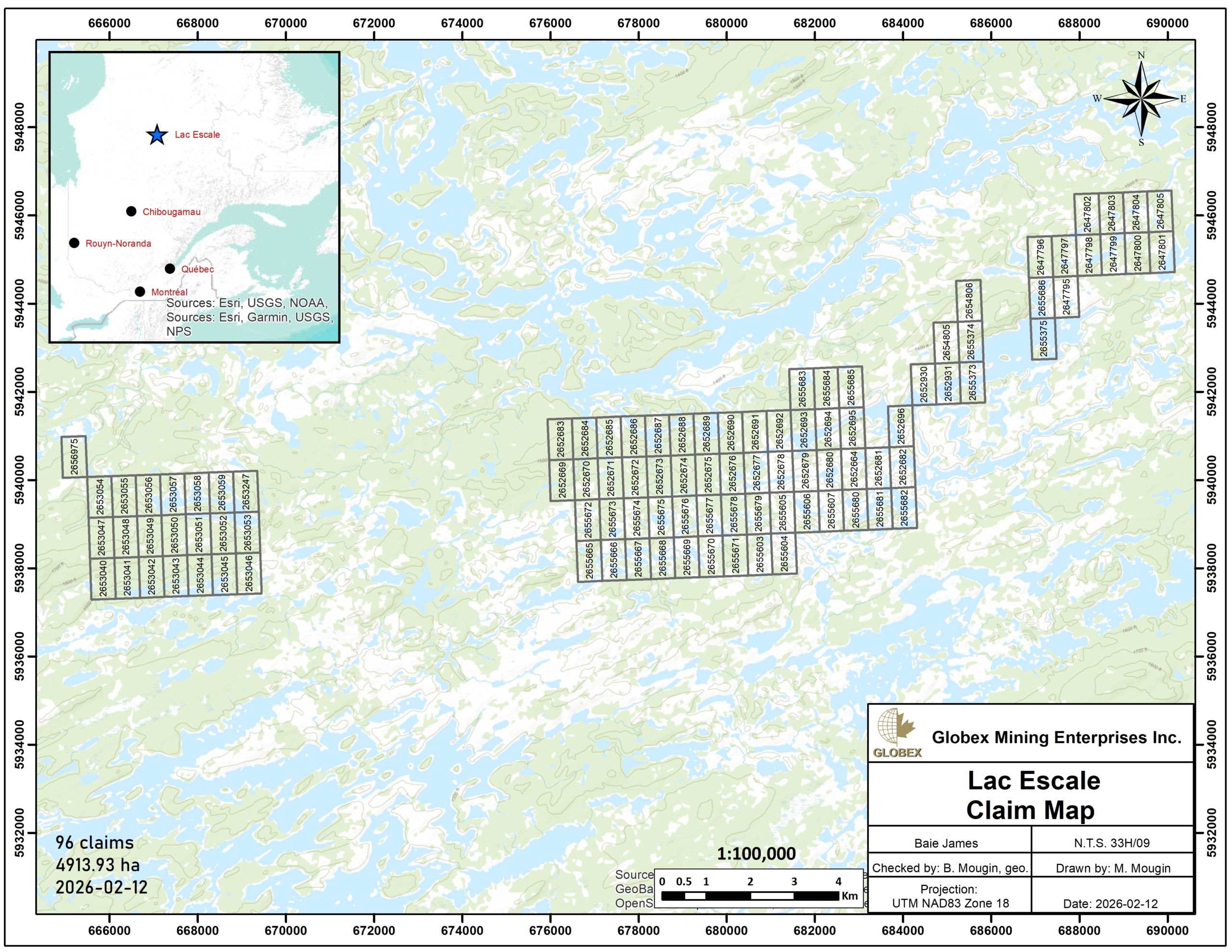
The Lac Escale property is located in Eeyou-Istchee James Bay Government, Northern Québec, Canada (NTS 33H09 and 33H10), approximately 75 km southeast of the La Grande 4 Reservoir of Hydro-Quebec and 40 kilometers south of the Trans-Taiga Highway. It consists of 96 non contiguous claims covering a total area of 4,913.9 hectares. The Project is only accessible by helicopter or seaplane. The claims are part of the advanced exploration stage Mirage Project of Brunswick Exploration ; Globex retains a 3% Gross Metal Royalty (GMR) on these specific 96 claims.
Brunswick acquired the Mirage Project in January 2023. The Mirage project included an option on the “Lac Escale” claim block from Globex which allows BRW to acquire a 100% interest in the Lac Escale project for a total consideration of $500,000 in cash over a 3-year period upon closing of the formal agreement, and an aggregate amount of $1,000,000 in Work Expenditures. Upon successful completion of the Option Agreement, Brunswick Exploration will enter into a Royalty Agreement granting a 3% Gross Metal Royalty (“GMR”) to Globex of which 1% of the GMR may be purchased by BRW for $1,000,000, resulting in a net GMR of 2%. The royalty shall also apply to any mineral rights newly staked by either party within 1 kilometer of the current claim boundaries. On the 5th anniversary of the coming into force of the Royalty Agreement or 5 years following total expenditures of $4,000,000, whichever comes first, Brunswick start paying Globex an annual $100,000 advance royalty payment deductible from eventual production royalty (Brunswick PR dated January 24, 2023).
In early 2026, Brunswick has filed a NI 43‑101 Technical Report and Mineral Resource Estimate (MRE) for the Mirage Project which highlighted Open-PitInferred Mineral Resource of 52.2Mt at 1.08% Li2O and 131ppm Ta2O5 (Table 1 below) for total contained lithia in excess of 550,000 tonnes. This places Mirage among the largest undeveloped hard rock lithium resources in the Americas.

Geology and Mineralization
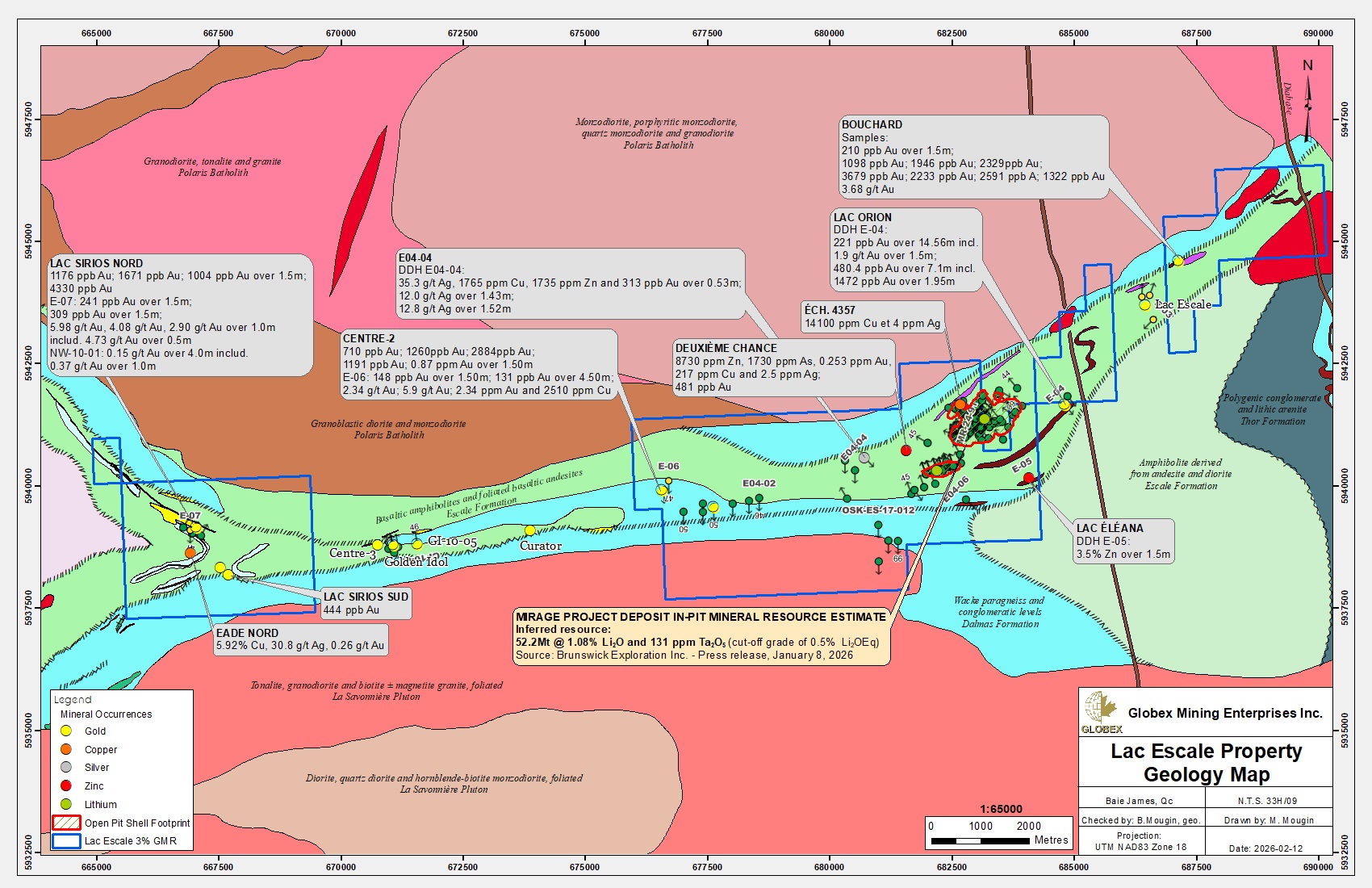
The Mirage Property encompasses a significant portion of an Archean greenstone belt within the La Grande geological Sub-province of the Superior Craton, one of the world’s most prospective and well-endowed hard-rock terranes.
The Archean volcano-sedimentary rocks in the region are attributed to the Duhesme Group, which consists of three (3) formations: the Escale Formation, the Dalmas Formation, and the Thor Formation. These three formations are intersected by granodioritic, dioritic, and tonalitic masses, as well as porphyritic monzodiorites and monzonites. NNW-oriented Proterozoic diabase dykes intersect all Archean lithologies. Regional foliation observed in the rocks of this area has a general direction of N080° and steep dips (GM 66253).
The host stratigraphy records multiple phases of regional deformation, with metamorphic grades ranging from greenschist to amphibolite facies, providing a favourable structural and thermal framework for pegmatite emplacement and preservation. Lithium mineralization at Mirage occurs as spodumene-bearing pegmatites hosted within a diverse package of metavolcanic and metasedimentary rocks, as well as mafic to ultramafic intrusive units.
Detailed geological modelling indicates that the geometry, orientation, and distribution of the spodumene-bearing pegmatites are strongly controlled by regional folding and structural architecture. At the deposit scale, mineralization is concentrated within a large antiform fold hinge, which acted as a structurally favourable conduit during pegmatite emplacement. This well-understood structural control enhances predictability for resource expansion and supports continued targeted drilling within and beyond the current resource footprint.
History
In the early 2010s, Virginia conducted limited exploration work on their Escale property which englobed part of the current Lac Escale property of Globex. Virginia carried-out prospection and till sampling (GM66240), rock stripping (GM66253), as well as Airborne magnetometry (GM65712) and induced polarization (GM66244), in search for gold (Au) mineralization.
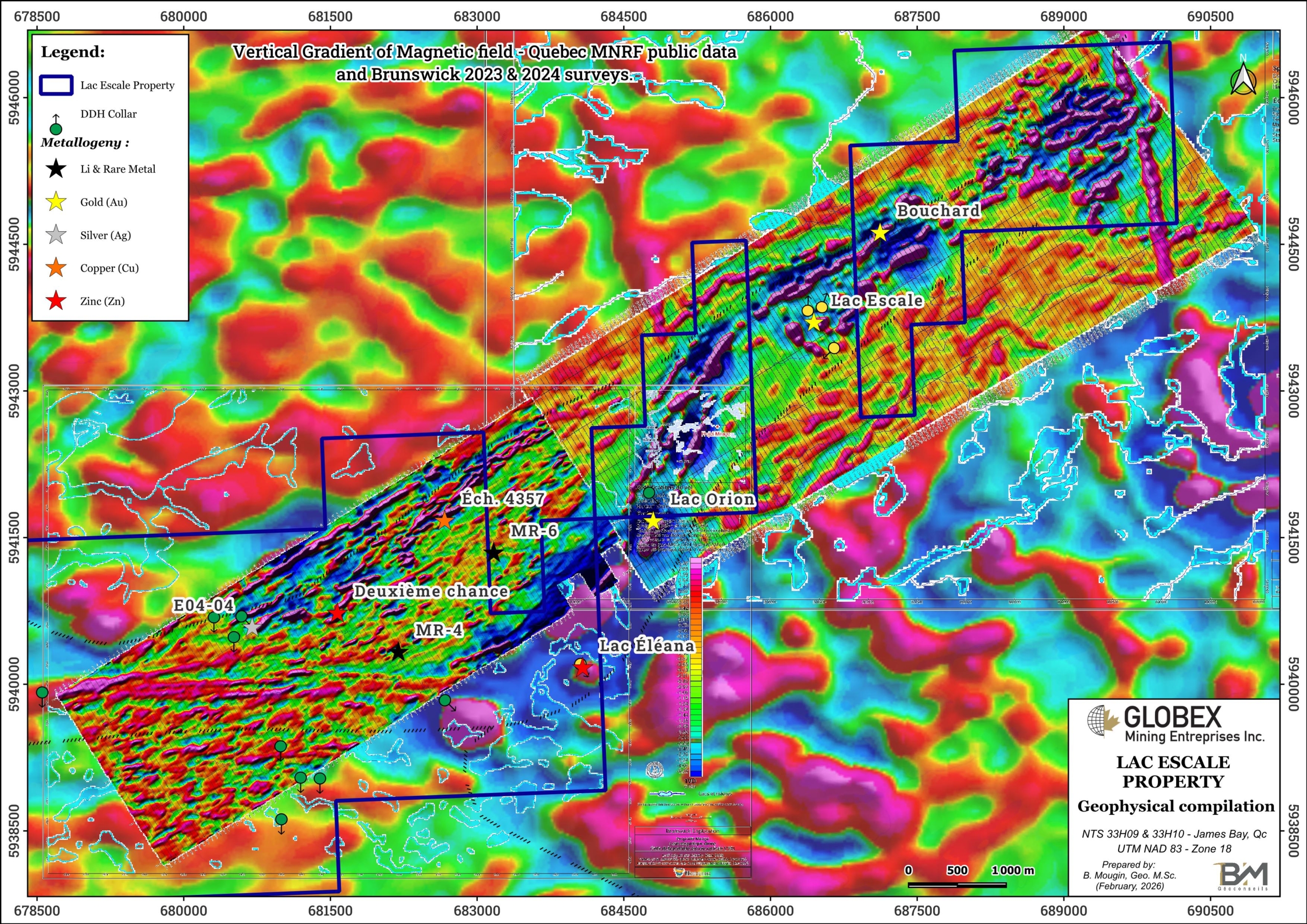
The high-definition magnetic survey identified numerous NE structures; the intersection of these structures with the NS lithological contacts represent high-priority targets. The IP anomalies located near these intersections will require further work.
The discovery of an area of erratic blocks of silicate iron formation and sediments highly mineralized in arsenopyrite and anomalous in gold (from 0.51 to 2.81 g/t Au) represents the best discovery of the 2011 summer campaign.
Recent developments :
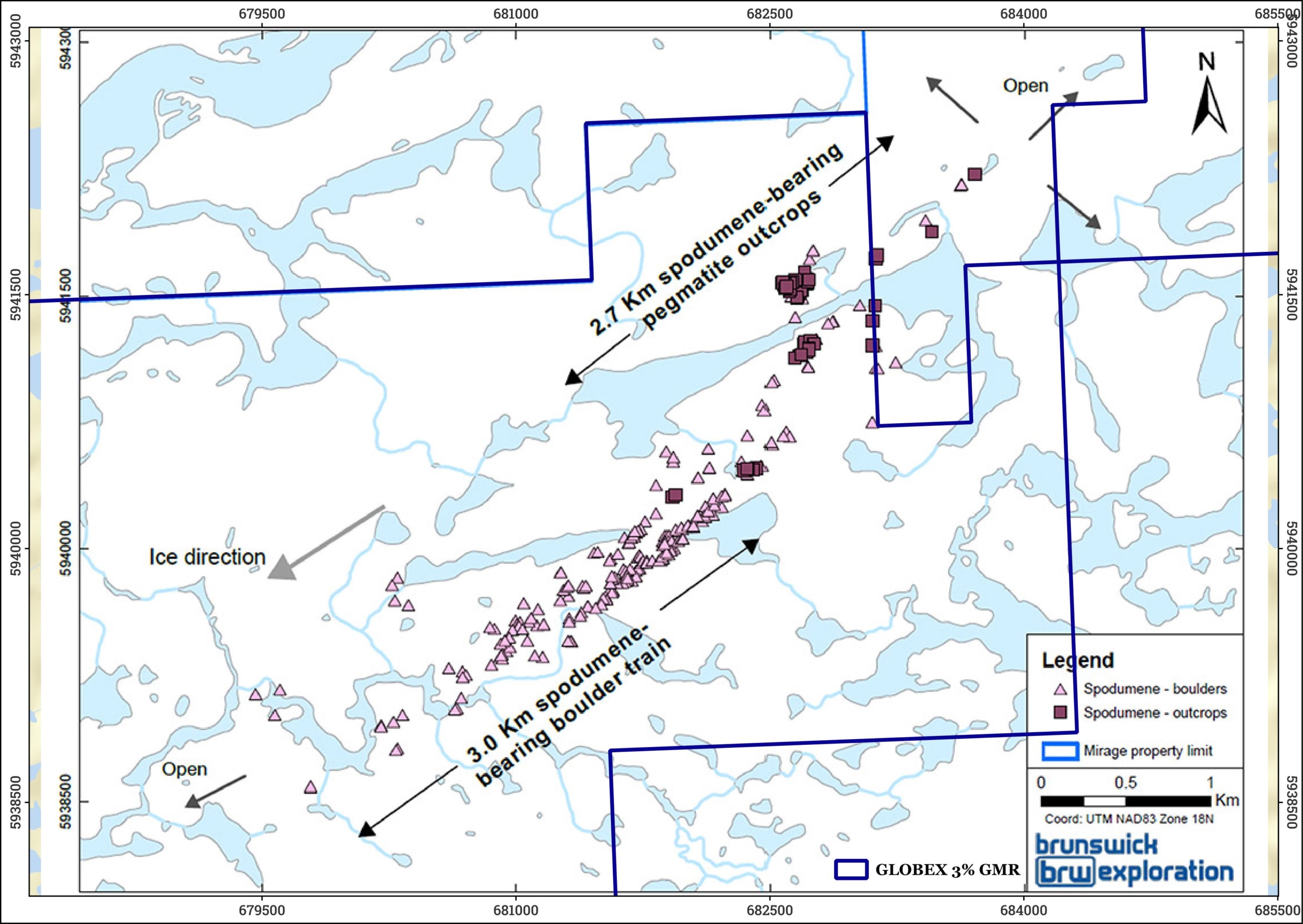
In 2023, Brunswick completed prospection work which rapidly identified a major trend of large spodumene- bearing pegmatite boulders over 3 km of strike length, and well-mineralized pegmatite outcrops observed along a 2.7 kilometre-long by 850 metres trend. The company immediately started a 36 holes (5,090 metre) diamond drill (DDH) program which outlined four major spodumene-bearing pegmatite dykes distributed along three major trends in a NE-SW axis, hosting significant intervals of continuous lithium mineralization at shallow depth (Brunswick PR dated December 4, 2023).

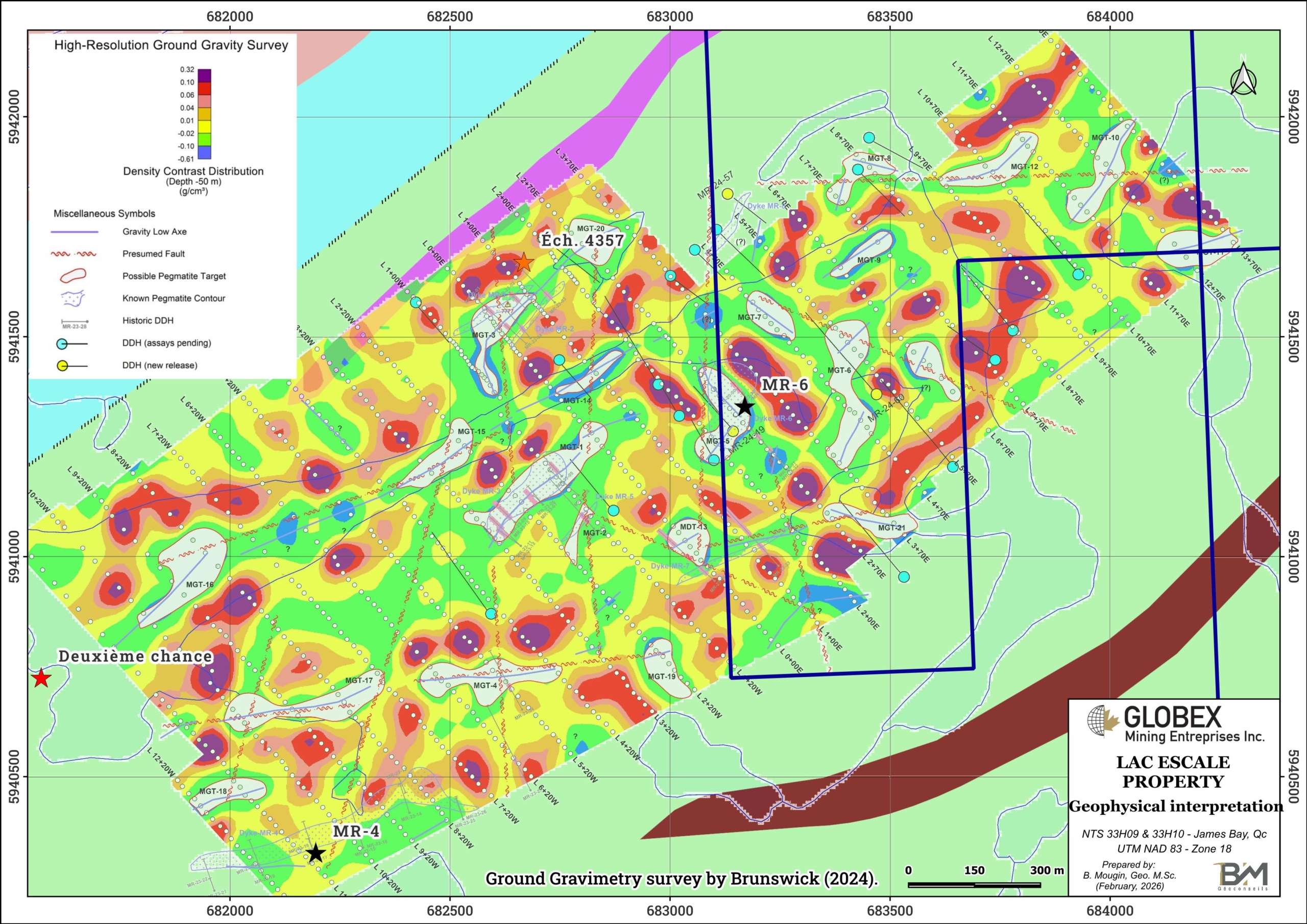
As the mineralized pegmatitic dykes identified were predominantly hosted by meta-basalts and amphibolite which generally present moderately magnetic signatures, Brunswick carried-out combined Airborne LiDAR, magnetometry and gravimetry surveys in 2023 and 2024 (GM73944, GM73946, GM73950 and GM73952) hoping to outline the unexposed strike extent of the mineralized dykes.
High-priority untested targets were discovered during the 2023 and 2024 exploration campaigns or during subsequent geophysical surveys and consist of surface-outcropping spodumene pegmatites and low-grade gravity anomalies with associated lithium geochemical anomalies, that Brunswick tested by several DDH programs in 2024 and 2025. Best intersections from Brunswick DDH from 2023 to 2025 are presented below :


Table 1: Best DDH intersections by Brunswick on the Mirage Project from 2023 to 2025.
|
Hole |
Li2O (%) |
Core length (m) |
|
MR-23-02 |
2.57 |
25.8 |
|
Including : |
3.08 |
14.2 |
|
MR-23-07 |
1.06 |
50.6 |
|
MR-23-14 |
2.75 |
16.2 |
|
MR-23-26 |
3.28 |
10.6 |
|
MR-23-28 |
1.80 |
37.2 |
|
MR-24-43 |
1.27 |
18.6 |
|
MR-24-61 |
1.64 |
69.3 |
|
MR-24-62 |
1.55 |
93.45 |
|
MR-24-76 |
3.09 |
10.85 |
|
MR-24-92 |
3.3 |
14.1 |
|
MR-24-102 |
1.51 |
35.65 |
|
MR-25-115 |
1.19 |
29.25 |
Metallurgical test work was also completed on the 2024 core and confirmed encouraging preliminary recoveries using crushing followed by dense media separation (DMS) only, with no requirement for flotation.
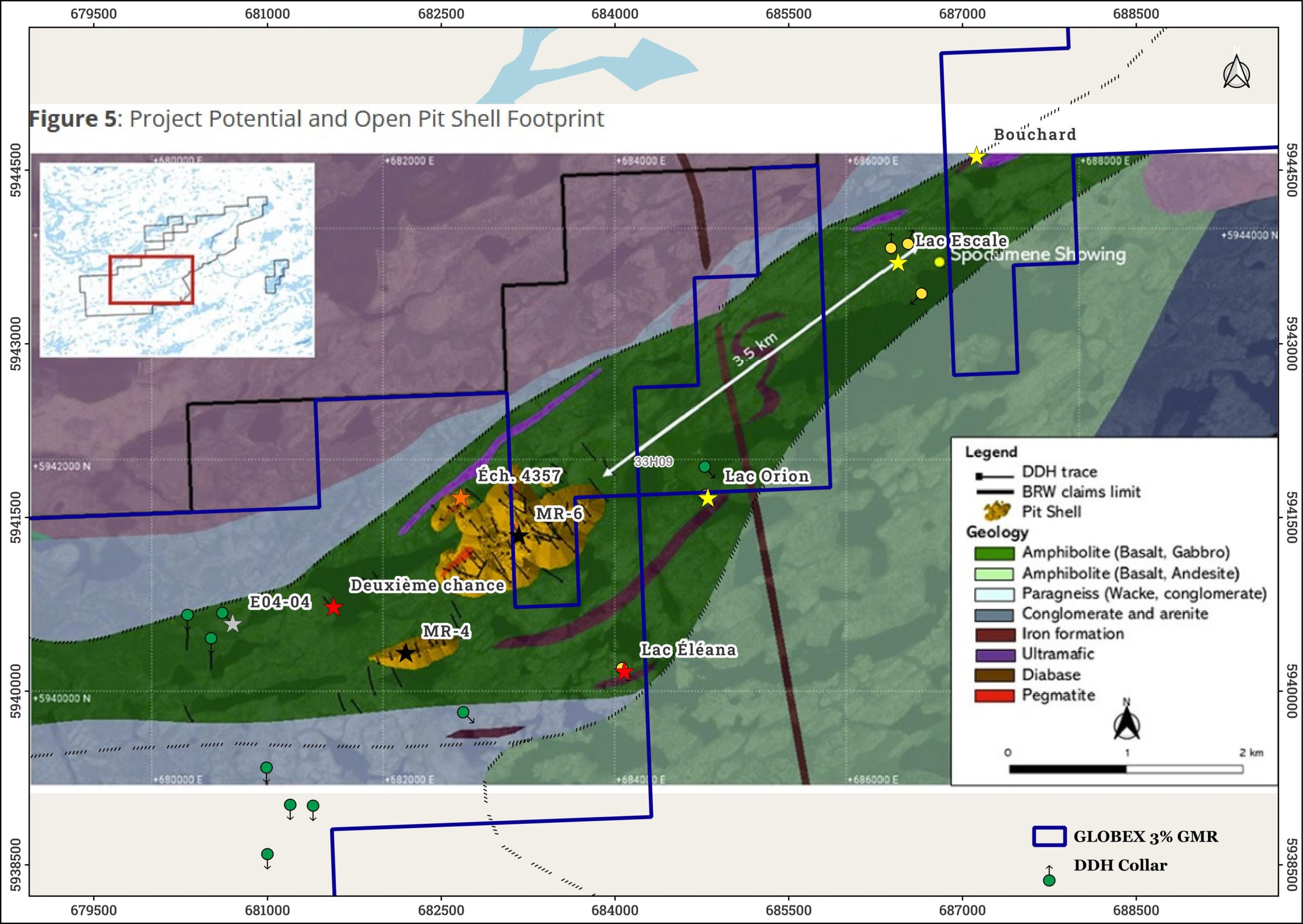
In early 2026, Brunswick filed a NI 43-101 MRE (Richard, 2026; Brunswick PR dated January 8, 2026) with estimated Inferred Mineral Resource of 52.2Mt at 1.08% Li2O and 131ppm Ta2O5 in a pit shell where more than half is located on Globex royalty claims.
Resources and Potential
Historical work in the area identified a regional favorable context for lithium mineralization associated with spodumene-bearing pegmatites. Since 2023, Brunswick Exploration has identified a large spodumene-bearing boulder train measuring approximately 6.5 kilometres in length and 1.4 kilometres in width on the Mirage Property. Importantly, the bedrock source of these boulders has yet to be convincingly identified, suggesting the presence of additional, potentially significant buried spodumene pegmatite bodies elsewhere on the property (Brunswick website, February 2026).
The combination of limited regional drilling, favourable geology, and demonstrated lithium mineralization underscores the Mirage Project’s strong potential for continued resource growth well beyond the current footprint.
Globex is pleased with the progress on this project by Brunswick and looks forward to its continued development. Brunswick stated that it is currently planning its next drill campaign for the Mirage Project and that program will focus on continued exploration efforts on the core area and across the entire length of the project. It should be noted that very little exploration work has been completed outside the current MRE, where the exploration potential remains high and where spodumene bearing pegmatite dykes have been identified up to 3.5 km along strike from the pit shell to the northeast :
After the completion of the 2026 drilling program, new MRE update will be required and additional metallurgical test work is planned to build on these encouraging results.