
Moly Hill
Location, Access, Description
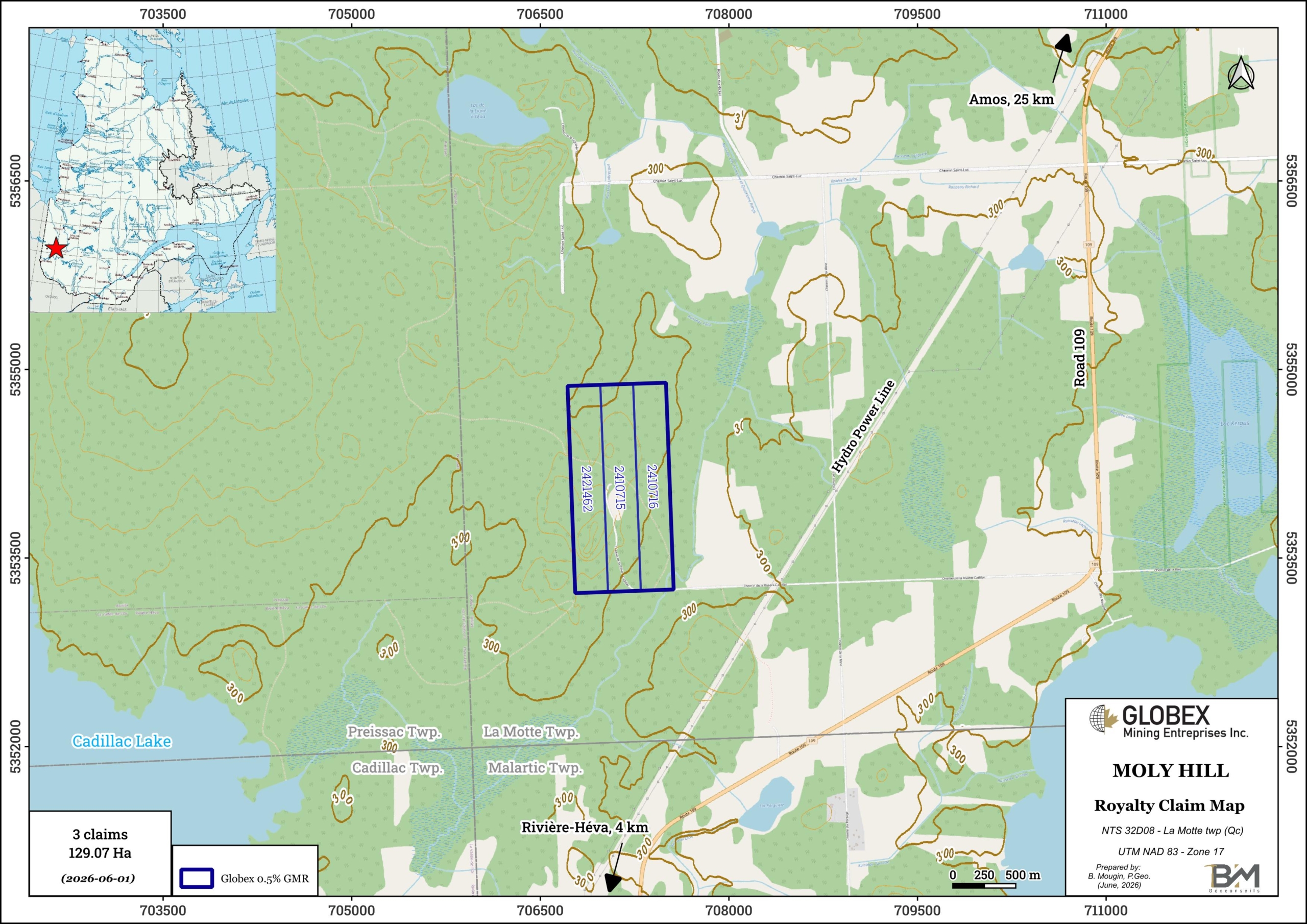
The Moly Hill property consists of 3 mining claims covering an area of 129.07 Ha in the La Motte Township of Abitibi-Temiscamingue (Quebec). The claims are located approximately 30 km south of Amos (Qc) and 35 km northwest of Val-d’Or (Qc). The claims belong to Linear Minerals (ex First Energy Metals), and Globex will retain a 0.5% Gross Metal Royalty (GMR) on any future production.
The property is accessible in vehicle via the 109 Provincial Road linking Val-d’Or to Amos and a network of gravel roads and exploration trails. These towns can provide remote workers with all food and sleep facilities as well as shops and contractors. A high-voltage power line runs to the east of the property
Geology and Mineralization
The information below was transcribed from D’Amours, 2009 (GM64514) and Lafrance et al., 2015 (MB2015-12).
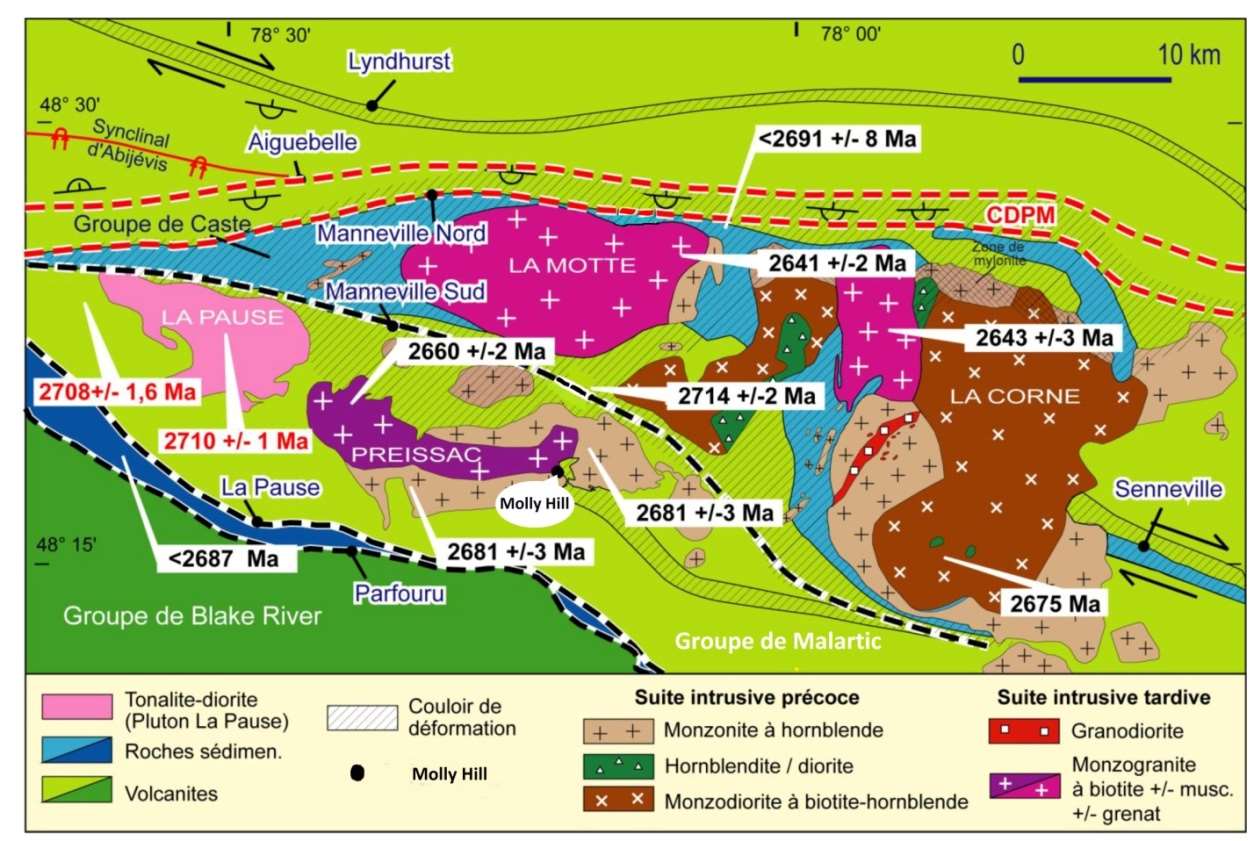
The Moly Hill property is located within the Abitibi Subprovince of the Canadian Shield. The Abitibi Subprovince is an Archean greenstone belt which hosts some of the richest mineral deposits of the Superior Province.; it is divided into two distinct parts (Chown et al., 1992): the South Volcanic Zone (SVZ) and the North Volcanic Zone (NVZ), separated by the Destor-Porcupine-Manneville fault.
The property lies at the stratigraphic base of the Malartic Group (Dimroth et al., 1982) which extends from just north of the town of Val D’Or up to the Destor-Porcupine Tectonic Zone. The Malartic Group consists of a volcano-sedimentary assemblage characterised by the predominance of komatiitic and tholeiitic lava flows. It is divided in three formations which are from bottom to top: (1) the Lamotte-Vassan Formation, (2) the Dubuisson Formation, and (3) the Jacola Formation. This volcano-sedimentary assemblage is crosscut by pre to post-tectonic plutons and by NE-SW Proterozoic dykes.
Rocks of the area were strongly deformed and present evidences of a moderately east-dipping stretching lineation. The property is squeezed between the Manneville-Sud Fault to the north and the Rivière-Héva Deformation Corridor to the south. The Marbridge shear zone is also associated with several Ni (±Cu ±EGP) prospects, including the Marbridge former mine (historical production of 703,027 tonnes grading 2.28% Ni for a total of 12,000 tonnes Ni and 543 tonnes Cu). The La Motte Anticline (Imreh, 1984) is an overturned fold inclined to the south. Regional metamorphism generally exhibits a green schist facies and can reach an amphibolite facies near late-tectonic intrusions.
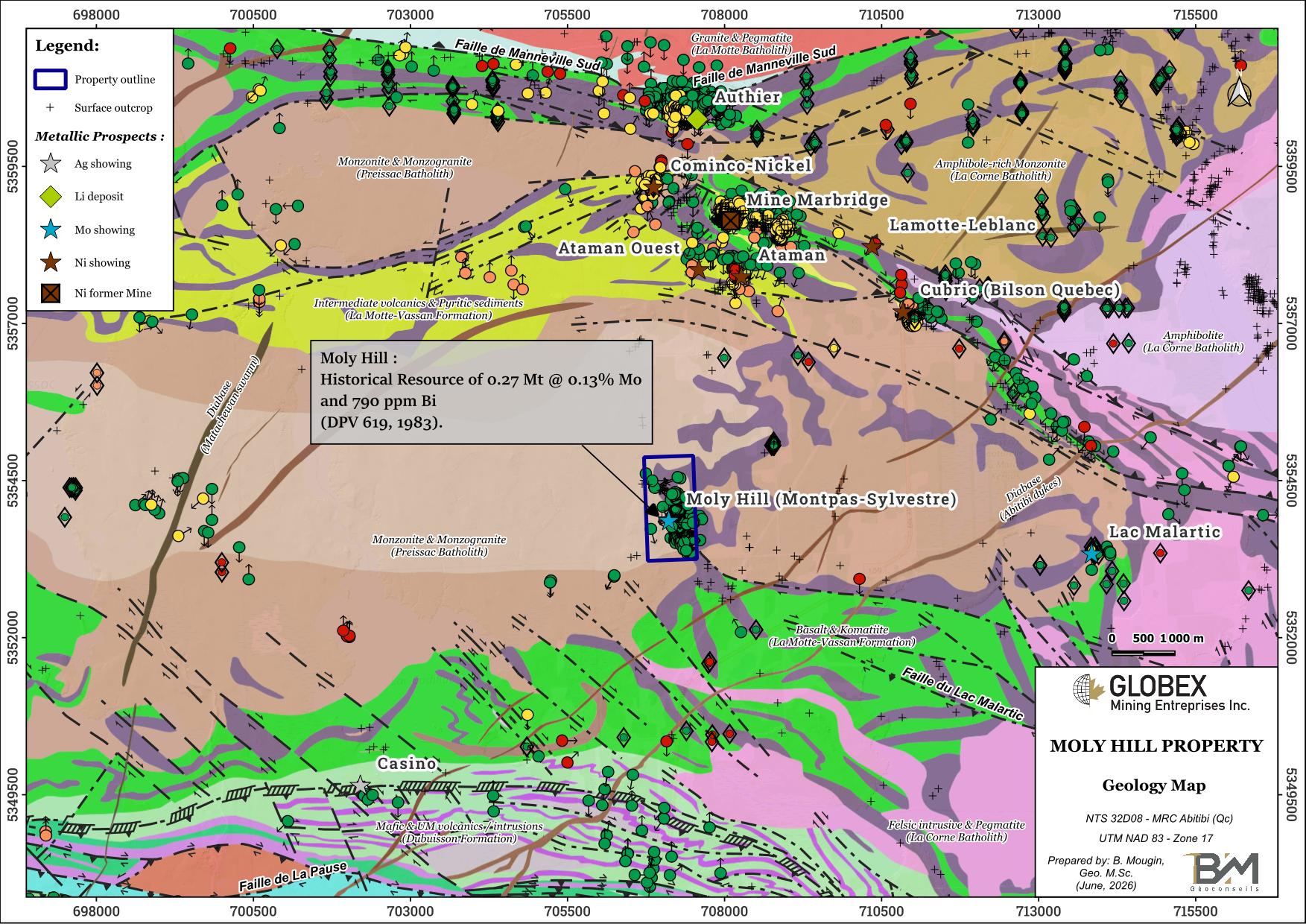
The Moly Hill property is underlain by intermediate intrusive rocks of the Preissac batholith and volcanics of the Lamotte-Vassan Formation (LVF). The LVF consists largely of komatiites with lesser intercalated basalts and minor felsic volcanoclastites and undifferentiated metasediments. This largely ultramafic sequence is intruded by three major batholiths (ET84-03; RG160; MM82-04) : the La Motte, Preissac and Lacorne Batholiths, respectively of monzogranitic, granitic and granodioritic compositions. The LVF and granitoid plutons are crosscut by Proterozoic diabase dykes.
The “Moly Hill Pluton” consists of muscovite-garnet monzogranite and biotite monzogranite. At the contact between the ultramafic rocks and the muscovite-garnet monzogranite lies the Moly Hill deposit, which is mineralized with molybdenite and bismuth. Work carried out by Moly Hill Mining Corporation between 1965 and 1966 led to a historical resource estimation (non-43-101 compliant) of 272,400 short tons @ 0.13% Mo (0.21% MoS2) and 0.079% Bi (DPV 619). The molybdenite mineralization is contained within three (3) different pegmatitic quartz veins with muscovite and potassium feldspar, associated with NNE-trending shear zones hosted both in intrusive rocks and UM volcanics. To the southwest lies a biotite monzogranite containing several aplite and granitic pegmatite dykes in which disseminated beryl and columbite-tantalite mineralization is present (Boily, 1995).
The Marbridge mine is located about 3.8 km NE of the Moly Hill Property. The Falconbridge Nickel reported production of 702,366 tons grading 2.28% Ni and 0.10% Cu from 1962 to 1968 (Class 1 Nickel website) from four mineralized mineralized lenses, prior to being placed on care and maintenance in 1968. Mineralization is commonly found in komatiite and it is associated with a shear zone or massive sulfide veins. The lithologies are affected by tight folding with a NW-SE structural grain. Near mineralized zones, ultramafic rocks show serpentine, talc and tremolite-actinote alteration.
The Authier Lithium deposit of Sayona Mining Ltd. is located about 5.3 km north from the Moly Hill Property, within mafic and ultramafic volcanics of the La Motte-Vassan Formation, south of the La Motte Batholith. JORC compliant Proven and Probable Reserves of 11.2 Mt @ 0.96 % Li2O have been calculated on the Authier Lithium Project in 2023 (Leblanc et al., NI 43-101 Feasibility Study Report).
History
Molybdenite was first discovered in the Moly Hill area in 1901 on the western shore of Lake Preissac. The discovery of Moly Hill appears to date back to 1937, when prospecting work led to the discovery of a large pegmatite dyke containing molybdenite (GM 38307). The deposit was initially named Montpas-Sylvestre.
Subsequently, trenching and diamond drilling were carried out by several successive claim holders, and in 1964, Moly Hill Mining Corporation discovered two new zones of molybdenum and bismuth mineralization. From February 1965 to January 1966, Moly Hill Mining Corporation carried out a total of ninety (90) drill holes totaling approximately 8,832 meters (GM 16411, GM 16657; GM 16810, GM 17072; GM 17236).
In 1967, the Department of Energy, Mines and Resources of Canada conducted a metallurgical study of ore samples collected from bulk samples taken at the Moly Hill Mining Corporation property (GM 17943).
In 1978, the Ministry of Natural Resources conducted systematic sampling at 3-meter intervals over a total length of 244 meters to verify tantalum grades along the roof and wall of the vein (GM 34260). The results showed limited tantalum content of up to 70 ppm Ta₂O₅ in the lower wall of the vein.
In 1980, Belleterre Quebec Mines Ltd. carried out three (3) small drill holes totaling 21 meters (GM 36006).
In 2005, Gérard Houle (Les pierres du Nord) carried out blasting operations, and approximately two (2) tons of samples were collected for a market study aimed at verifying the site’s potential for the collectors’ market (GM 62055).
In 2009, Arianne Resources conducted a field visit to the property to assess the geological context and collect a few samples (GM 64475).
Recent work and developments :
In 2014 and 2015, Globex carried out geological mapping and channel sampling in order to characterize the distribution of Mo and Bi mineralization in the different lithologies and alterations (GM 68536, GM 68855, GM 69533).
Following the high silica grades encountered in the 2015 channel sample results, Globex continued its channel sampling work in 2018 to determine the average silica grade of the Moly Hill zone in order to assess whether the rock can be used as a flux by Glencore at the Horne smelter (GM 71349). A total of 53 samples totaling 51.95 linear meters were collected using a rock saw during the summer of 2018.
In 2019, Globex sent a 5-kg composite sample to the Horne smelter in Rouyn-Noranda in order to conduct their own assays. This work confirmed high silica content and the absence of high concentrations of undesirable metals such as arsenic or bismuth (GM 71713).
Resources and Potential
Historical exploration on the Moly Hill property recognized sub-economic Mo mineralization associated with quartz veins hosted in NNE-oriented shear zones. Based on historical drilling data, the potential for increasing resources appears to be limited.
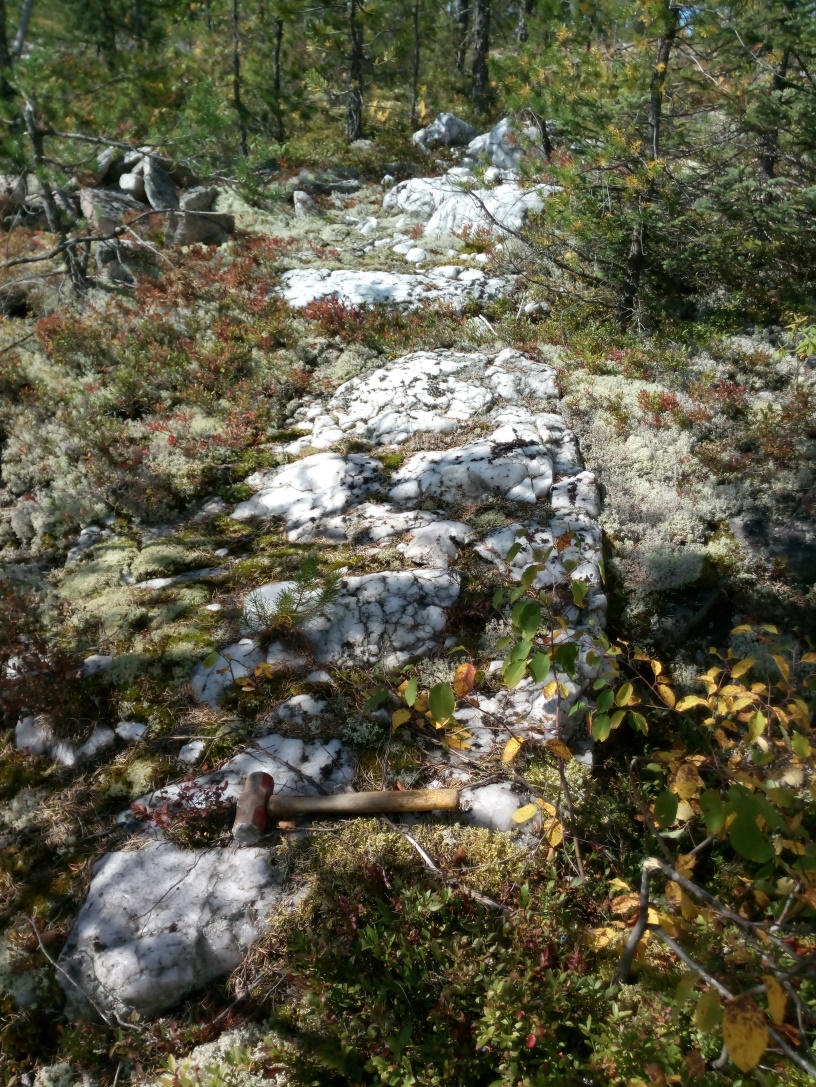
Following the 2018 trenching work, Globex estimated a mineable volume of 20,000 to 25,000 m³ @ 92.24% SiO₂ (non-NI 43-101) in the Moly Hill area, which is open to the north and south. The 5-kg sample analyzed by Glencore in 2019 at the Horne smelter confirmed this high silica content, as well as the absence of high concentrations of undesirable metals such as arsenic or bismuth. The discussions between the two sides never came to a conclusion.