
New Alger
Location, Access, Description
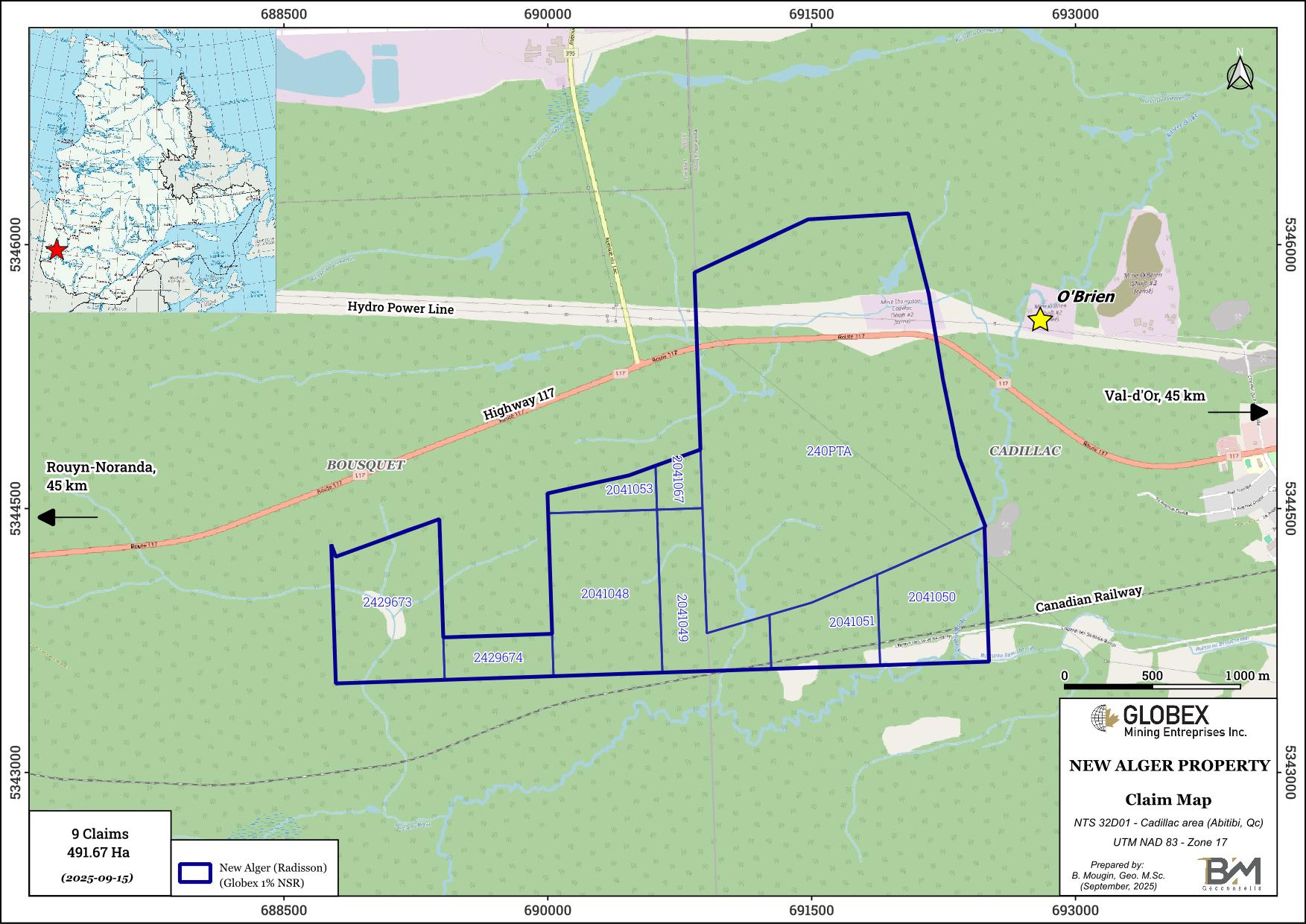
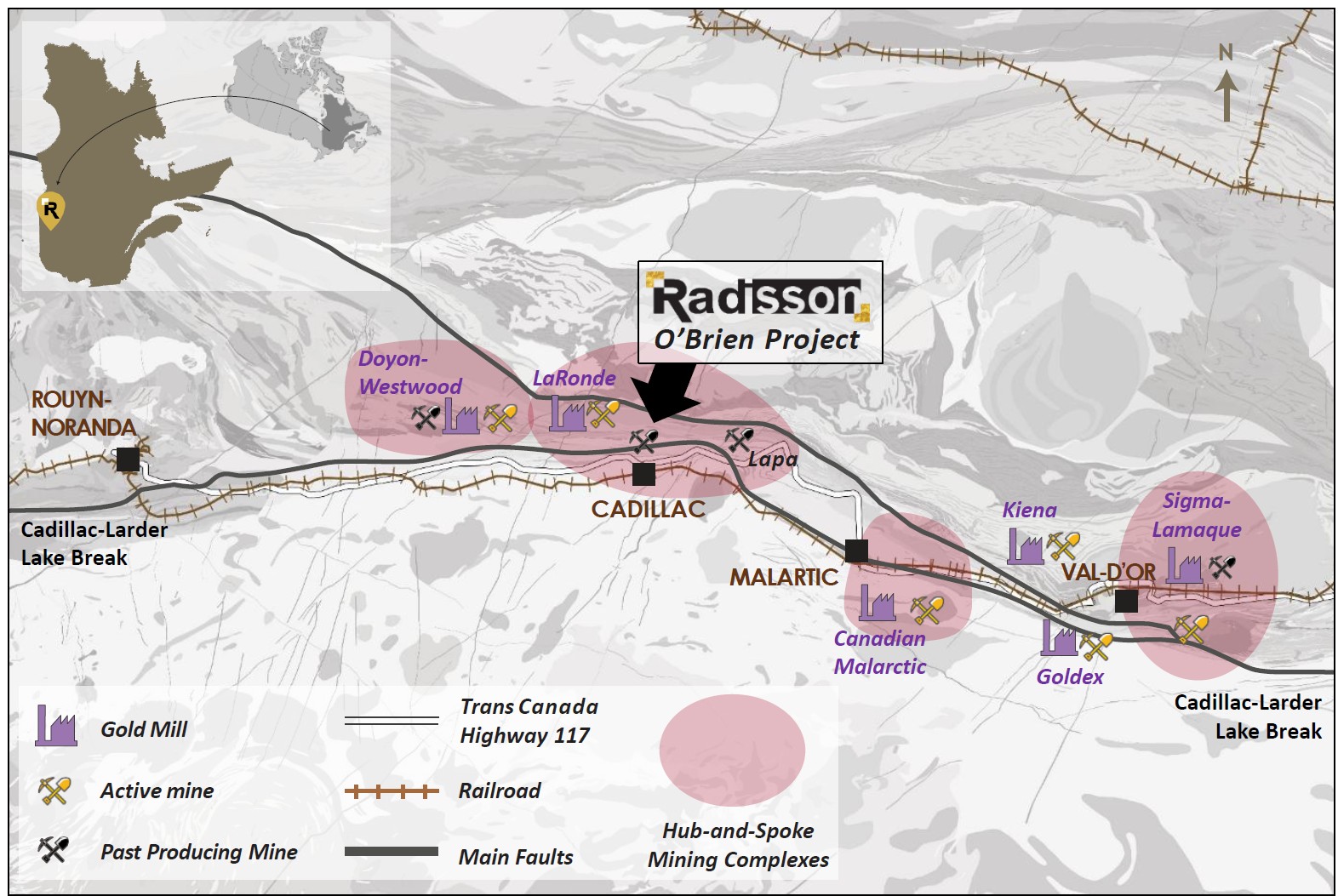
The New Alger property consists of 9 mining claims covering an area of 492 Ha west of Cadillac (Abitibi), in the MRC of Rouyn-Noranda. The property is located approximately 45 km east of Rouyn-Noranda (Qc) and 45 km northwest of Val-D’Or (Qc). The claims are part of the advanced exploration stage O’Brien Project of Radisson. Globex retains a 1% Net Smelter Royalty (NSR) on these nine (9) claims.
The Property has direct year-round access from the Trans-Canada Highway 117. This region is associated with several active mines and numerous exploration companies. A full range of infrastructure, service companies, and experienced human resources are available in most nearby communities including Val d’Or, Malartic, and Rouyn-Noranda. Two regional airports, located in the cities of Rouyn-Noranda and Val d’Or, provide regular connection with the main centers of the province (Montreal and Québec City). the Property is also connected to a high voltage power line and is intersected from east to west by provincial highway Route 117 and the Trans-Canada Railway.
Geology and Mineralization
The New Alger property is located on the contact between the Abitibi and Pontiac subprovinces, separated by the Cadillac–Larder-Lake Deformation Zone (CLLDZ). The Abitibi Subprovince is an Archean greenstone belt which hosts some of the richest mineral deposits of the Superior Province whose total endowment, including Production, Reserves and Resources is estimated to be > 9,375 t Au (Dubé and Mercier-Langevin, 2020).
Volcanic and sedimentary rocks of the Cadillac area form a series of east-west-trending steeply dipping monoclonal panels. Sedimentary rocks, mainly wackes, of the Pontiac Group lie south of the CLLFZ. Most of the orebodies in the southern part of the Cadillac mining camp are hosted in rocks of the Piché Group (volcanic rocks interbedded with conglomerates, wackes, graphitic schists and pyritic cherts), which forms a thin band several tens of kilometres long that follows the trace of the CLLFZ (Evans, 2023).
All Archean rocks were deformed and verticalized during the Kenorean Orogeny (2.7 – 2.68 Ga). Regional metamorphism ranges from the greenschist facies to the upper greenschist facies. Non-deformed NE-oriented Proterozoic diabase dykes run throughout the area.
The northern half of the New Alger property is underlain by steeply south dipping greywackes, mudstones and banded iron formation of the Cadillac Group. The southern portion of the property is underlain by greywackes and lesser mudstones of the Pontiac Group. The sedimentary groups are separated by a narrow but critically important 50-200 m wide band of talc/chlorite schists and mafic volcanic rocks of the Piche Group that strike east-west and dip steeply to the south. The CLLDZ is best developed within the Piche Group mafic and ultramafic volcanic but occasionally widens to encompass parts of the adjacent bounding sedimentary formations.
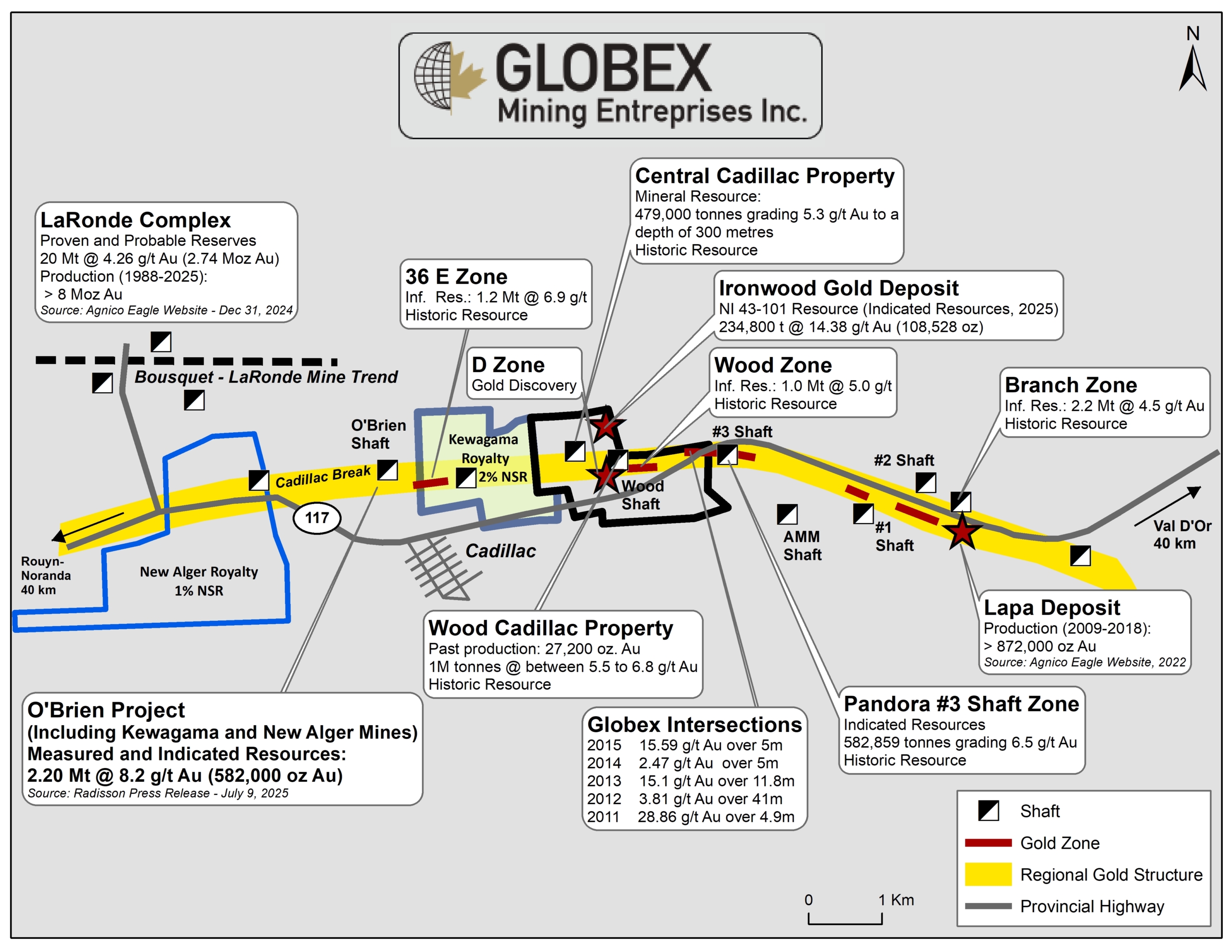
The New Alger property is located in the central part of Cadillac Township, in Abitibi, at the heart of one of Canada’s most productive gold mining camps. Most of the gold mineralization in the Cadillac mining Camp is closely associated with the CLLDZ and its subsidiary structures. Approximately 40 gold deposits, which have produced over 60 million ounces of gold since the early 20th century, are associated with this major structure and its subsidiary faults (Evans, 2023 NI 43-101 Technical Report on the O’Brien Project).
The deposits are quartz-lode type, generally consisting of auriferous sulphide-bearing quartz-carbonate shear veins frequently containing free milling gold, disseminated arsenopyrite-pyrite haloes to the veins in shear zones and related structures and to a lesser extent, veins in extensional fractures, structural zones, and breccias. The O’Brien Mine is an inactive underground mine, which experienced intermittent production from 1925 to 1957 and was considered to be the Abitibi Greenstone Belt’s highest grade gold producer during its life, producing 1,197,147 tonnes @ 15.25 g/t Au for 587,121 ounces of gold (Williamson, 2019).
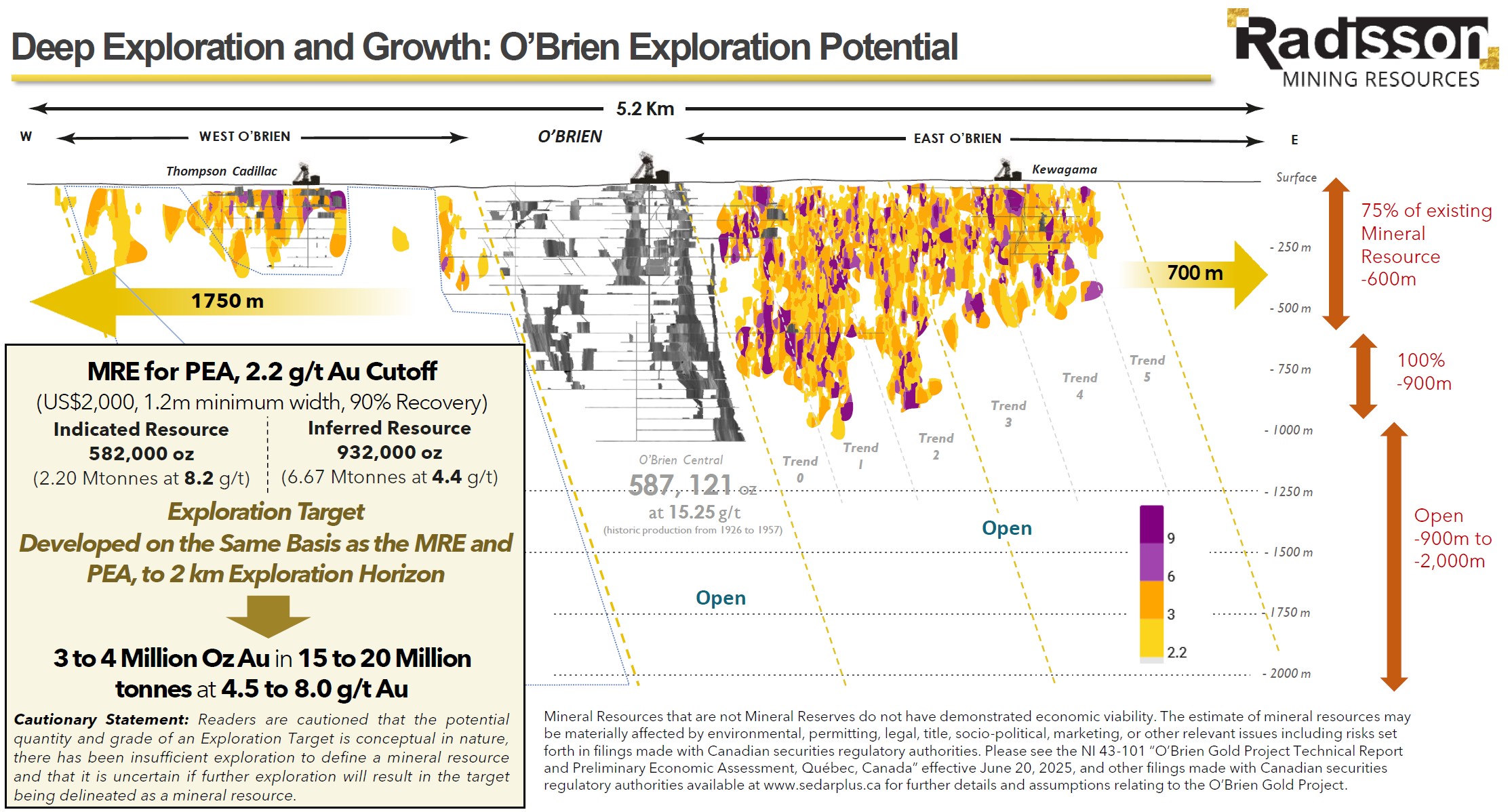
According to the Preliminary Economic Assessment (see Radisson PR dated July 9, 2025), Indicated Mineral Resources of the O’Brien Project are estimated to 2.20 Mt @ 8.2 g/t Au, containing 582 koz Au. Mineralization is currently defined within two areas of the Project site : O’Brien East, host to both Zone 36 East (east of the historic O’Brien mine) and Kewagama (at-depth extension of the historic Kewagama mine), and O’Brien West, host to New Alger, an at-depth and lateral extension of the historic Thompson-Cadillac mine.

History
The New Alger Property has a long history of mining and exploration activities dating back to 1924 when gold was discovered by E.J. Thompson. The Property hosts the Thompson-Cadillac Mine, an historic past-producer. The mine was initially developed during the period 1925-29 when the No. 1 Shaft was sunk to 189 m (620 ft). The main mining activity took place between 1936 to 1939 when an estimated 21,740 oz of gold were reportedly produced (Yassa, 2020). Development in 1945 to 1948 resulted in the shaft being deepened to 343 m (1,124 ft.), however mining activities appear to have been limited in this period. Historical reports suggest that the Thompson Cadillac process plant gold head grade was 4.2 g/t Au (0.123 oz/ton).
O’Brien Gold Mines Ltd. began mining the O’Brien deposit in 1925 with the sinking of the first shaft and commencement of underground development. Following intermittent activity, the O’Brien mine was shut down permanently in 1981 and allowed to flood in 1985. Total historical production at O’Brien (1926-1957) is estimated to 1.2 Mt @ 15.25 g/t Au, for 587,121 oz Au (Radisson website, September 2025).
Cadillac Ventures and Renforth Resources established a joint-venture on the New Alger property in 2006 and Renforth acquired full ownership in 2013. In 2020, Renforth completes a NI 43-101 Mineral Resource estimate at New Alger (Yassa, 2020) then sells the New Alger property to Radisson for CDN$ 4.34M in securities and cash.
In 2022, Radisson embarked on an extensive exploration campaign on the New Alger area of the O’Brien Project. The work was separated into three distinct phases and was carried out between January and October 2022. The work consisted of a compilation/planning phase, a prospecting and sampling phase, and a trenching phase. Analytical results confirmed gold and base metal potential of the sector and the prospecting campaign also revealed mineralization-bearing lithologies and structures.
Between 2015 and 2025, several Mineral Resources Estimate reports were released by Radisson on O’Brien Project. The last in date is a positive Preliminary Economic Assessment (PEA) released in July, 2025, that anticipates underground mining with a life span of 11 years, with 740 k oz Au extracted and 647 k oz Au recovered at an average recovery rate of 87% (see Radisson website for more details).
Resources and Potential
A Preliminary Economic Assessment (NI 43-101 “O’Brien Gold Project Technical Report and PEA, effective date, June 27, 2025) described a low-cost, high-value Project with an 11-year mine life and significant growth potential based on the use of existing regional infrastructure. Indicated mineral resources are estimated at 0.58 million ounces (2.20 million tonnes at 8.2 g/t Au), with additional Inferred mineral resources estimated at 0.93 million ounces (6.67 million tonnes at 4.4 g/t Au).
Mineral Resources are located between 0 and -900 m under the Kewagama and O’Brien former mines and between 0 and -400 m under the Thompson-Cadillac (New Alger) former mine. Potential is fully open at depth.