
Nourricier-Lac Suzanne
Location, Access, Description
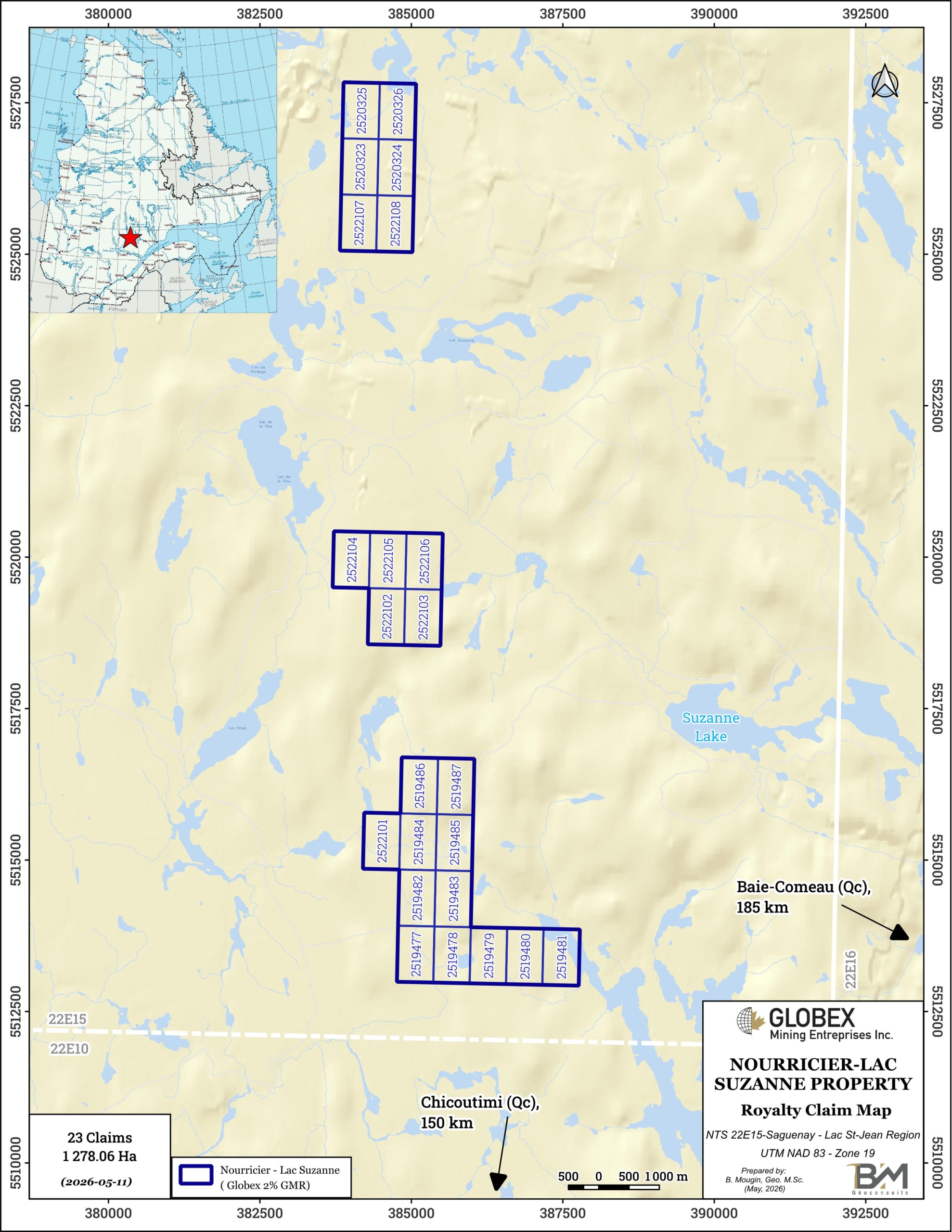
The Nourricier – Lac Suzanne Property is located about 150 km north of Chicoutimi (Qc), and 185 km west of Baie-Comeau (Qc). It is composed of 23 mining claims covering an area of 1,278.06 ha in the Saguenay – Lac St-Jean administrative region of Quebec Province. The claims belong to Coniagas Battery Metals inc. and are part of the Graal project ; Globex retains a 2% Gross Metal Royalty (GMR) on these specific 23 claims.
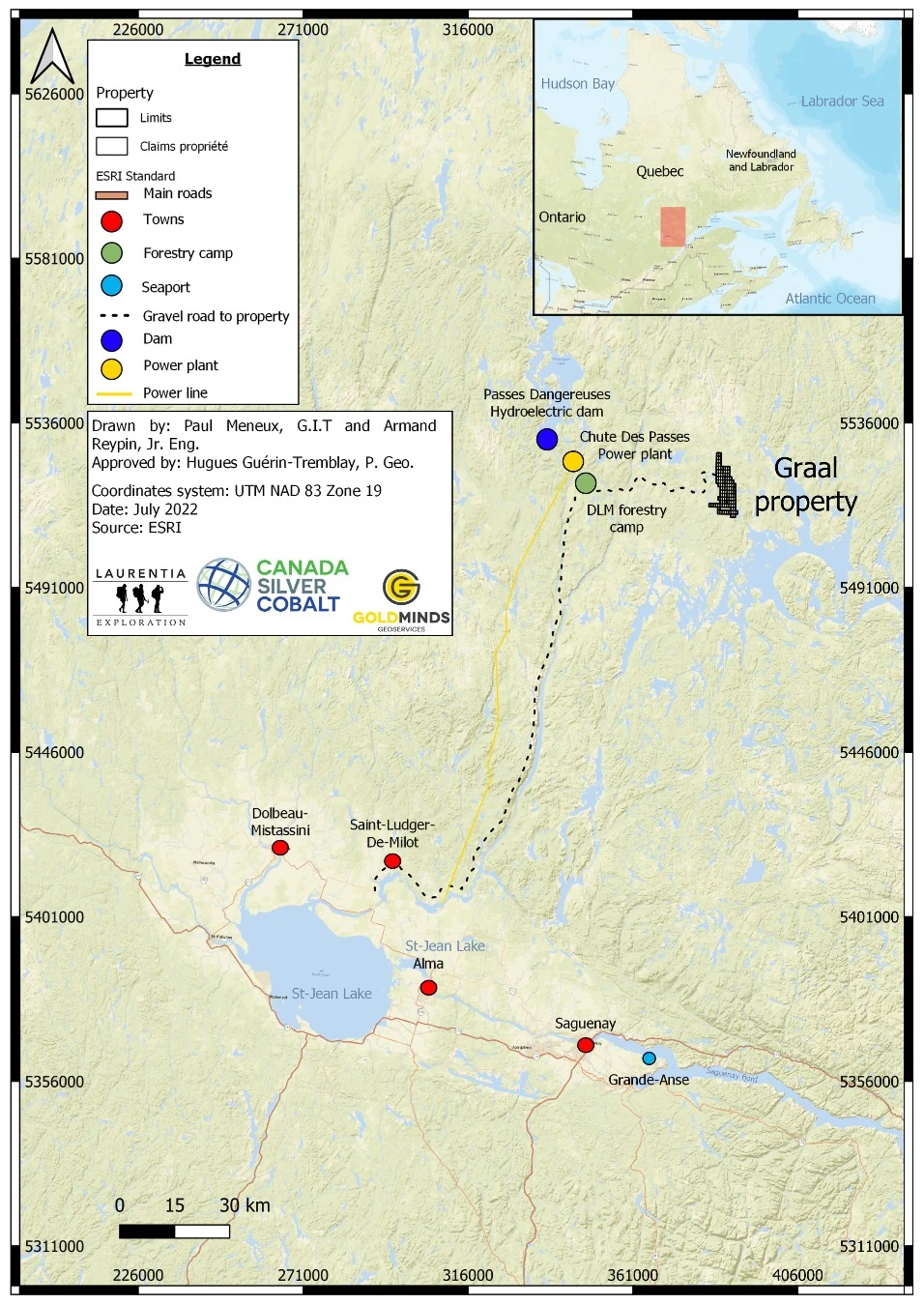
Access to the property is possible in vehicle thanks to the Chutes-des-Passes all-weather gravel road and a dense network of secondary roads. The Lac Suzanne property is accessible from the municipality of St-Ludger-de-Milot by travelling on the Chutes-des-Passes road for approximately 188 kilometers. However, the fastest way to get there is by helicopter or seaplane.
Nickel, copper, and cobalt are critical metals for which demand is rising sharply in response to the energy transition.
Geology and Mineralization
The Nourricier – Lac Suzanne property belongs to the Allochtone unit of the Grenville Province. The Allochtone is composed of rocks from the Paleoproterozoic to Mesoproterozoic era (1.6 to 0.985 Ga). Regional metamorphism is high grade, ranging from the upper amphibolite facies to the granulite facies (Moukhsil et al., 2013). Archean rocks underwent deformation during the Kenorean (D1) and Grenvillian (D2) orogenies. The Grenvillian orogeny generated isoclinal folds and NE-trending mylonitic deformation corridors.
The property is located at the northernmost part of the Lac-St-Jean Anorthositic Suite (LSJAS) which is composed of various units which comprise leuconorite, anorthosite, norite, gabbronorite, nelsonite, leucogabbro and leucotroctolite. Rocks surrounding the gneissic complex contain hornblende-quartz-biotite-gneiss, granulitic gneiss and gabbroic ribbon gneiss. These rocks are injected by the intrusion of felsic granite and monzonite (RG 99-05).
Anorthositic complexes are particularly abundant in the Grenville Province. Their economic potential is usually limited to Fe-Ti-P deposits. However, discoveries of Cu, Ni and Co-bearing sulphides showings in the area revitalized exploration and geoscience research interest (PRO 98-06). Mineralization on the Lac Suzanne property occurs mostly as disseminated, semi-massive to massive sulphides, primarily pyrrhotite with lesser amounts of chalcopyrite. This kind of mineralization is known as magmatic massive sulphides deposits associated with anorthosite, troctolite, mangerite and nelsonite intrusives, where through magmatic differentiation, the nickel and copper enriched magmas are brought to near surface through diapiric ascension (Hébert et al, 2000).
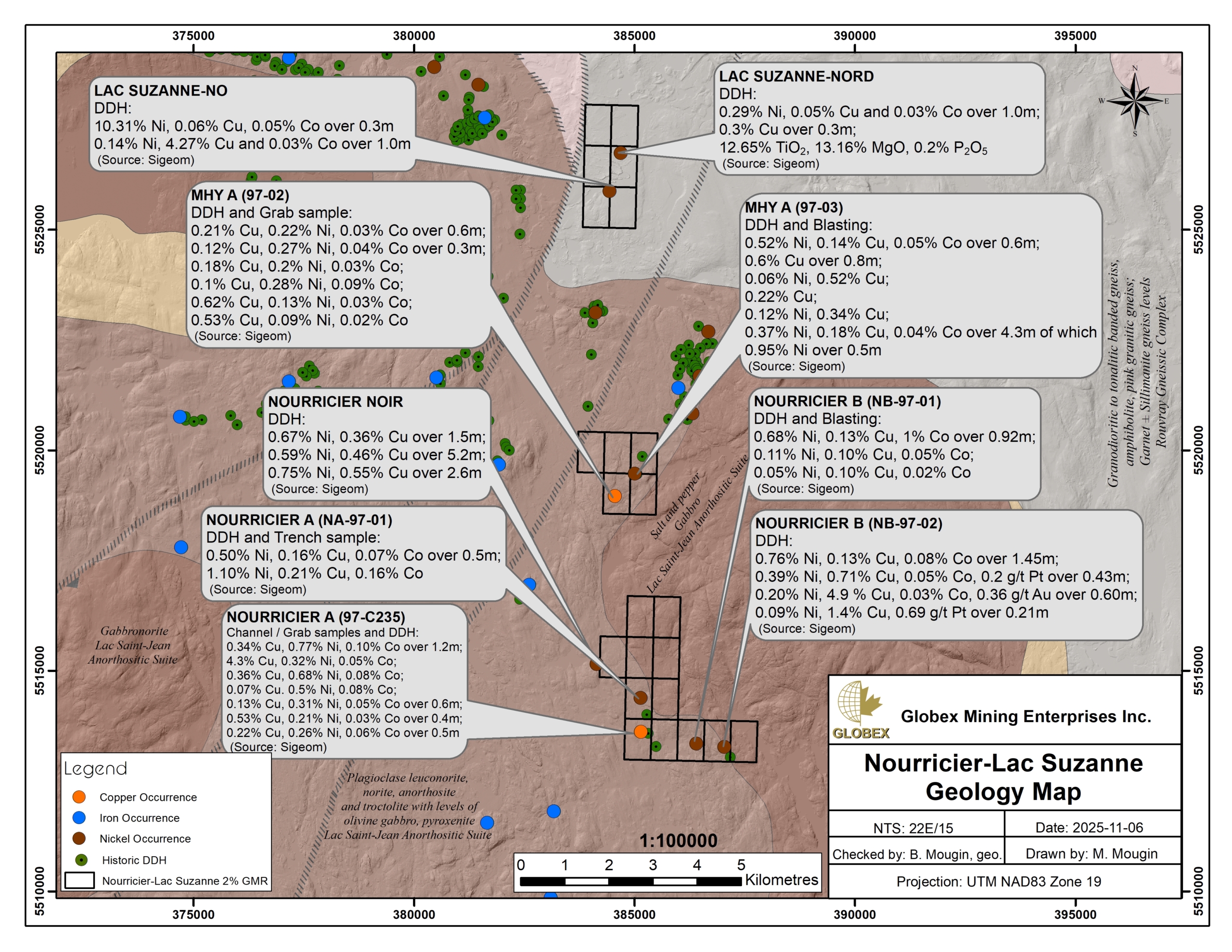
Several metallic occurrences are present within Globex’s royalty claims. These were discovered through surface mapping, blasting, grab sampling and also through several diamond drilling campaigns spanning from 1997 to 2004, except from the “Discovery Zone” showing which was discovered by drilling in 2021.
Significant Ti-P mineralization is also recognized in the area. The Lac à Paul project of Arianne Phosphate, located 9 km west of the property hosts Proven & Probable Reserve of 472.09 Mt @ 6.88% P2O5, and Measured and Indicated Resource of 590.24 Mt @ 7.13% P2O5 (GM68177 : NI 43-101 Feasibility study on the Lac à Paul Project, 2013).
History
The Pipmuacan Reservoir area was last mapped in 2009 by Quebec Government’s geologists (RG2009-01).
During the 2000’s, Mines d’Or Virginia Inc. carried out exploration work on the Chutes-des-Passes project which covered the area of the “MHY” showings. This work included geological mapping and sampling, ground geophysics, soil geochemistry, trenching and channel-sampling, and diamond drilling. The best results from the drill core sampling (GM56023, GM58807, GM58815, GM59143, GM60730, GM61185) returned low-depth intersections of up to 10.31% nickel over 0.3 m, 4.9% copper over 1.0 m and 1% cobalt over 0.92 m.
Significant Ti-P mineralization was also intersected in history. The drill hole 1279-01-37 (Lac Suzanne-Nord showing) returned 12.65% TiO2, 13.16% MgO and 0.2% P2O5 over 30.6 meters (GM59143).
Recent developments :
In 2019, Globex carried out a compilation of historical work on the Nourricier – Lac Suzanne property (GM71373).
Between 2021 and 2023, Canada Silver Cobalt Works inc. undertook high-resolution airborne gravimetric and magnetic survey on the Graal property (GM72163) ; the survey covered the entire Globex royalty claims. The company then conducted a 64-holes diamond-drilling program (16 788.25 m) in the area of the “MHY” showings (GM73399). Best metallic intersections are presented in table below :
Tableau 1: Best intersections of from the 2021-2022 DDH campaign by Canada Silver Cobalt.
|
DDH hole |
Ni (%) |
Cu (%) |
Co (%) |
PGE (g/t) |
Core length (m) |
|
NRC-21-03 |
0.84 |
0.59 |
0.03 |
0.06 |
5.70 |
|
GRL-22-60 |
0.73 |
0.41 |
0.09 |
0.09 |
28.90 |
|
NRC-22-24 |
0.32 |
0.46 |
0.04 |
0.05 |
33.60 |
According to Meneux and Clairet (2023), “The 2021-2022 drilling campaign succeeded in extending the known footprint of the MHY and Gravi massive sulfide zones, on top of highlighting the new Discovery Zone. In each of these settings, the width and attitude of the massive sulfide intersections are heterogenous from a drill hole to another or between drilling sections.”
Canada Silver Cobalt rebranded as Coniagas Battery Metals in 2024. In 2025, the Company carried out new field prospection and started a collaboration with the University of Quebec at Chicoutimi (UQAC) to study the metallogenic processes responsible for the formation of nickel-copper sulfides on the Graal property.
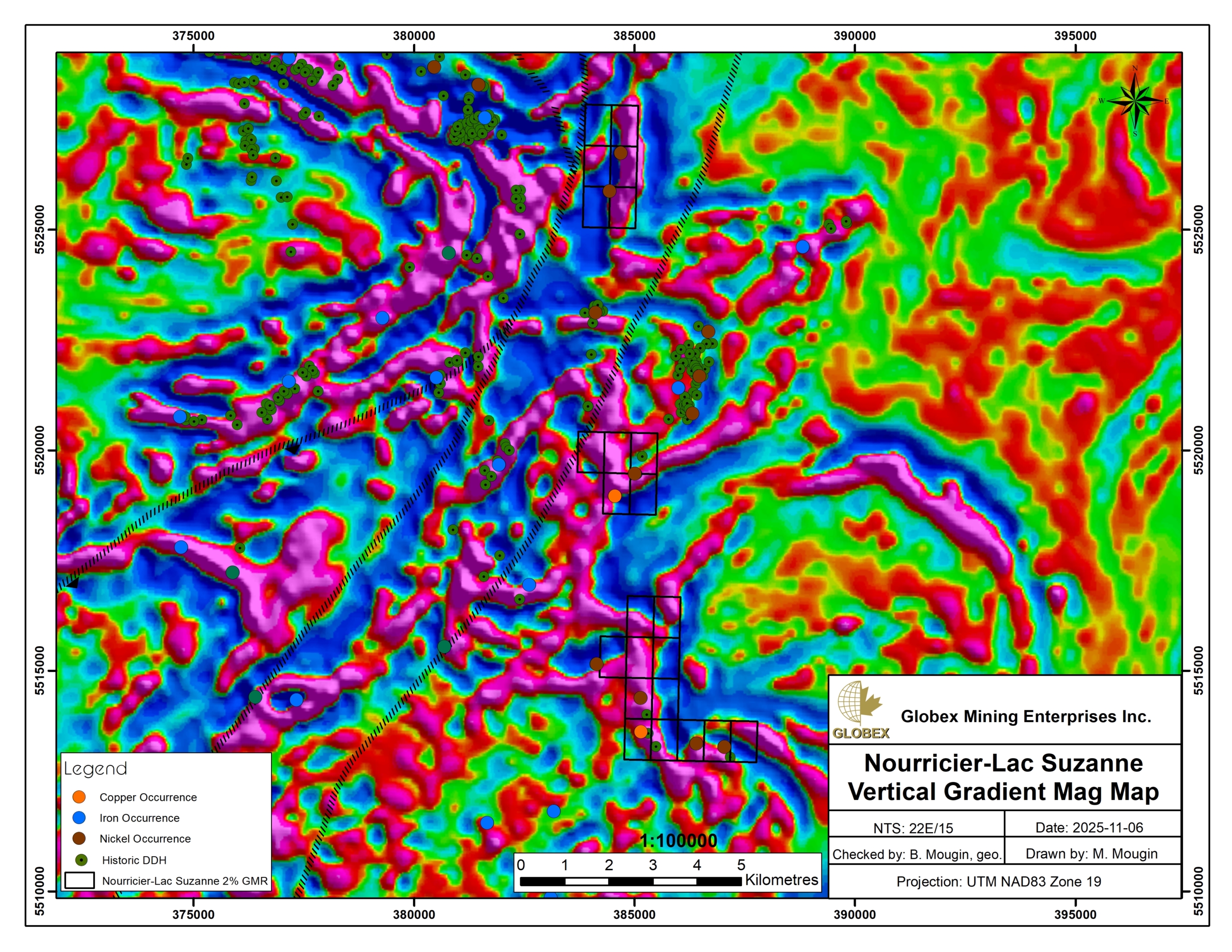
Coniagas flew the whole property with an 578 km² high-resolution Mag and TDEM survey in November, 2025; the company decided to double the size of its Graal property based on the positive results of this survey (Coniagas PR dated May 5, 2026).
Resources and Potential
The economic potential of the Nourricier – Lac Suzanne property is real and remains to be defined. The demand for nickel, copper and cobalt is still growing and prices for these metals are currently reaching record highs.
Significant Ti-P mineralization has also been observed in historical drilling in the property area. The governments of Quebec and Canada added phosphate to their respective lists of critical minerals in 2024. Coniagas retained the services of Laurentia Exploration to design a drilling program for 2026.
No Resource estimate has been calculated on the Nourricier – Lac Suzanne property yet. It is clear that Coniagas intends to actively explore its Graal property which hosts the Nourricier-Lac Suzanne claims, with the aim of defining resources and reserves over the next few years.