
Parbec Deposit
Location, Access, Description
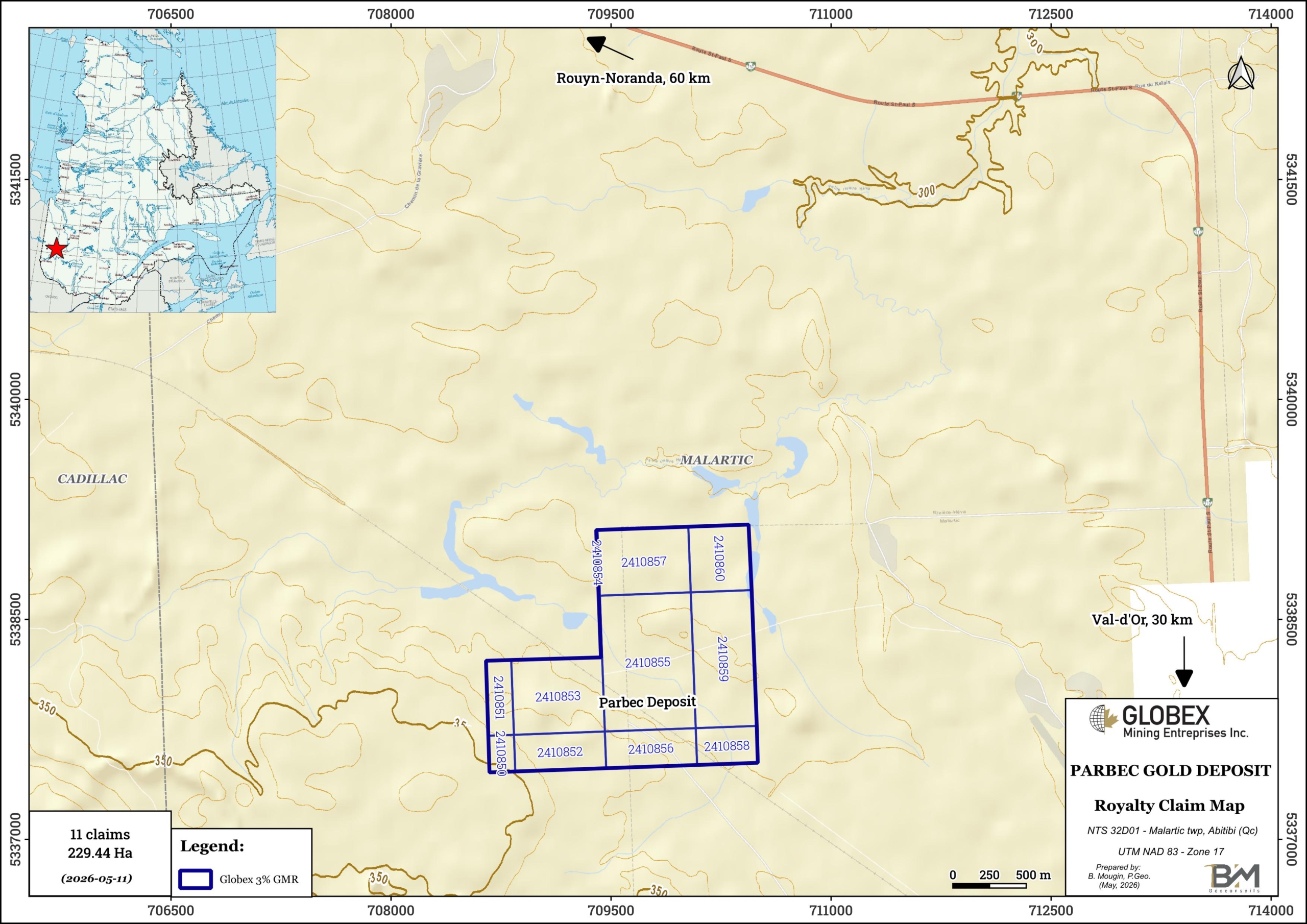
The Parbec Gold Royalty consists of eleven (11) mining claims covering an area of 229.44 in Malartic township, MRC of La Vallée-de-l’or. The Trans-Canada Highway (Québec Highway 117) passes 3 km to the east of the Property between Rouyn-Noranda, 65 km to the west and Val-d’Or, 30 km to the east. The Property is located on the Larder Lake – Cadillac Deformation Zone (or the “Cadillac Break”) that occurs near the southern boundary of the Abitibi greenstone belt in an area of prolific mining activity.
In January 2015, Globex optioned the property to Renforth Resources Inc. for $550,000 in cash, $4 million in exploration work and 2 million Renforth shares over 4 years. Renforth earned 100% interest in the Parbec Property in 2019. Globex retains a fixed 3% Gross Metal Royalty (GMR) on the property.
The region is associated with several active mines and numerous exploration companies. A full range of infrastructure, service companies, and experienced human resources are available in most nearby communities including Val d’Or, Malartic, and Rouyn-Noranda. Two regional airports, located in the cities of Rouyn-Noranda and Val d’Or, provide regular connection with the main centers of the province (Montreal and Québec City). The Property is also connected to a high voltage power line and is intersected from east to west by the Trans-Canada Railway.
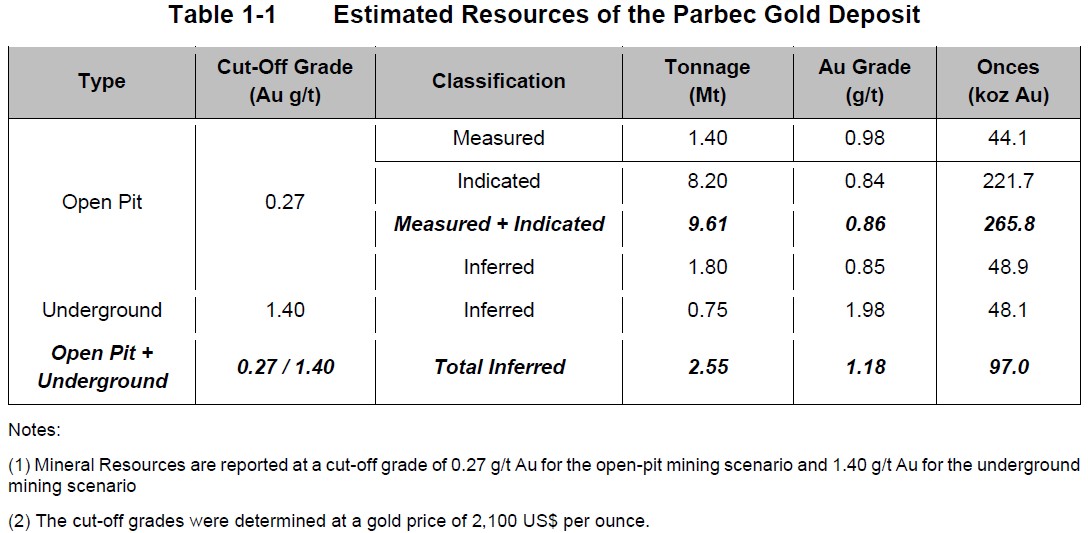
Recent NI 43-101 Mineral Resource Estimate (MRE) of the Parbec Gold Deposit Project (Camus, 2025) estimated Open-Pit Measured + Indicated Mineral Resources of 9.61 Mt grading 0.86 g/t Au (265.8 koz Au), and Inferred Resources (Open-Pit + Underground) of 2.55 Mt grading 1.18 g/t Au (97 koz Au).
Geology and Mineralization
The Parbec property is located on the contact between the Abitibi and Pontiac subprovinces, separated by the Cadillac–Larder-Lake Deformation Zone (CLLDZ). The Abitibi Subprovince is an Archean greenstone belt which hosts some of the richest mineral deposits of the Superior Province whose total endowment, including Production, Reserves and Resources is estimated to be > 9,375 t Au (Dubé and Mercier-Langevin, 2020).
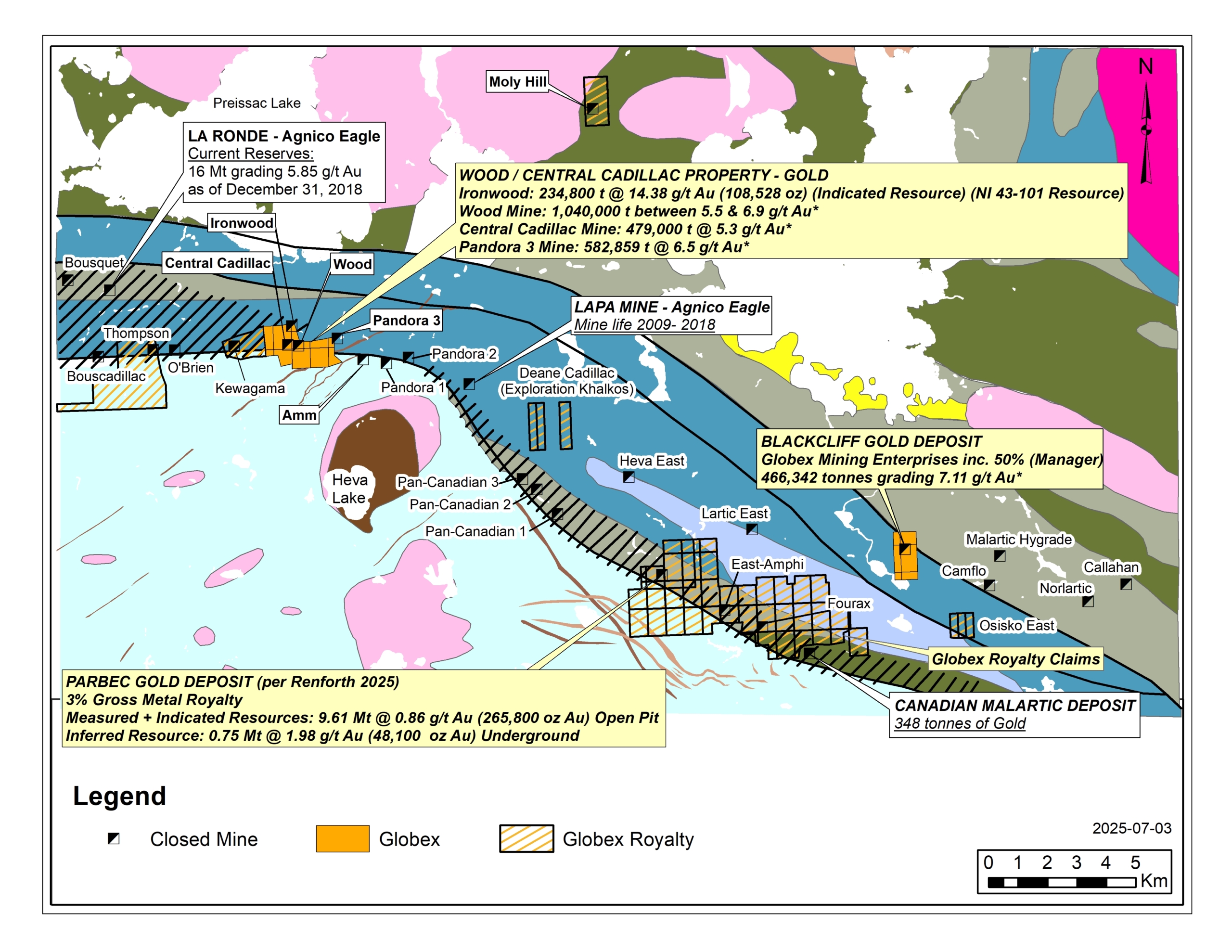
The Parbec property is favourably situated within the Malartic Val d’Or gold mining camp of northwestern Quebec. It is located in close proximity to former gold producers such as the East Malartic and Barnat mines.
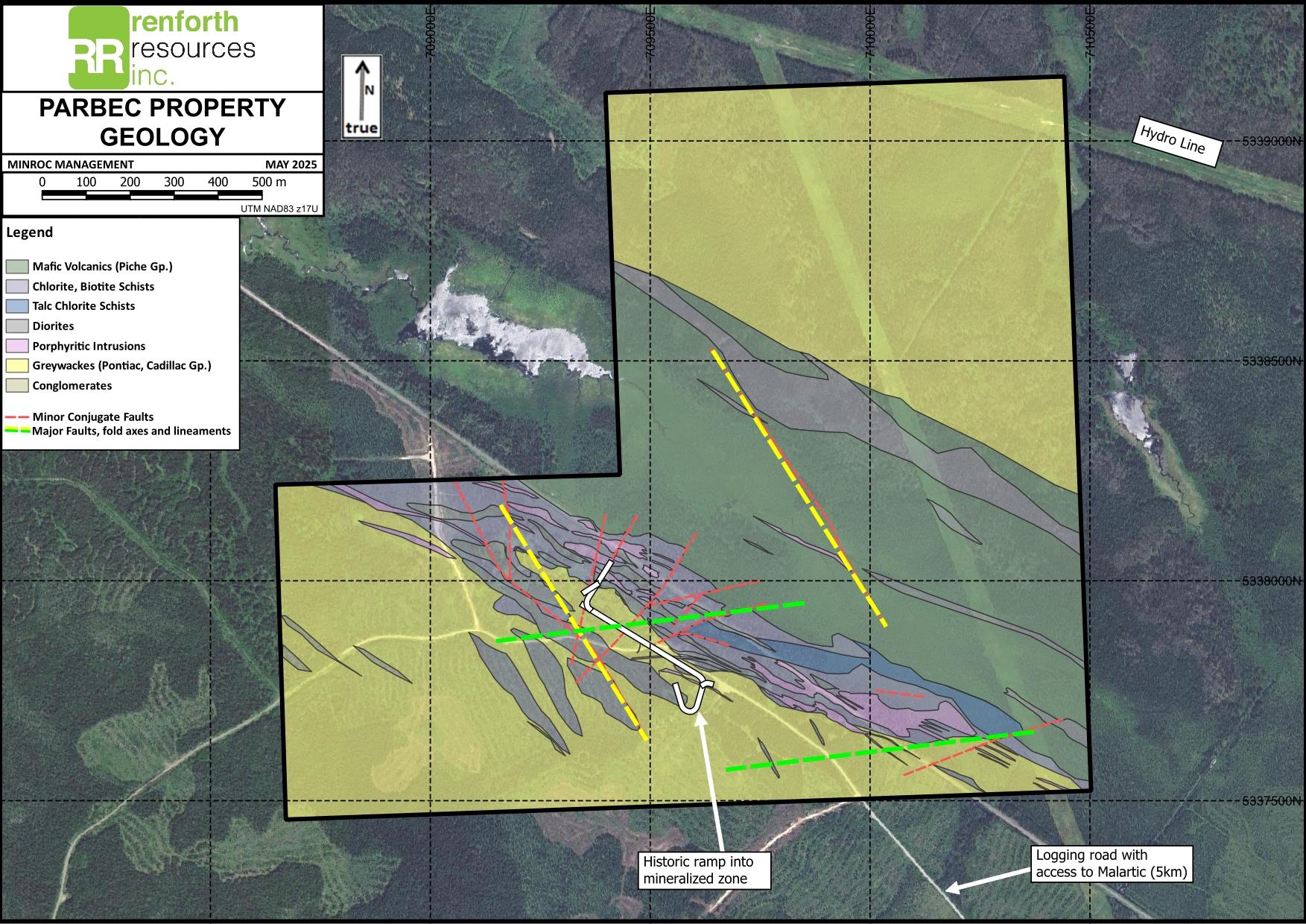
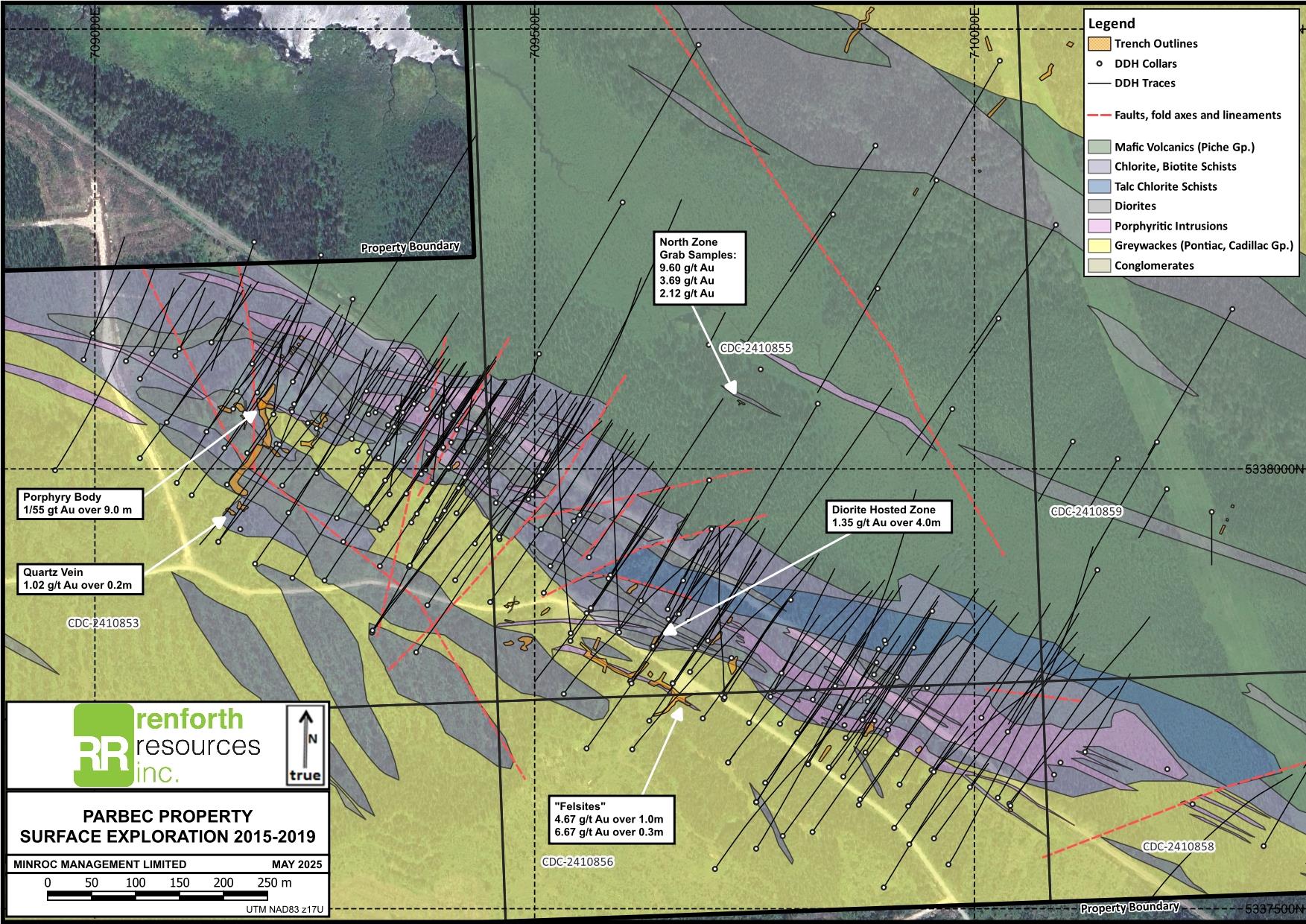
The main mineralized zones occur throughout a series of stratigraphically continuous mafic lapilli tuff horizons lying south of the northern contact of the Cadillac Break and within fractured, quartz veined and silicified areas of the dioritic and feldspar-porphyry intrusive bodies. Mineralization has also been noted in silicified, brecciated and bleached sections of the greywacke along the southern contact of the Break. Further indications of mineralization occurring along the sheared northern contact of the volcanic sequence may represent a major splay fault off of the main Cadillac Break.
The mineralized tuff horizons have been correlated east and west of the Camp Zone Area along a strike length of approximately 600 m. The average width of the mineralized zones is 1.9 m. The bulk of mineralization intersected by drilling is contained in the Camp Zone area, over a strike length of 150 m and to a depth of 150 m and within the Discovery Zone area over a strike length of approximately 90 m to a depth of 90 m.
Parbec is considered prospective for orogenic gold deposits, typical of Archean greenstone belts. These deposits are usually controlled by crustal-scale shear zones like the Cadillac Break and feature gold-bearing quartz-carbonate veins hosted in both ductile and brittle structural zones. Mineralization often occurs in proximity to felsic intrusives and may be influenced by the chemical or mechanical properties of the host rocks.
Gold at Parbec is typically associated with pyrite and occurs in silicified or chloritic halos around quartz-carbonate veins, as well as in biotitized zones along the Cadillac Break. Mineralization is found within schists, intrusives like fractured and quartz-veined diorites, and the competent parts of the Piché Volcanics. Coarse gold has been noted in some areas. The Cadillac Break hosts the main Parbec deposit, but gold also occurs in the Piché Volcanics to the north and, more recently discovered, in Pontiac sediments to the south.
The deposit shares features with several nearby camps, including Barnat and East Malartic in the Malartic field, and Lapa and East Amphi. The Canadian Malartic deposit, part of the same trend, also exhibits mineralization that extends well into the Pontiac Group, suggesting a model where intrusive rocks play a central role in controlling broad, low-grade gold halos suitable for open-pit mining. This analogy supports the exploration model at Parbec, where gold mineralization could extend significantly beyond the Cadillac Break and into the surrounding units.
History
The Parbec Property has a long history of exploration activities dating back to 1924 when gold was discovered by John Knox. Ste. Genevieve Resources Ltd. and Augmitto Explorations Ltd. carried out a significant work program in 1985-1989 that included several drilling programs and culminated in the development of a 580 m ramp into the Camp Zone. No prior mining activity is reported for the Property.
Recent work and developments :
Between 2015 and 2019, Renforth Resources conducted multiple surface exploration programs on the Parbec Property, including mapping, trenching, stripping, sampling, and limited drilling. Notable gold results included 9.6 g/t from the North Zones and 6.67 g/t from felsite-hosted veins.
In 2019 additional geochemical analysis was performed on previously collected pulps and rejects to assess alteration styles, potential secondary metals, and the nugget effect in gold distribution. Metallic screen assays revealed that gold often occurs in both coarse and fine fractions, with coarse gold sometimes dominating, especially in the Island Trench samples (up to 76.4% of total Au).
Since 2015, Renforth has conducted several surface drilling campaigns on the Parbec Property. From December 2017 to February 2019, six short programs were completed, totaling 37 drill holes and 8,428.6 meters of NQ core. This was followed by a more extensive drilling effort in 2020–2021, during which an additional 53 holes were drilled, adding 15,686.85 meters of NQ core to the project database.
Table 1: Best gold intersections in Renforth’s DDH.
| Hole | Au (g/t) | Length (m) | Zone |
| PAR-18-73 | 1.44 | 32.6 | Main B |
| PAR-18-74 | 0.87 | 49.7 | Main B |
| PAR-18-78 | 1.71 | 44.8 | A101 |
| PAR-18-84 | 3.24 | 14.0 | B14 |
| PAR-18-92 | 1.04 | 27.5 | Main B |
| PAR-20-112 | 4.95 | 24.2 | Main B |
| PAR-20-116 | 1.38 | 52.85 | Main B |
| PAR-21-127 | 2.88 | 33.05 | Main B |
| PAR-21-128 | 2.21 | 44.5 | Main B |
| PAR-21-133 | 3.54 | 25.4 | Main B |
| PAR-21-141 | 1.86 | 44.7 | Main B |
Renforth’s work highlighted a vertically-oriented gold zone trending north to northeast, cross-cutting lithologies and suggesting stacked mineralized zones that plunge southward beneath the Cadillac Break into the Pontiac Group. This interpretation significantly expands the exploration potential beyond the Break. The deposit has two primary structural controls: the vertical Cadillac Break and the south-dipping contact with the Pontiac Sediments to the south.
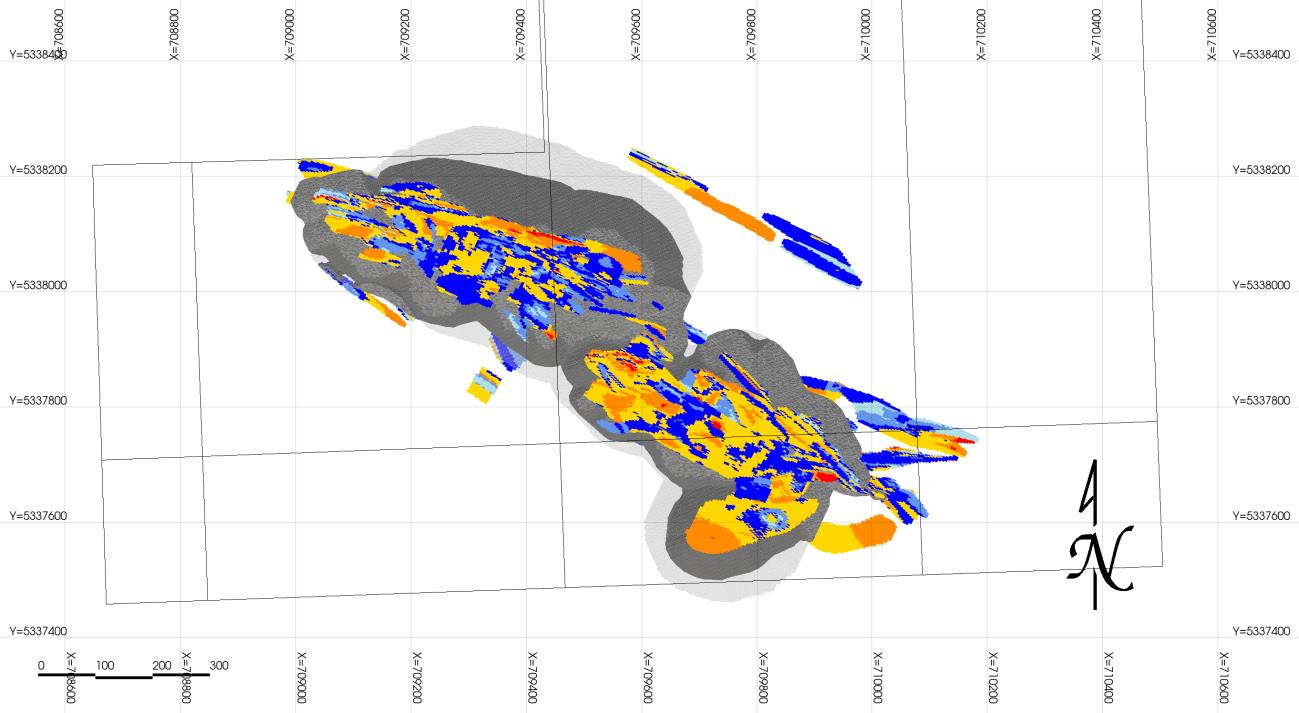
In 2025, Renforth commissioned SGS Geological Services to prepare a NI 43-101 Mineral Resource Estimate (MRE) of the Parbec Gold deposit (Camus, 2025). The current MRE takes into consideration that the Project deposit would be mined by open pit and underground mining methods, as follows :
Table 2: Estimated Resources of the Parbec Gold Deposit (from Camus, 2025):
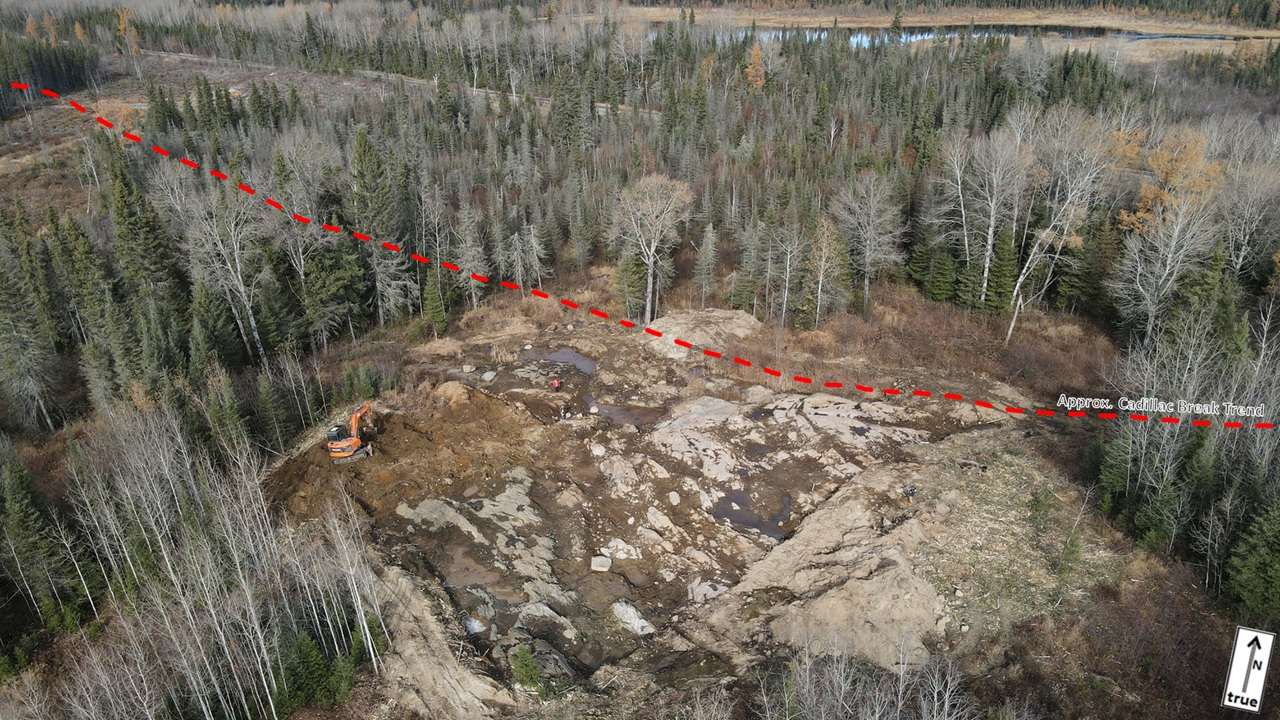
In 2025-2026, Renforth carried out rock stripping and channel sampling that confirmed the presence of faults and structures crossing the Cadillac Break at oblique and perpendicular angles. Higher gold grades appear to be associated with this structural intersection (Renforth Press Release dated February 26, 2026).
Resources and Potential
The current Parbec MRE model does not extend up to the surface everywhere. This creates some easy targets for some extensions towards the surface. More drilling is recommended to recognize this possible mineralization to try to expand the current MRE. Also, the Main C zone is currently not drilled extensively and could have extensions at depth, along strike in each direction and towards the surface.
The upcoming phase of work at Parbec will integrate bulk sampling, refined structural model to improve predictability of gold mineralization, and targeted drilling (DDH) focused on:
- Better define known mineralized zones
- Expand resources laterally
- Test vertical continuity below current drilling density
- Evaluate mineralization potential within the Pontiac sediments to the south
- Test the northern contact
In parallel, environmental and geotechnical studies are being advanced to ensure regulatory readiness and support the bulk sample permitting process.