
Silica 22F03
Location, Access, Description
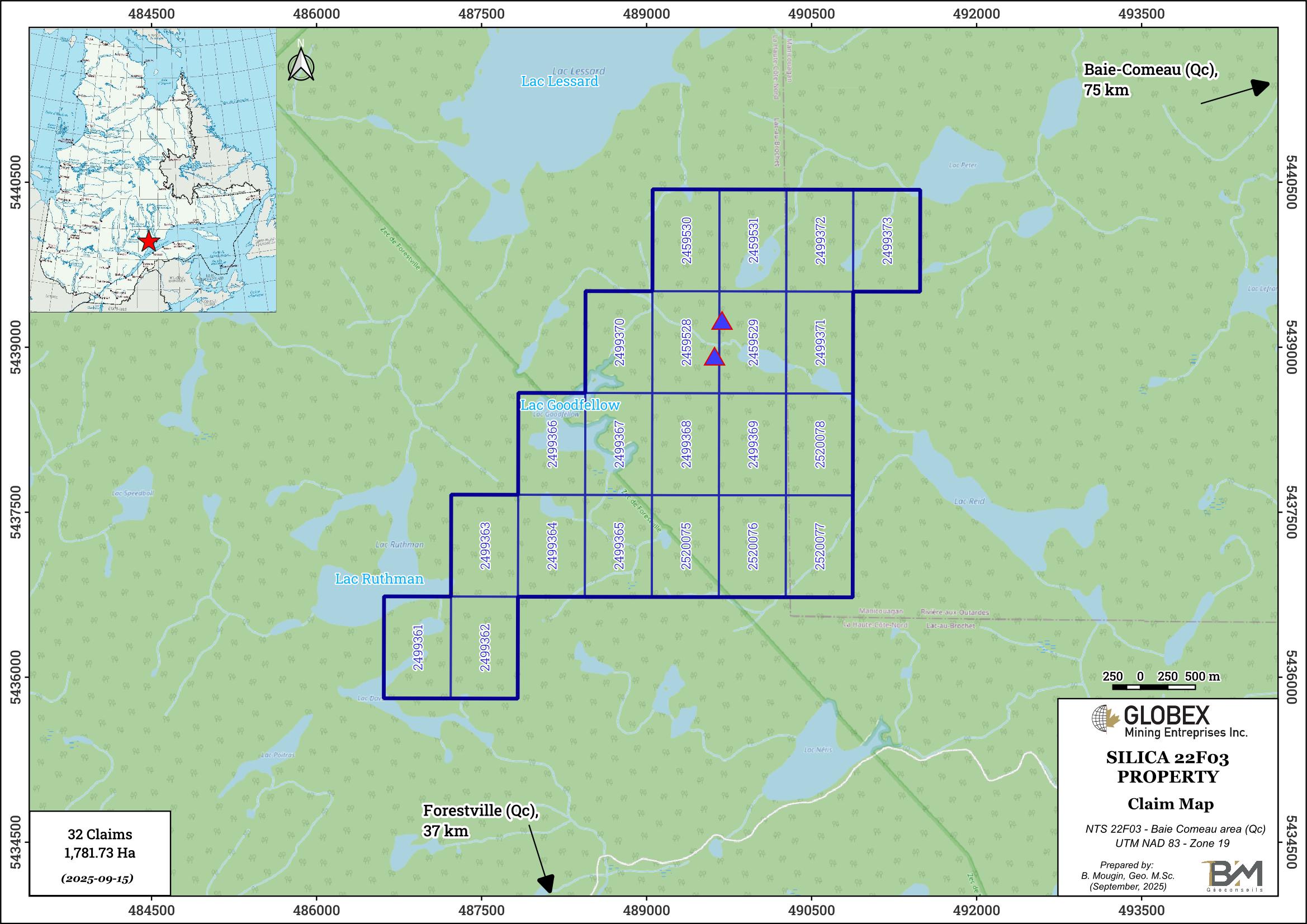
The Silica 22F03 property is located in northern Quebec, about 300 km northeast of Quebec city, and 75 km west of Baie-Comeau (Qc). The property consists of 32 mining claims totaling 1,781.73 Ha. The claims are held by Saffron H.O.F Inc. with Globex retaining a royalty on it, the terms of which are still under discussion.
The property is accessible in vehicle from Forestville via a network of paved and gravel roads and forestry trails. Numerous commodities can be found in Baie-Comeau regarding contractors, skilled labor, equipment rental, as well as sleep and food accommodation of remote workers. The Bersimis-2 Hydro power station is located 9 km northwest of the property.
Geology and Mineralization
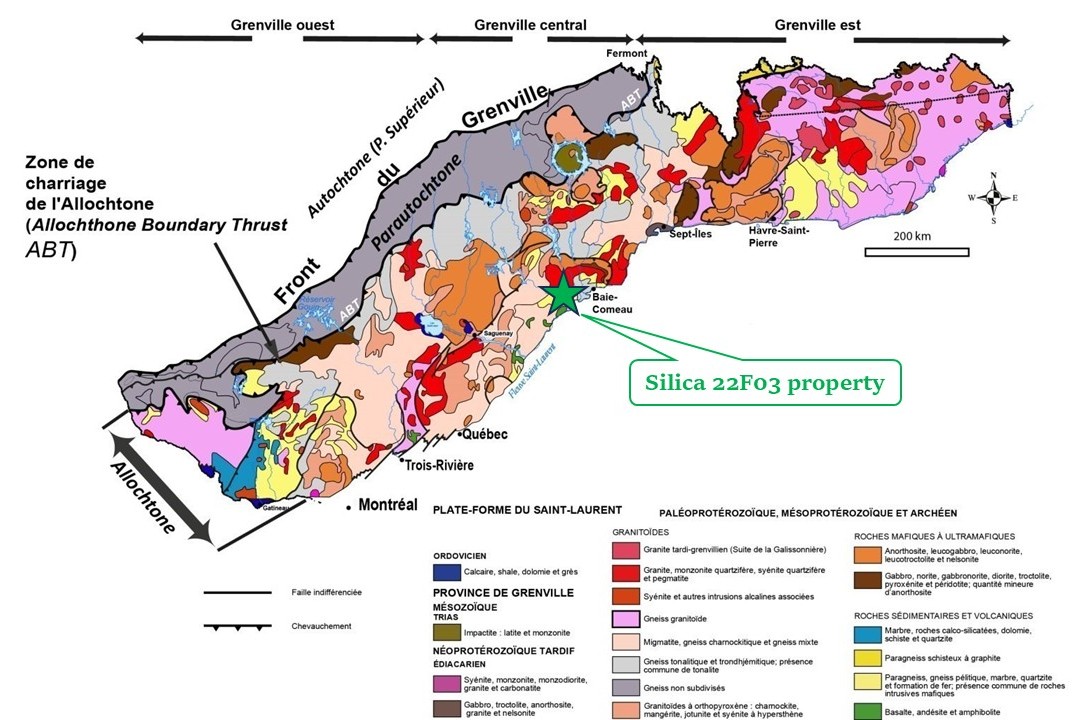
The property is located in the Allochtone unit of the Grenville Province, made up of all the Grenville rocks lying south of the Parautochthonous (Rivers et al., 2012). The Allochtone is composed of metamorphosed detrital, pelitic and carbonate rocks of Paleoproterozoic to Mesoproterozoic age (1.6 to 0.985 Ga ; Rivers et al., 1989 ; Friedman and Martignole, 1995 ; Martignole and Calvert, 1996).
Rocks of the area belong to the Proterozoic age Bourdon Complex, mainly composed of paragneiss, metatexites and diatexites which represent sediments that have been migmatized to varying degrees. (Moukhsil et al., 2007 – RG2009-03). Several quartzite horizons up to several meters thick have been identified and assigned to the Bourdon Complex and are interesting targets for a potential silica resource. Rocks of the Bourdon complex are intersected by felsic to ultramafic intrusions.
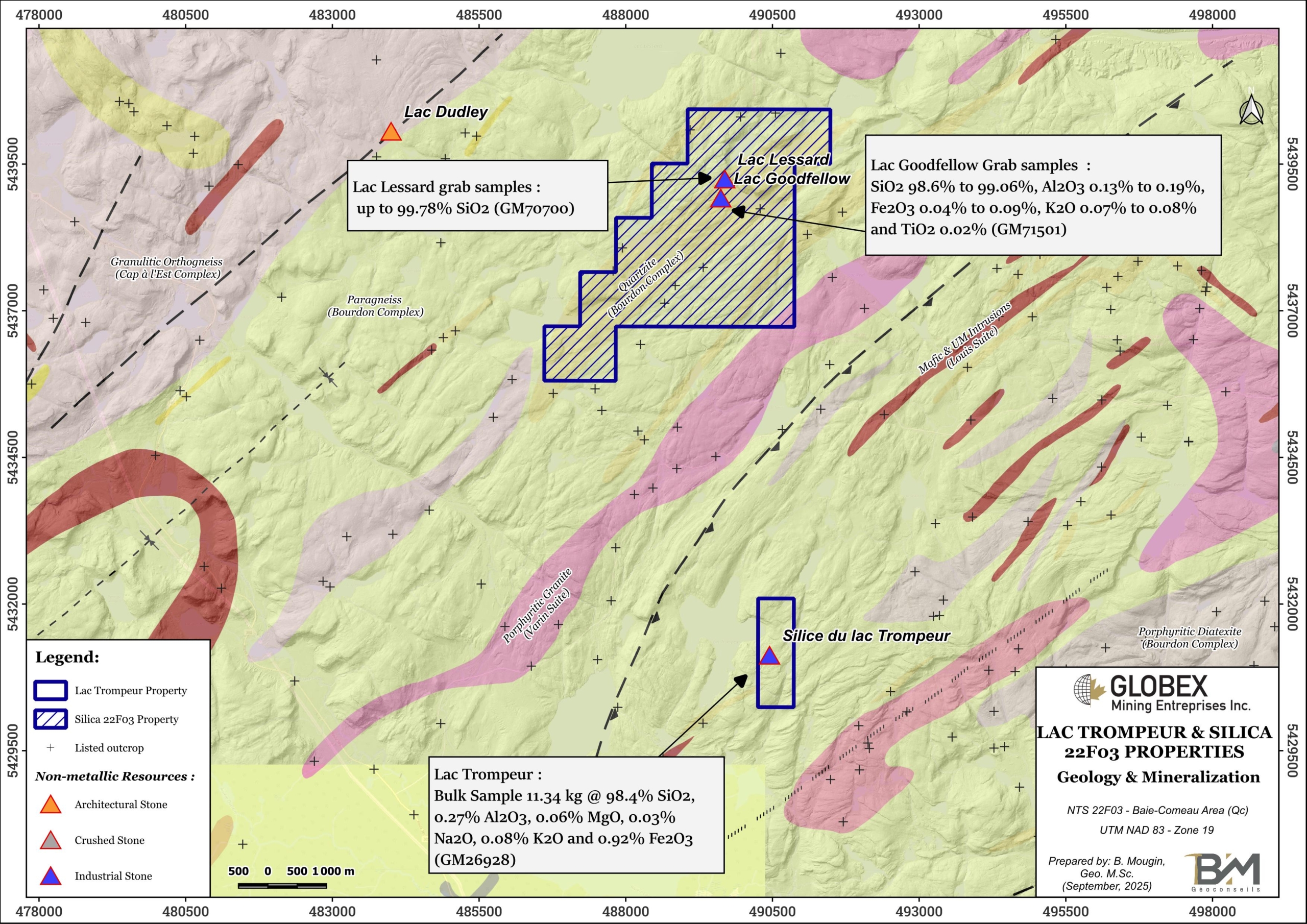
The Silica 22F03 property is essentially set on paragneiss and quartzite of the Bourdon Complex. The quartzite unit forms horizons up to several hundred meters thick, interbedded within the paragneisses. These quartzites commonly display gray-white-pink banding, suggesting ancient sedimentary stratification (RG2009-03). Pink or white pegmatites are frequently associated with units of the Bourdon Complex.
Following Moukhsil et al (RG2009-03), several types of mineralization have been identified in the region of Baie-Comeau, including: 1) Fe-Ti mineralization in gabbronorites associated or not associated with anorthositic suites, 2) Fe-Ti-P mineralization in gabbronorites; 3) Ni-Cu mineralization in mafic to ultramafic igneous rocks; 4) U-Th ± rare earth mineralization in leucogranites and pegmatites; and 5) rare earth mineralization in pegmatites. The region is also valued for its sites enriched in industrial minerals such as silica and sillimanite.
History
E. Canova visited a series of outcrops in the Goodfellow lake area in 2015 and reported white grey quartzites with minor impurities and not much oxidation, returning 98.6% to 99.06% SiO2 (GM71501). The impurities include biotite, muscovite, ilmenite, magnetite, K-Feldspars and garnets, and these can be separated with an optical sorter.
In 2018, Midatlantic carried-out rock stripping, blasting and sampling of several tons of material in the area of Lake Goodfellow and recommended the pursuit of stripping and field mapping (GM71501). Drilling work carried out in 2019 identified a band of white quartzite measuring 50 m long by 30 m wide by 20 m deep.
Resources and Potential
The quartzite of Lac Goodfellow is fairly pure (up to 99.78% SiO2, GM70700), as shown by the results of analyses of samples taken during previous prospecting campaigns.
Further exploration including prospection, rock stripping and diamond drilling is required in order to better define the volume of rock with a high silica content.