Turner Falls
Location, Access, Description
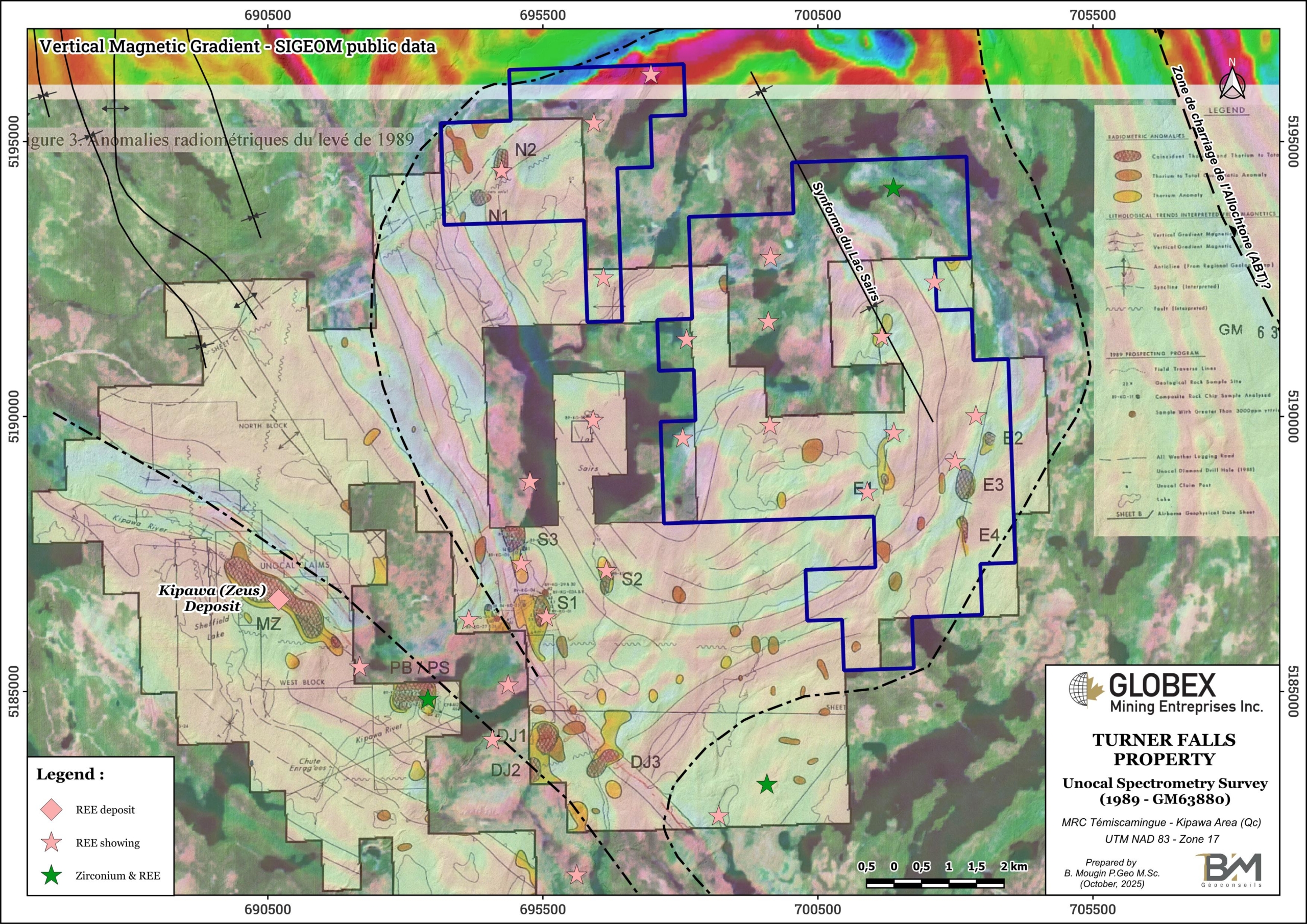
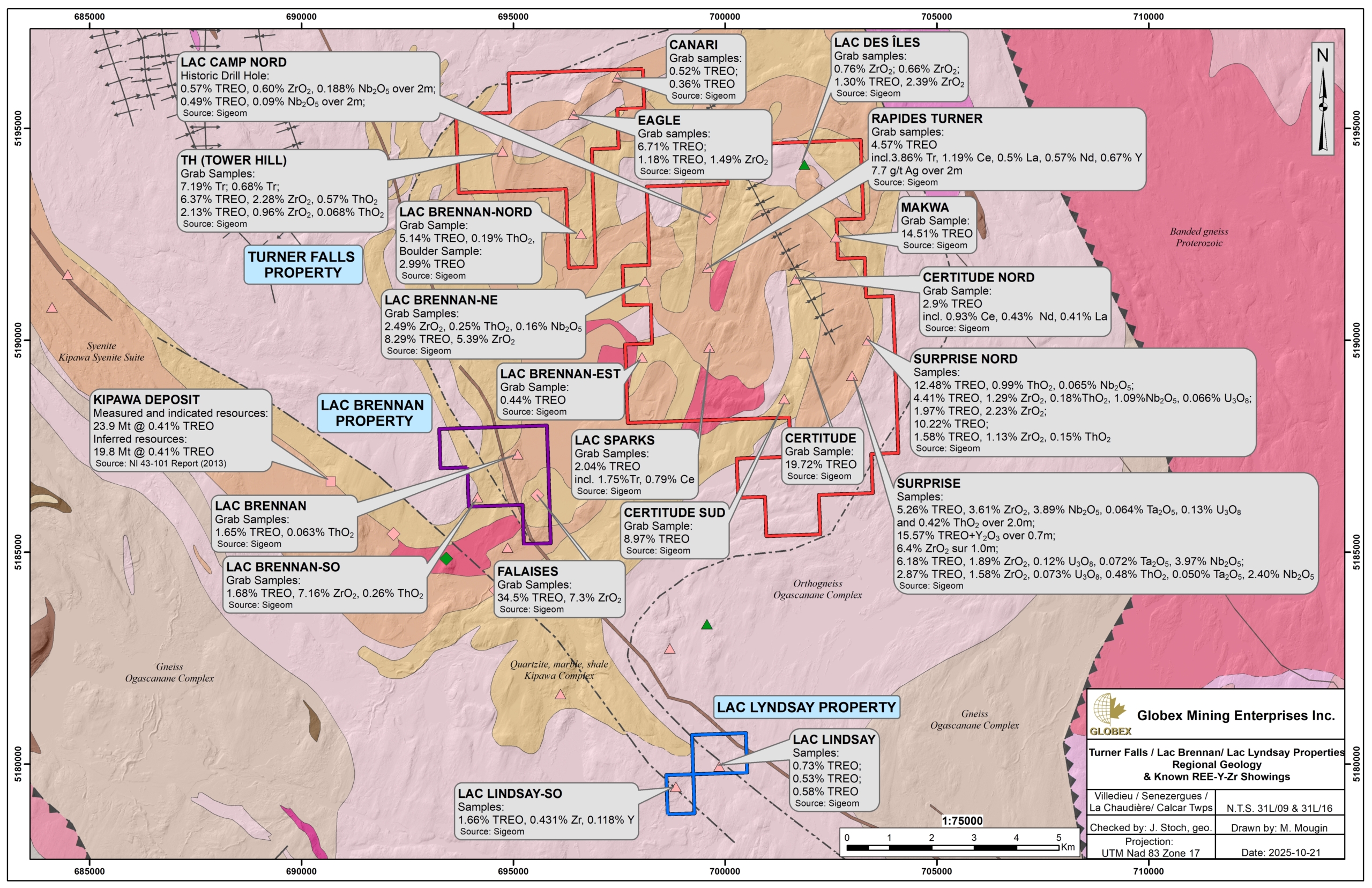
The Turner Falls property is composed of 87 mining claims covering 5,123.89 Ha in the Kipawa area (Quebec), within the Lacs-du-Temiscamingue Municipality, located about 50 km east of Témiscaming and 160 km south of Rouyn-Noranda (Qc). The claims are 100% held by Globex Mining Enterprises Inc. and are not subject to any third party interests.
The property is accessible by vehicle via a network of gravel roads and forestry trails.Alternatively the property is accessible by float plane. Food and sleeping facilities as well as gasoline are available in Témiscaming or Kipawa. Many other commodities can be found in Rouyn-Noranda regarding daily workers, contractors and equipment rental.
Geology and Mineralization
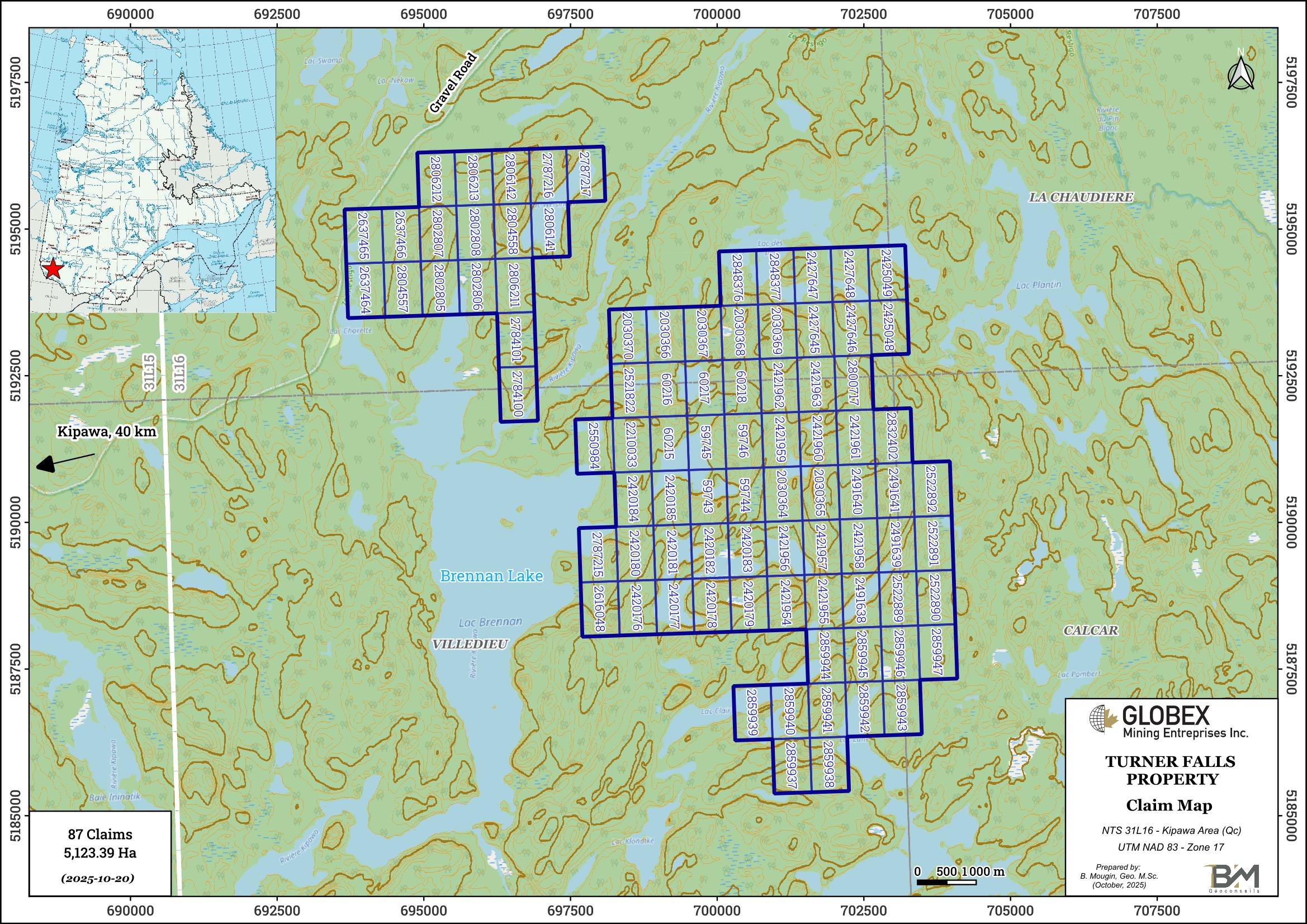
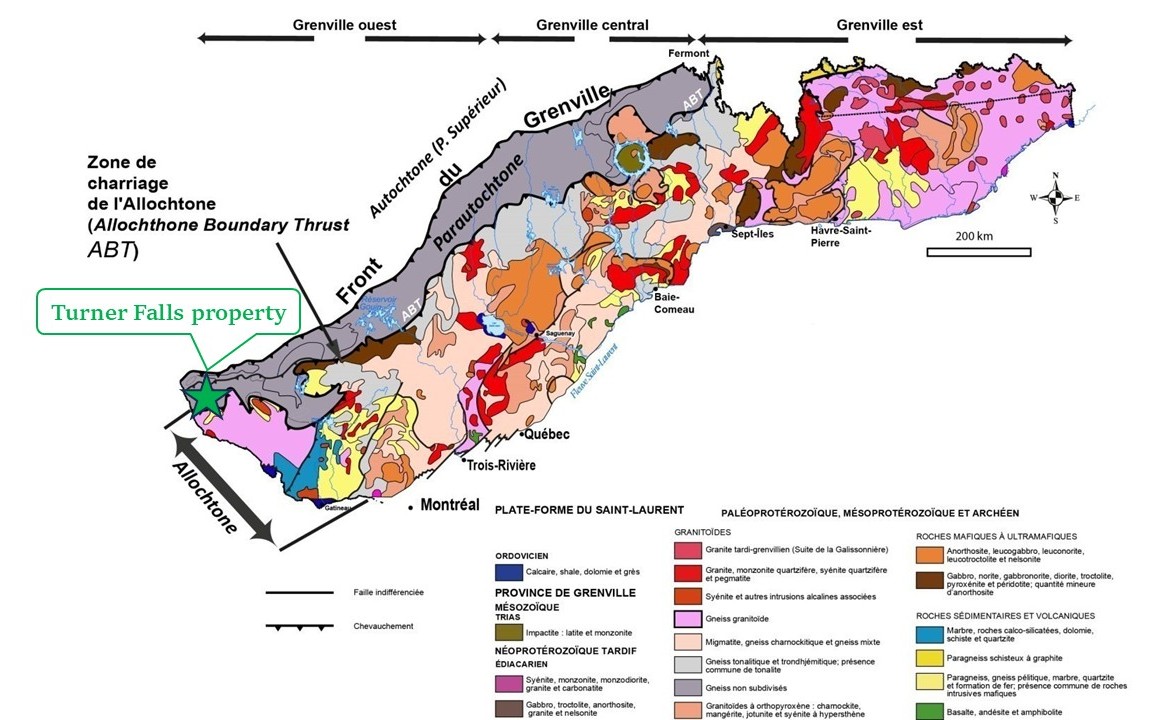
The property lies within the Parautochtonous unit of the Grenville Province, about 50 km south of its boundary with the Superior Province. The Parautochtone is composed of Archean to Proterozoïc supracrustal and plutonic rocks which have been intensely deformed and metamorphosed during the Grenvillian orogeny (1,080 to 985 Ma). Metamorphism is at the Upper Amphibolite / Granulite. In the area of the property, rocks of the Grenvillian sequence are made of metasediments of the Kipawa Complex, syenite of the Kipawa Intrusive Suite, and both orthogneiss and quartz-feldspar gneiss of the Ogascanane Complex. The Kipawa Suite formed around 1.03 Ga, either through a purely magmatic process or through anatexis of the Archean basement (Ogascanane Complex) and intruded the stratigraphic sequence.
Rives (RP606) mapped the area of Lac Sairs (Brennan) in 1973. Rocks of the Turner Falls property are composed of Quartzite, marble, schists, and leucocrate gneiss of the Kipawa Complex, intruded by syenite of the Kipawa Suite and orthogneisses of the Ogascanane Complex. NNW-oriented diabase cuts through every other lithologies on the property.
REE mineralized zones associated with alkaline rocks are characterized by large volumes and low grades, and are typically enriched in heavy rare earths relative to light rare earths. In the Kipawa Suite, REE mineralization is associated with the period of intensive deformation associated with the Grenville orogeny. Radioactive minerals and rare earths were remobilized and concentrated in linear sills in the contact zones between the peralkaline intrusion and the sediment series. As a result, mineralization occurs predominantly along the contact between the Kipawa Suite and the metasediments of the Kipawa Complex (GM36400).
The reference deposit in the region is the Kipawa (Zeus) (or “Sheffield”) deposit, located approximately 7 km west of the Turner Falls property. Mineralization is disseminated and occurs as a series of decametric mineralized lenses at the base of the Kipawa Complex (GM67679).
Extensive exploration work by Matamec Explorations Inc. over the past several years on its Kipawa rare earths deposit located 8.5 km southwest of Globex’s Turner Falls property was outlined, on October 21, 2013, in a press release issued by Matemac indicating that the filing of the first NI 43-101 feasibility study for this heavy rare earth project represented an important milestone for the Company and the rare earth industry. A technical report, titled ”Feasibility Study for the Kipawa Project, Temiscamingue Area, Québec, Canada” was issued on October 17, 2013, with an effective date of September 4, 2013, by Roche Ltd, Consulting-Group in collaboration with Genivar, Golder and Associates, SGS Canada Inc. and filed on October 21, 2013 on SEDAR at (www.sedar.com) and on Matamec’s website at (www.matamec.com). Matemac Explorations inc. is a Canadian Issuer.
The technical report includes a reference (ref: page 151, Table 15.5) to “In-Pit” mineral reserves of proven and probable reserves of 19.769 Mt grading 0.4105% TREO, (mining/milling dilution included) and where TREO equals the total of rare earth oxides calculated as: LREO (%) + HREO (%) + Y2O3 (%).
|
In-Pit Mineral Reserves |
Metric Tonnes |
|
Proven (51.7% of the deposit) |
10,219,000 |
|
Probable (48.3% of the deposit) |
9,550,000 |
|
Total |
19,769,000 |
|
Total Grade |
|
|
Cerium (Ce2O3) |
0.1195 |
|
Lanthanum (La2O3) |
0.0588 |
|
Praseodymium (Pr6O11) |
0.0146 |
|
Neodymium (Nd2O3) |
0.0550 |
|
Samarium (Sm2O3) |
0.0123 |
|
Europium (Eu2O3) |
0.0015 |
|
Gadolinium (Gd2O3) |
0.0119 |
|
Terbium (Tb4O7) |
0.0022 |
|
Dysprosium (Dy2O3) |
0.0147 |
|
Holmium (Ho2O3) |
0.0032 |
|
Erbium (Er2O3) |
0.0101 |
|
Thulium (Tm2O3) |
0.0016 |
|
Ytterbium (Yb2O3) |
0.0096 |
|
Lutetium (Lu2O3) |
0.0013 |
|
Yttrium (Y2O3) |
0.0943 |
|
TREO |
0.4105 |
The technical information has been reviewed by a qualified person for Globex. To the best of Globex’s knowledge, information and belief, there is no new material scientific or technical information that would make the disclosure of this feasibility study, mineral resources, or mineral reserves inaccurate or misleading.
The total of measured and indicated resource now stands at 23,857,000 tonnes at 0.41% TREO representing 88% of the total resource. These results are at a 0.2% TREO cut-off and are not limited by an open pit (Kipawa feasibility Study dated October, 2013 (Saucier et al.)
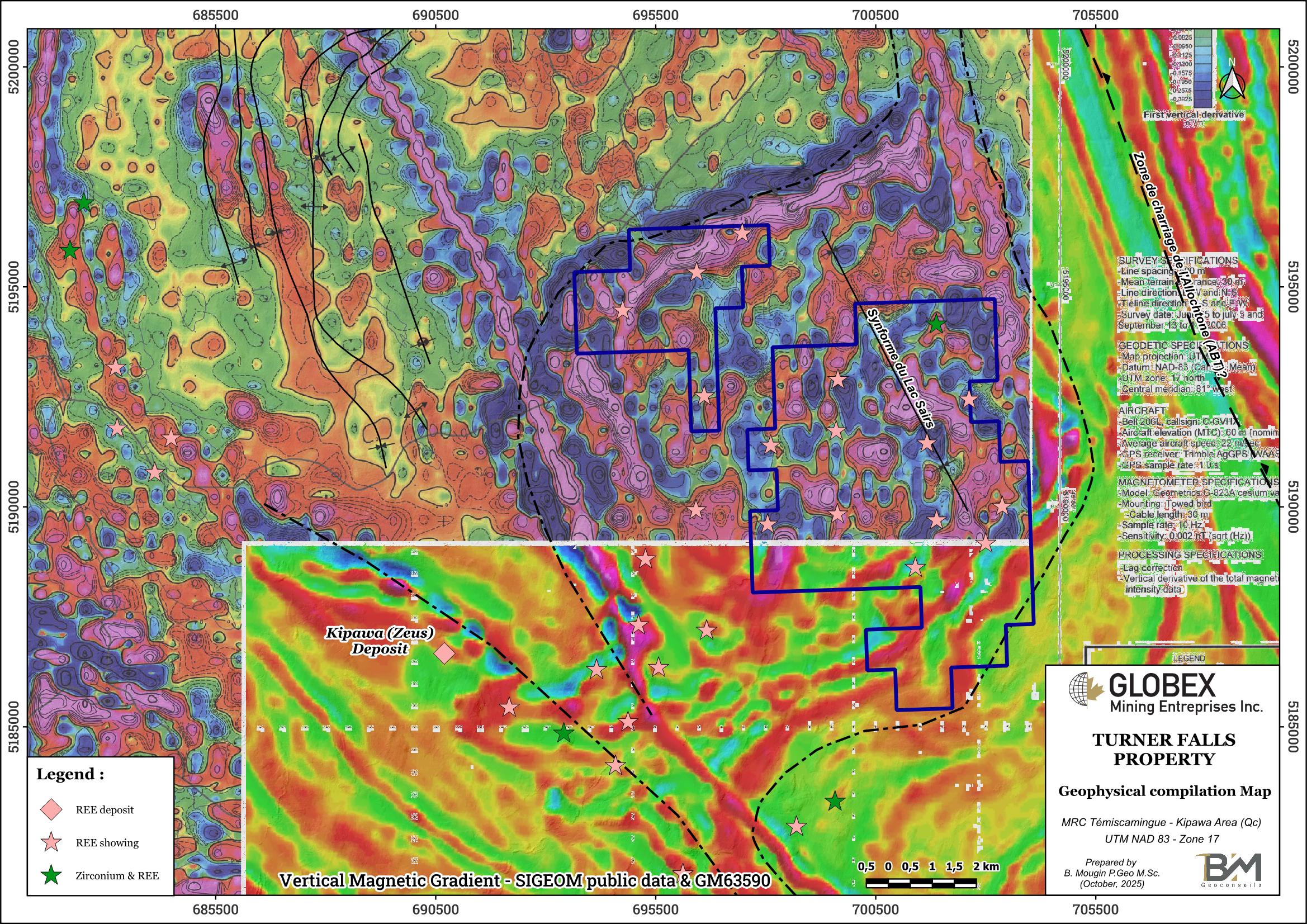
The Turner Falls property hosts numerous REE showings whose metallogeny is similar to that of the Kipawa deposit.
History
Exploration of the area started in the mid-1950’s following the discovery of Au-U mineralization at the contact between quartzite and biotite-gneiss at Hunter’s Point. This discovery launched a boom in uranium exploration in the region. A few rare earth (REE) showings are discovered, including the Kipawa (Zeus) deposit. The Quebec government mapped the region and conducted stream sediments geochemistry surveys in the 1970s-1980s to characterize regional metallic potential. Unocal Canada carried out a series of exploration programs in the 1980s, mainly focused on the Kipawa (Zeus) deposit, followed by Aurizon Mines (2005-2009) and Matamec Explorations (2007-2012). This work led to the discovery of numerous rare earth showings in the region.
Globex acquired the Turner Falls property by staking in 2007 and began fieldwork in 2009. Between 2007 and 2013, Globex carried out several exploration programs including geological mapping, grab sampling, ground geophysics (scintillometer and magnetometer), and diamond drilling (1,840 m, 23 holes). DDH TF-12-02 returned up to 1,994 ppm TREO + Y2O3 / 26 metres (GM68058), and up to 7,660 ppm TREO + Y2O3 / 2.0m was intersected on DDH TF-13-03 (GM68398). Between 2016 and 2025, Globex also carried out three (3) compilation reports of public data available in Sigéom regarding historical work on the Turner Falls property (GM69727, GM72209, GM74321).
Resources and Potential
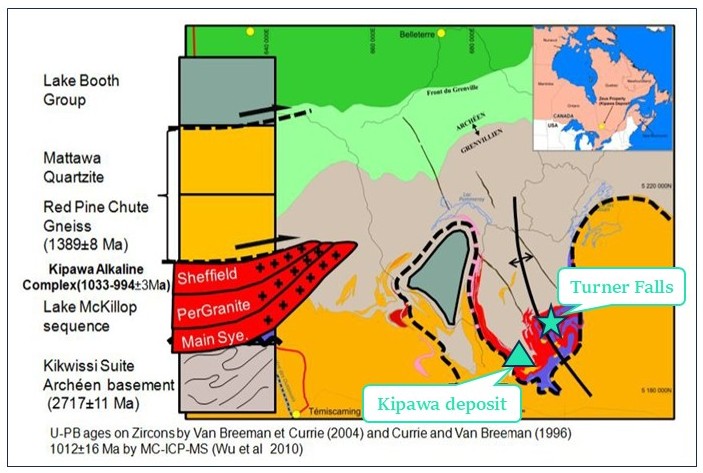
In 2009, Fleury (GM65184) wrote : “the western part of Sairs Lake (Brennan Lake) is particularly rich in radiometric anomalies. Although mostly isolated, with the exception of the Falaises and Couleuvre prospects, this region continues to yield new discoveries with each traverse”. This comment supports the notion that the Turner Falls property has definite potential for the discovery of new rare earth, yttrium, and zirconium mineralization.
Several radiometric anomalies highlighted on the Turner Falls property by Unocal in 1989 (GM63880) have never been tested by diamond drilling.