
Windfall
Location, Access, Description
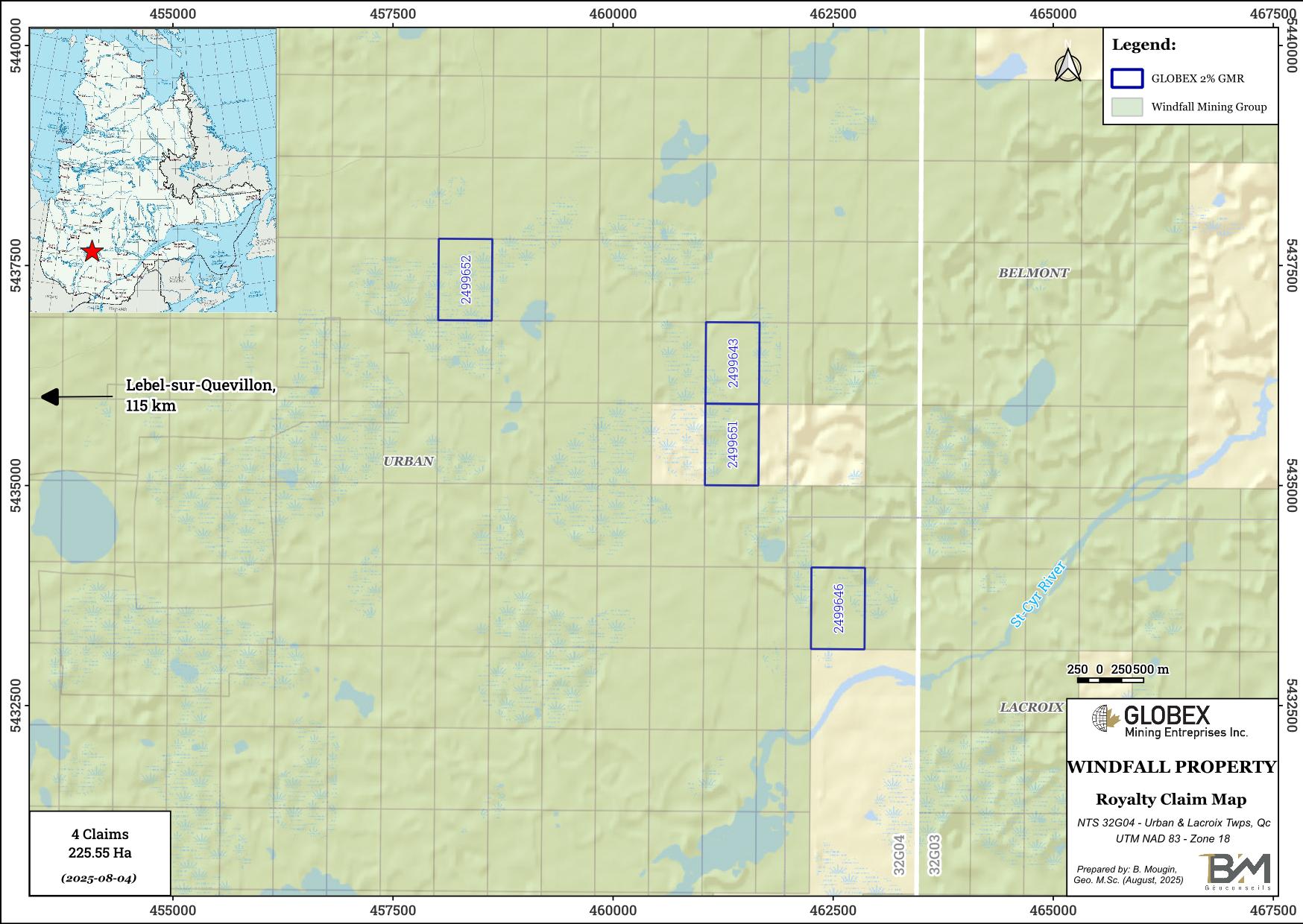
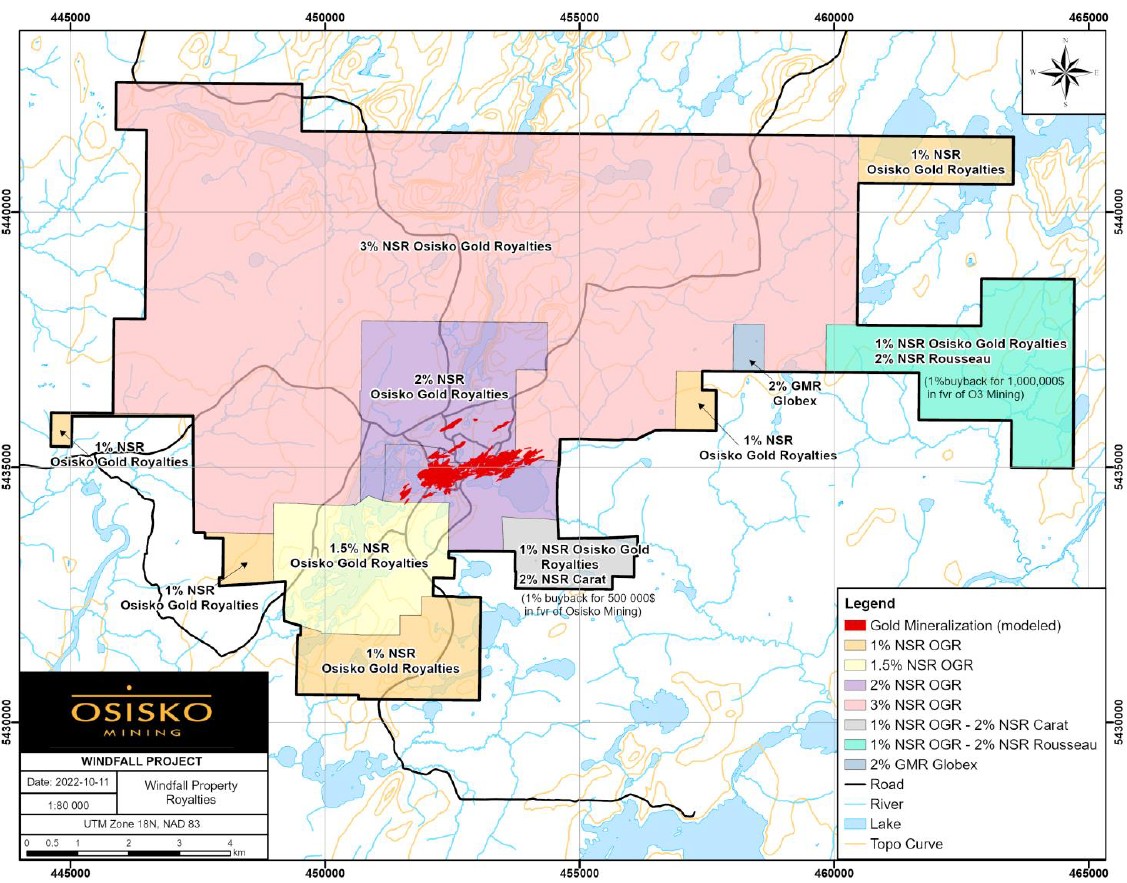
The Windfall property of Windfall Mining Group is an advanced exploration project of >12,000 ha located in Eeyou-Istchee James Bay Territory (EIJB), Quebec Province, within the traditional territories of the Waswanipi Cree First Nation, approximately 115 km east of Lebel-sur-Quevillon (Qc) and 200 km NE of Val-d’Or (Qc). It comprises both the Windfall and Urban-Barry properties. Globex retains a 2% Gross Metal Royalty (GMR) on four (4) mining claims covering an area of 225.55 Ha.
The property is accessible from Lebel-sur-Quevillon via a complete network of well-maintained logging roads. An exploration camp can provide with food and sleep facilities for 300 workers. Shops and contractors are available in Val-D’Or. Two (2) high-voltage power lines run directly on the property.
Geology and Mineralization
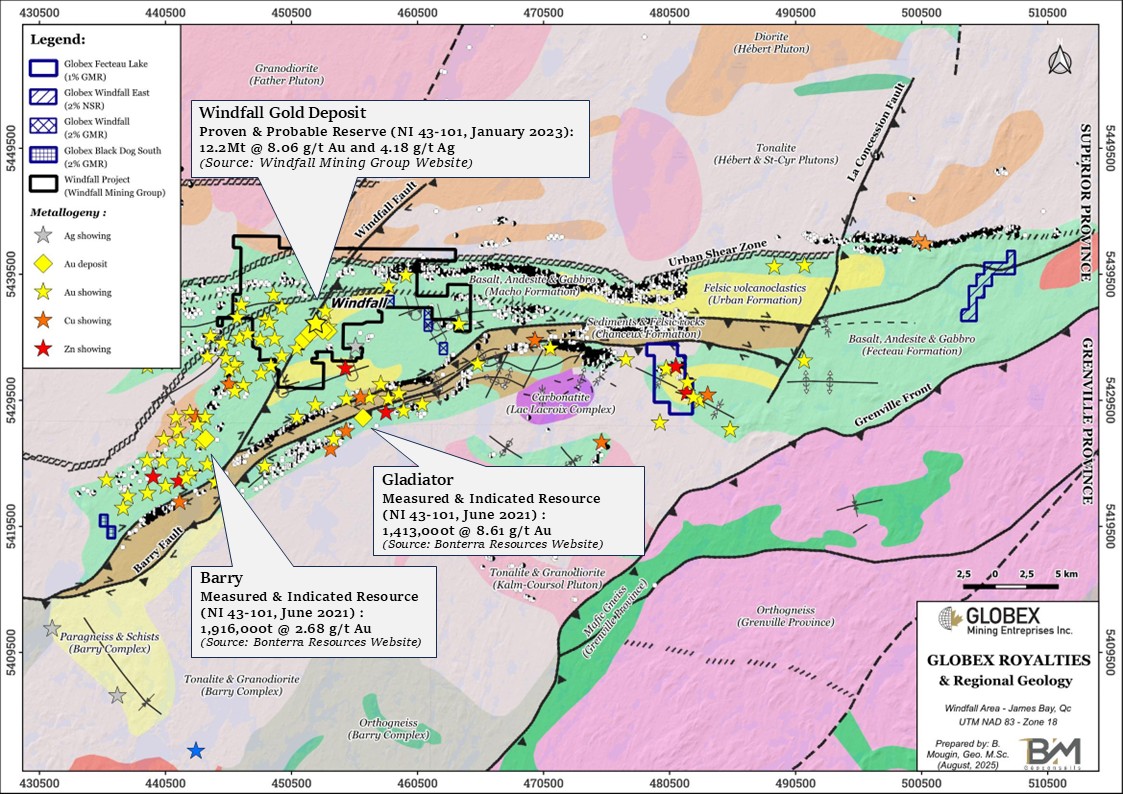
The Windfall property is located in the Abitibi Subprovince of the Canadian Shield, about 35 km west of the Grenville Thrust. The property is located in the central part of the Urban-Barry Greenstone Belt of the Superior Province which contains mixed mafic- to felsic volcanic rocks with lesser sedimentary deposits that are cross-cut by several east- and east-northeast trending deformation zones. The property is located along the Mazères deformation zone which is a regional-scale east-northeast trending ductile deformation zone that is interpreted to be a second-order structure to the east-west trending Urban deformation zone.
Rocks of the Urban-Barry greenstone belt are generally metamorphosed to greenschist facies and locally reached amphibolite facies. The regional metamorphic gradient generally increases eastward towards the Grenville Front (Joly, 1990).
The Windfall deposit is hosted within the Windfall Member of the Macho Formation (Figure 3), which primarily consists of felsic and intermediate volcanic rocks, including tuff and lava units of tholeiitic affinity. In the Windfall deposit area, the stratigraphy trends northeast and dips moderately towards the southeast. Volcanic rocks are intruded by a series of younger quartz-feldspar porphyry dikes, commonly referred to as quartz-feldspar porphyry (“QFP”) dikes.
Following both historical work by exploration companies and geological mapping programs of the Quebec Government (RG2001-14), the mineralization styles present in the area of the property are:
1) Volcanogenic Massive Sulphides (VMS) ;
2) Auriferous volcanogenic veins ;
3) Orogenic gold associated to shear zones ;
4) Au-Cu-Zn mineralization associated with tourmalinized metapelites ;
5) Molybdenum associated with felsic intrusions and pegmatites.
Historical work in this area succeeded in discovering three (3) gold deposits. The Barry and Gladiator deposits are currently explored by Bonterra Resources. Measured and Indicated Resources of 1,413,000t @ 8.61 g/t Au have been calculated at Gladiator (NI 43-101 Technical Report, June 2021), while Measured and Indicated Resources calculated at Barry are 1,916,000t @ 2.68 g/t Au (same report).
The Windfall deposit is classified as a pre-Temiskaming intrusion-associated gold deposit. Two dominant styles of gold mineralization are observed in the Windfall deposit, and these are a vein-type and replacement-type mineralization. In addition to this, numerous remobilized gold veins cross-cut these features. The bulk of the gold mineralization is contained in extensive anastomosed networks of quartz-pyrite veins and pyrite-rich alteration zones. The resources are defined from surface to a depth of 1,600 m (Andrieux et al., 2023 – NI 43-101 Technical Report Feasibility Study for the Windfall Project).
Most of the Lynx mineralization is contained in an extensive anastomosed network of quartz-pyrite veins hosted within silica-sericite-pyrite altered felsic volcanic rock, gabbros, and felsic QFP intrusions. Most mineralized envelopes in the Main area are associated with pyrite veinlets and stockworks hosted in silica-sericite-pyrite alteration zones occurring near contacts between volcanic rocks and felsic QFP intrusions.
The occurrence of high-grade gold intersections with spectacular visible gold is a well-documented phenomenon at the Windfall deposit. Proven and Probable Reserves at Windfall are estimated at 12.2 Mt @ 8.06 g/t Au for 3.16 million ounces of gold and grading 4.18 g/t Ag for 1.64 million ounces of silver (Andrieux et al., 2023). The drill hole database considered for the resource estimate contains 4,834 surface and underground diamond drill holes totalling 1,852,861 m of drilling, of which 4,152 drill holes (1,665,282 m) were completed and assayed by Osisko.
History
The property area has seen a great deal of historical exploration work spanning from 1943 to 2009, with no historical resource estimates or production for that period. The majority of historical work done in the area was completed west and southwest of the Windfall property in the area of Windfall and Barry Lake. Few geophysical magnetic and electromagnetic-VLF surveys were completed on the property. Detailed history of exploration is proposed in Andrieux et al. (2023).
The Windfall property area saw renewed exploration activities from 2009 to 2014 by Eagle Hill Exploration, producing three Mineral Resource Estimates (“MREs”) and a preliminary economic assessment (“PEA”) on the property. From 2018 to 2022, four Mineral Resource Estimates and two PEAs were produced based on exploration activities conducted by Osisko.
From October 19, 2015 to June 7, 2022, Osisko completed 4,222 drill holes for a total of 1,677,534 m of drilling on the Windfall deposit. The 2022 drilling program was designed to better define the mineralized lenses, with a high priority on expanding and refining the Lynx zones. The Caribou 2, Mallard, F-Zones and Underdog zones were also targeted with infill drilling campaigns.
In 2018, Globex wrote a compilation report about the historical work on the Windfall property (GM70915).
Resources and Potential
The Windfall property is located in an auriferous favorable geological and structural environment. The Windfall Project is at an advanced stage of exploration with Proven Reserves on it ; infill definition by Groupe Minier Windfall is still under progress. The 2023 NI 43-101 Feasibility study estimates a 10 years mine life ending in 2035. However, the vast Urban-Barry property is still at an early stage and more resources are still to be discovered.
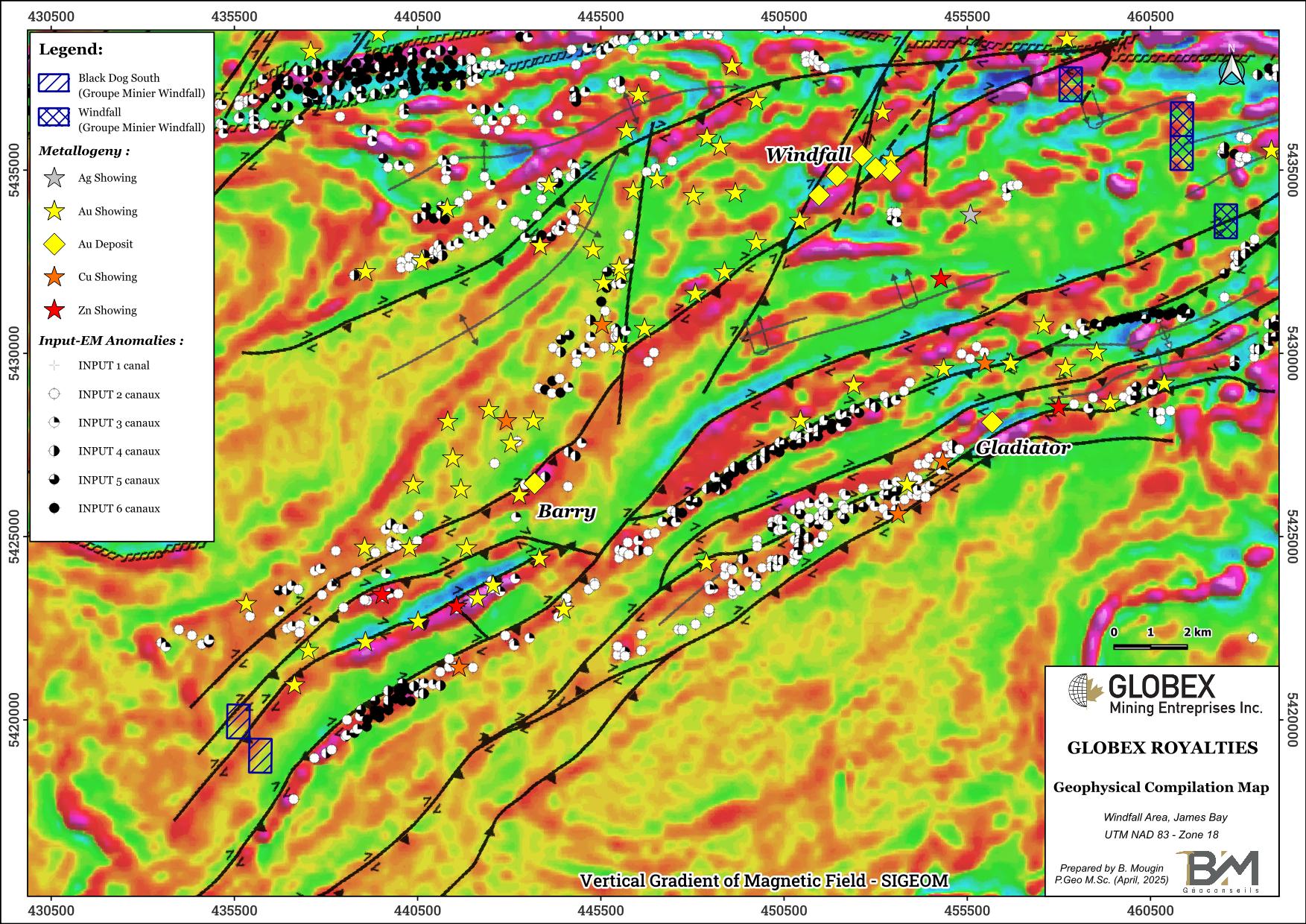
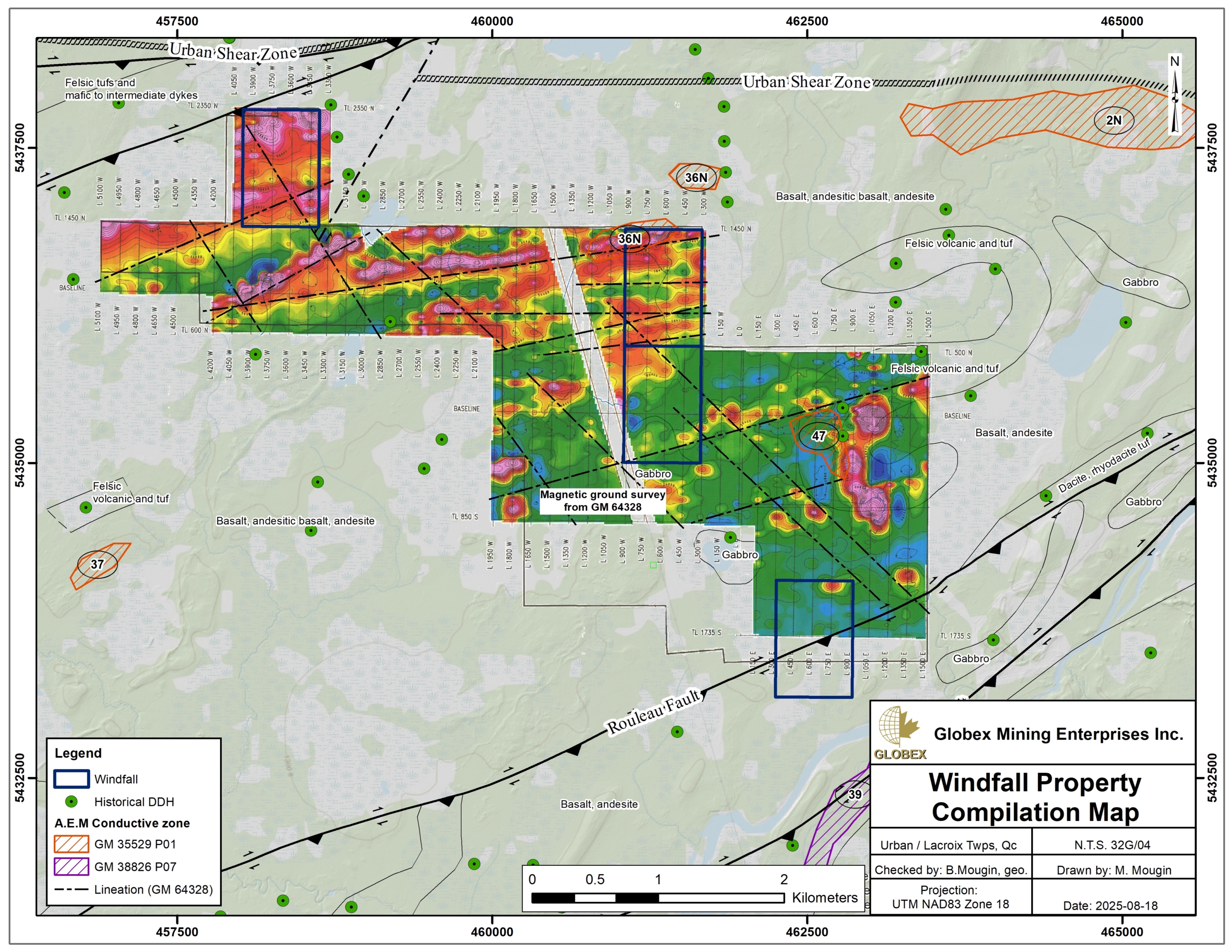
Gold deposits of the area appear to be associated with both structural features and positive magnetic anomalies on geophysical compilation map above.