
Nordeau
Location, Access, Description
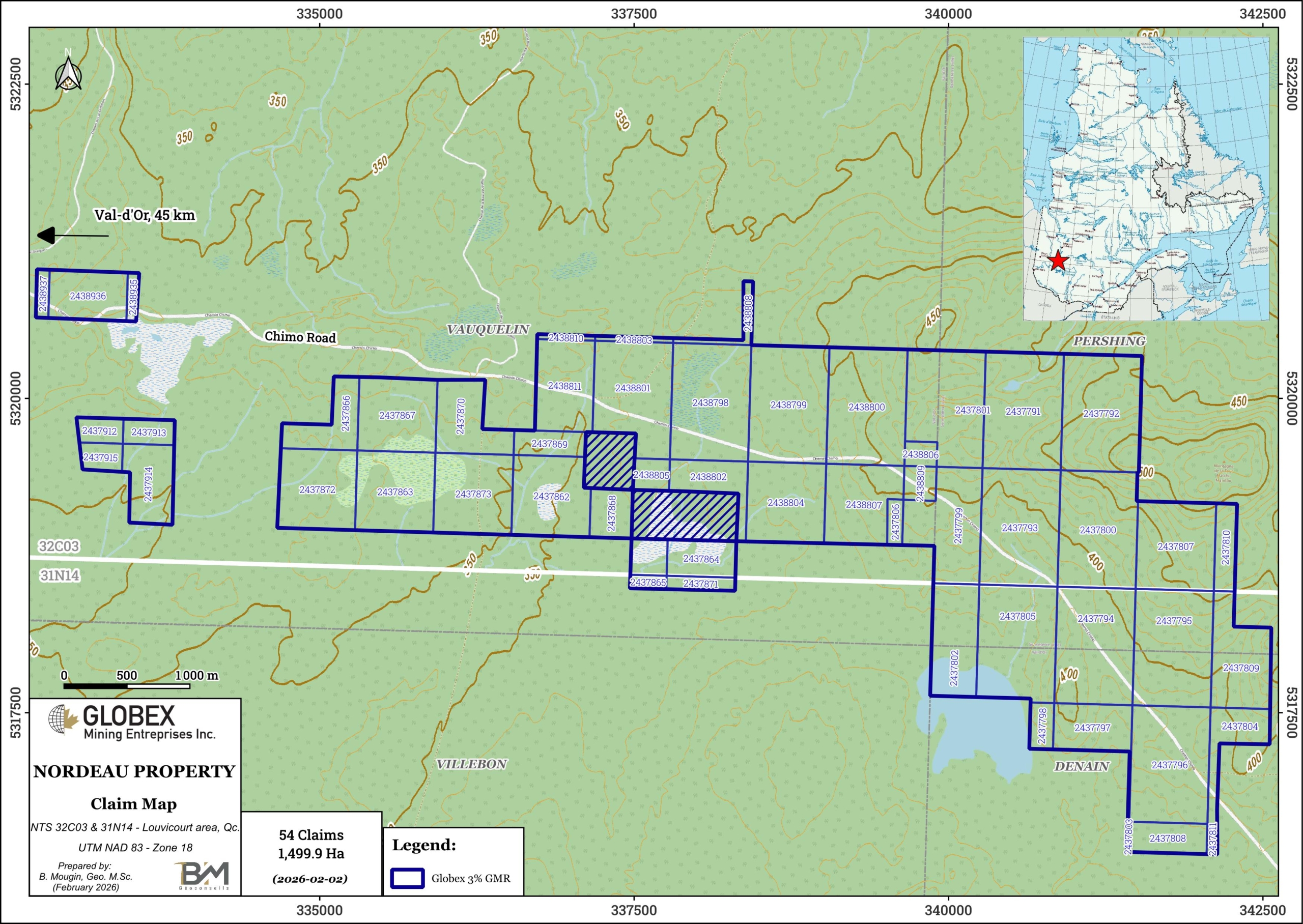
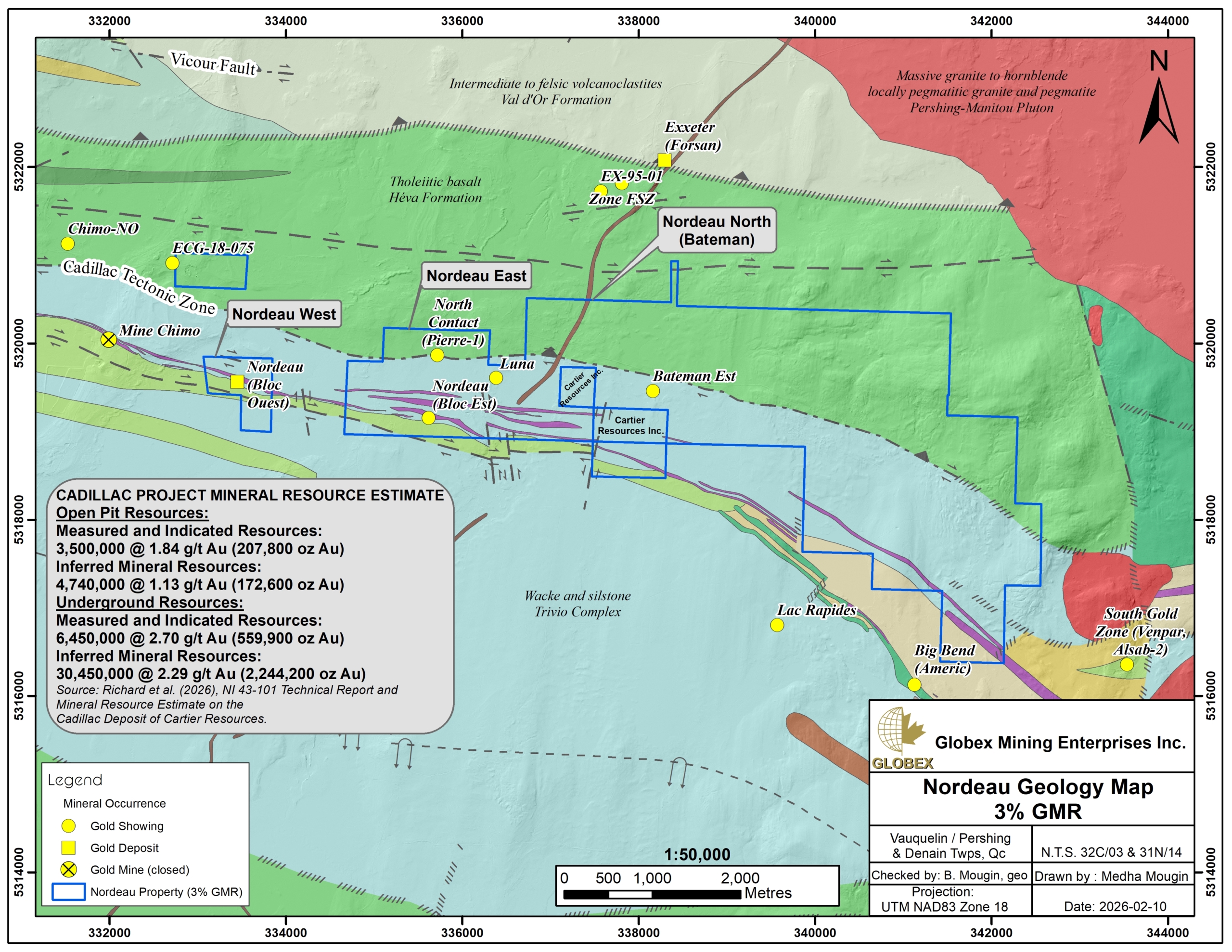
The Nordeau property is located in Abitibi, Québec, Canada, approximately 35 km east-southeast of the town of Val-d’Or (NTS 32C03 and 31N14). It consists of 54 non contiguous claims covering a total area of 1,489.89 hectares. The claims are part of the advanced exploration stage Cadillac Project of Ressources Cartier ; Globex retains a 3% Gross Metal Royalty (GMR) on these specific 54 claims.
The Project is accessible year-round via paved roads and secondary gravel roads. The former Chimo Mine which produced 379,012 ounces of gold through three producers between 1964 and 1997 (Richard et al., 2026 – NI 43-101 Technical Report on the Cadillac Project) is located only 1.5 km west of the West Nordeau deposit. Food and sleeping facilities as well as many other commodities including daily workers, contractors and equipment rental, are available in Val-d’Or and Senneterre.
On May 29, 2023, Cartier filed a NI 43-101 Technical Report for the Preliminary Economic Assessment (PEA) of the Chimo Mine and West Nordeau deposits. The study presents positive results with a 4,500 tpd underground operation with a 9.7-year mine life, averaging 116,900 oz Au annually (Cartier website, Feb. 2026).
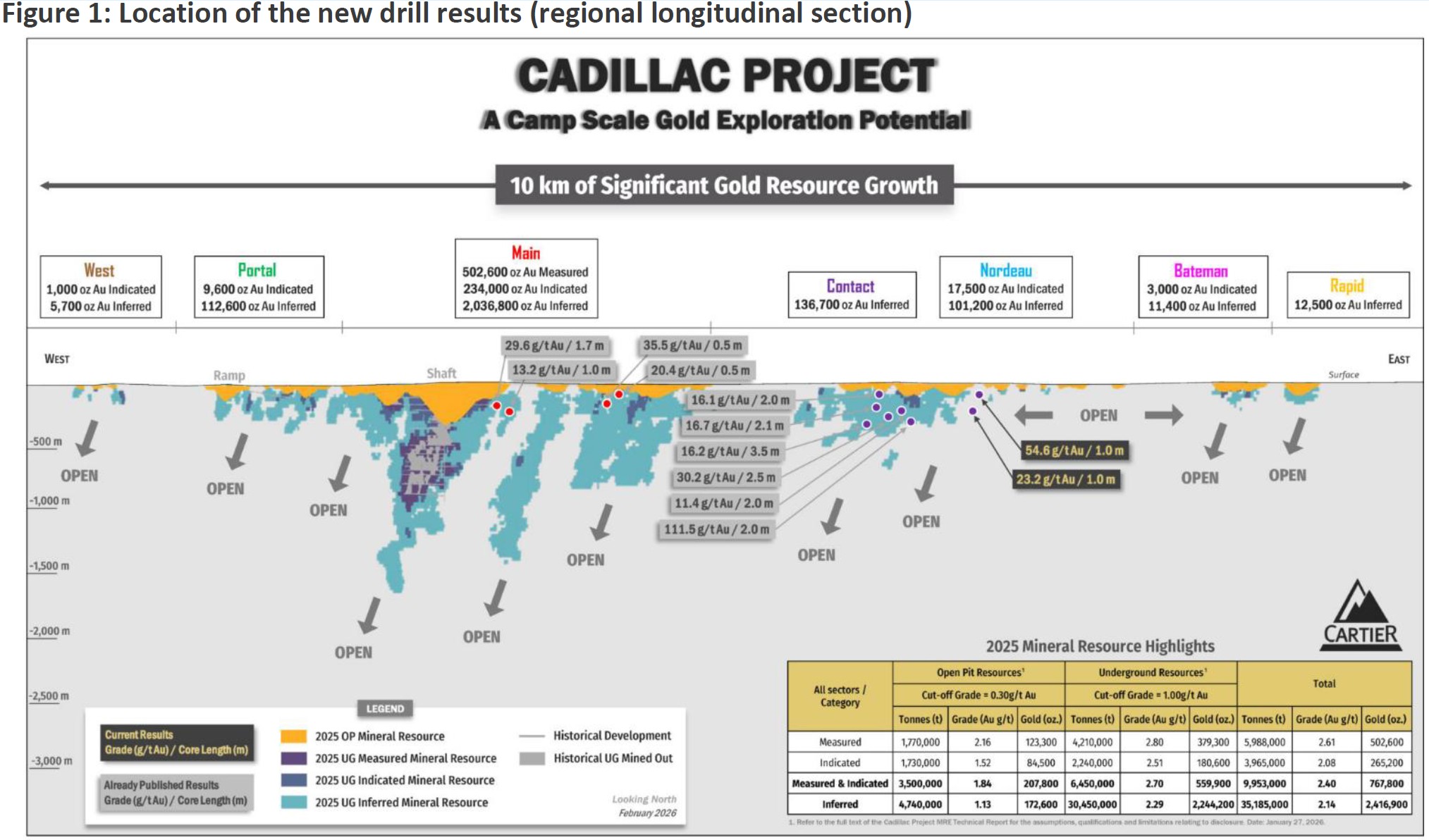
In early 2026, Cartier has filed its updated NI 43‑101 Technical Report for the Cadillac Project, integrating over 530,000 metres of drilling. The new Mineral Resource Estimate (MRE) shows significant growth, with 767,800 oz Au in Measured & Indicated resources and 2,416,900 oz Au in Inferred resources. The update highlights strong underground potential supported by existing mine infrastructure.
Geology and Mineralization
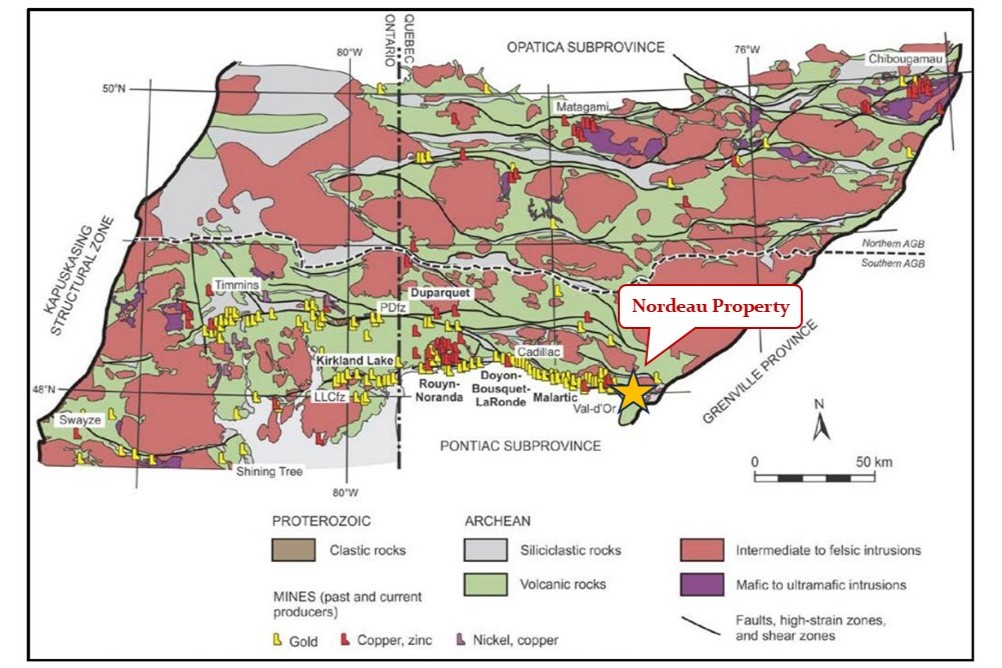
Rocks of the Nordeau property belong to the Superior Province of the Canadian Shield (Card and Ciesielski, 1986). The Abitibi Subprovince is an Archean greenstone belt which hosts some of the richest mineral deposits of the Superior Province. Rocks of the Abitibi greenstone belt are composed of Archean volcanics and sediments intruded by large Archean intrusions. Archean rocks were deformed and metamorphosed to the greenschists facies during the Kenorean orogeny about 2.7 to 2.5 Ga ago.
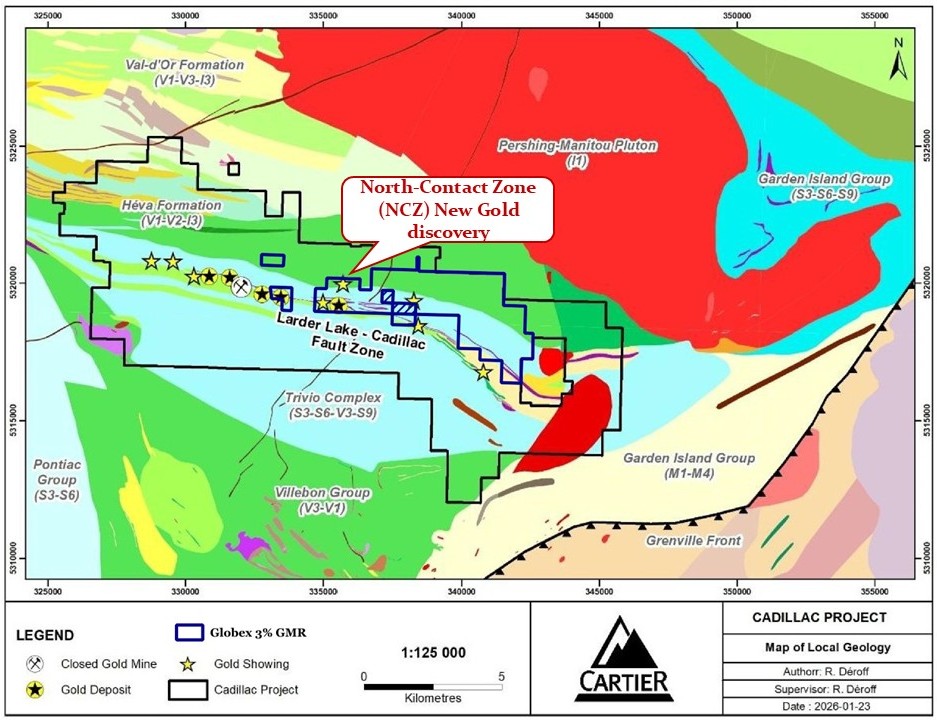
The property is located in the Southern Volcanic Zone of the Abitibi Subprovince. This zone is crossed in the north by the possible extension of the Larder Lake-Cadillac deformation zone. The project is crossed by the volcano-sedimentary rocks of the Trivio Complex which is composed of a structural complex containing a set of lenticular bands of sedimentary rocks and mafic volcanic rocks, in shear contact with each other. Proterozoic mafic intrusions trending NNE cut across all Archean units.
As for Langton et al. (2019), the Project has geological potential for two main types of orogenic gold deposits: 1) greenstone-hosted quartz-carbonate vein type (Dubé and Gosselin, 2007); and 2) BIF-hosted gold mineralization type (Robert et al., 2007). Two gold deposits (the historic Chimo Mine and the West Nordeau occurrence) and several occurrences are known on the Project; the Chimo mine produced 379,012 ounces of gold through three producers between 1964 and 1997; Measured and Indicated Resource (Open-pit + Underground) of 9.95 Mt grading 2.40 g/t Au (Richard et al., 2026) are reported on the Cadillac Project of Cartier, including the West Nordeau deposit located on Globex’s Royalty claims :
Gold mineralization on the Project occurs epigenetically in silicified lodes with disseminated sulphides, spatially related to banded iron formation and altered shear zones with temporally related quartz ± carbonate veins. When related to shear zones, Au mineralization typically occurs in volcanic units with disseminated arsenopyrite, pyrite and chalcopyrite. Graphite horizons are also common with this type of mineralization.
In addition, several new prospective gold zones have been discovered in recent years, namely the South Nordeau, North Contact, Far West Simon and Lac Rapides zones, all of which are roughly parallel to, and closely associated with, the LLCFZ.
History
The first exploration work listed in Quebec public data (Sigéom) dates back to the 1930s when Quemartic Mines observed visible gold (VG) in prospection. Subsequent geophysics and DDH were undertaken by Chimo Gold Mines in the 1940s. A 183 m deep vertical shaft was sunk in 1964 and the Chimo Mine entered into production for the first time from 1966 to 1967. SOQUEM put the Mine into production again in 1985 and Cambior became operator from 1989 to 1997.
Numerous exploratory works were also carried out in the area, including on the Nordeau east and west deposits. A detailed history is presented in the NI 43-101 Technical Report prepared by Richard et al. for Ressources Cartier in 2006.
Recent developments :
In October 2016, Chalice Gold Mines conducted a wide range of surface exploration programs and drilling campaigns. The work resulted in the creation of a comprehensive geochemical database to better define potential exploration targets. In addition, the claims were covered by ground-based (OreVision) and airborne (Mag, VLF-EM) geophysical surveys and an airborne LiDAR survey. Between 2017 and 2019, Chalice drilled 97 diamond holes totaling 33,632 m. The programs tested gold targets along the Larder Lake-Cadillac fault zone, around the Simon West and Nordeau West showings, as well as numerous geochemical and geophysical targets.
Between 2020 and 2021, O3 completed a 20,889 m (46 holes) drilling program to follow up on promising historical drill intersections in the Simon West, Nordeau West, Nordeau East, and North Contact areas (Ballesteros, 2021). A stripping campaign followed by channel sampling, as well as geophysical and soil sampling surveys, were also carried out (Ballesteros, 2021 and 2022). Mechanical stripping and geophysical surveys conducted by O3 (Mag – 116 km and PP – 57 km) identified ten (10) new drill targets (Simard, 2021).
In February 2019, Cartier began compiling, interpreting and modelling the mineralized structures to build a 3D model using GeoticMine software. Since 2019, Cartier’s team has been continuously compiling, interpreting and modelling in 3D the different mineralized zones of the Cadillac Project. This compilation and exploration target generation work continues to this day and is constantly being updated with new diamond drilling data.
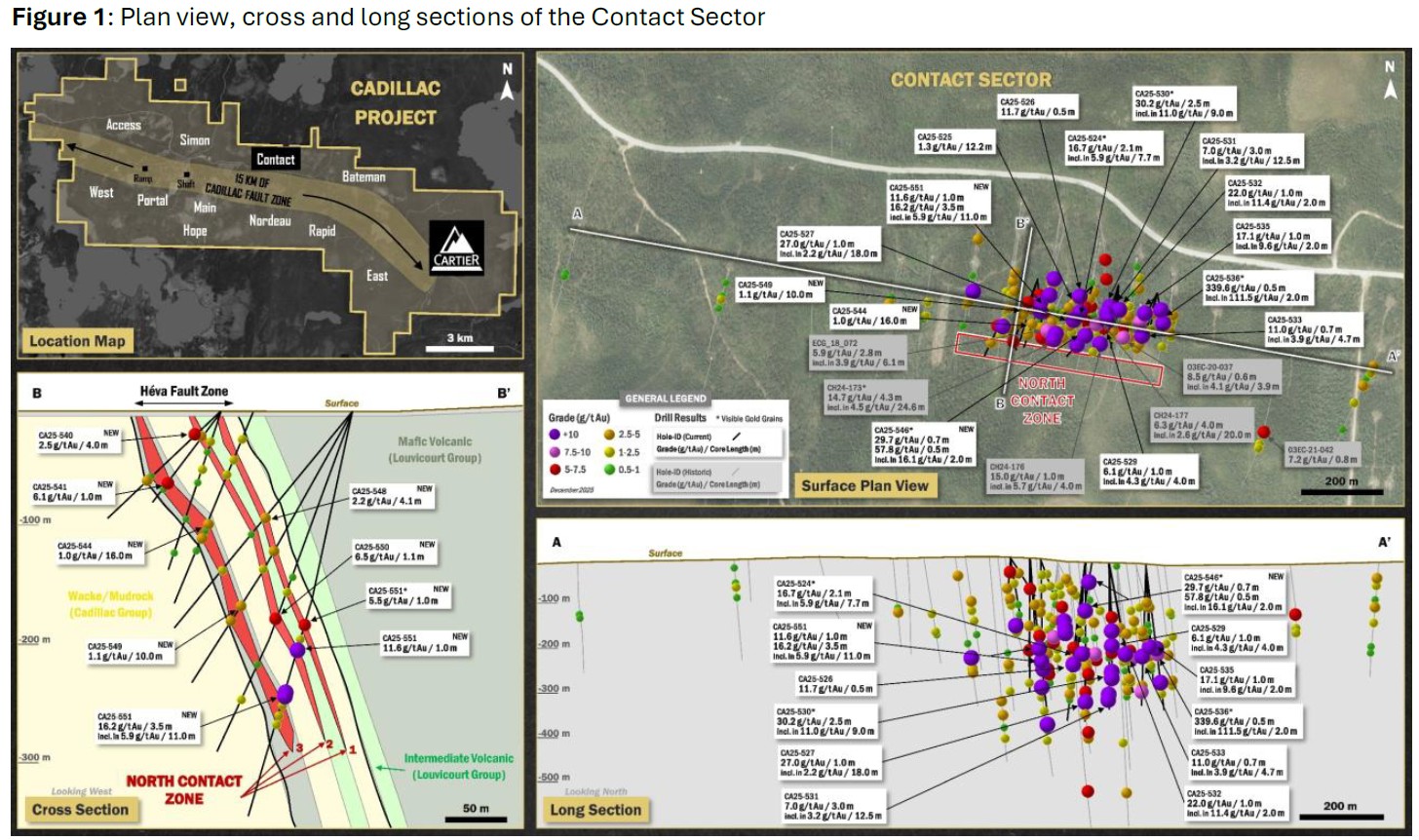
Between 2016 and 2024, Cartier undertook 286 holes (85,980 metres) of drilling and made an important gold discovery called the North Contact Zone (NCZ), located directly on Globex Royalty claims; a new 100,000 metres DDH program has started in 2025 and intersected numerous auriferous intervals and several occurrences of visible gold (VG). Best assays to date are presented below :
Table 1: Best assays of the 2025-2026 DDH program on the Cadillac Project (drilling is still ongoing in February 2026).
|
Hole |
Au uncut (g/t) |
Core length (metres) |
|
CA25-524 |
5.9 |
7.7 |
|
CA25-529 |
4.3 |
4.0 |
|
CA25-530 |
11.0 |
9.0 |
|
CA25-531 |
3.2 |
12.5 |
|
CA25-533 |
3.9 |
4.7 |
|
CA25-536 |
111.5 |
2.0 |
|
CA25-551 |
5.9 |
11.0 |

Resources and Potential
Historical work in the area identified a regional favorable context for gold mineralization associated with sheared volcanics and oxide-iron formations.
Cartier reports (Press Release dated December 2, 2025) that drilling to date suggest that “the gold system remains robust and open in all directions, suggesting significant expansion potential. Upcoming drilling is required on NCZ to extend gold mineralization closer to surface 10-15 m) to support a future gold inventory. Further exploration drilling is already planned to test several new high priority regional targets at Contact Sector. Cartier is now evaluating an expansion of its drilling program toward the eastern extension of the NCZ.”
Globex is pleased by the good results reported by Cartier on Globex’s royalty claims. In 2026 Cartier will be drilling on other portions of Globex’s royalty claims as part of their greater than 100,000 metre planned drill program.
After the completion of the ongoing drilling program, the next steps in the project will include a feasibility study and metallurgical tests.